Muscle · AI-derived
Unitree G1+ Adds 2-DOF Neck and 110% Torque Boost at $15K
Unitree launched the G1+ humanoid on September 14, 2026, with a movable neck, stronger and cooler motors, and new sensors. The base model lists at about $15,000 while keeping the 35 kg weight and two-hour battery of the prior G1.
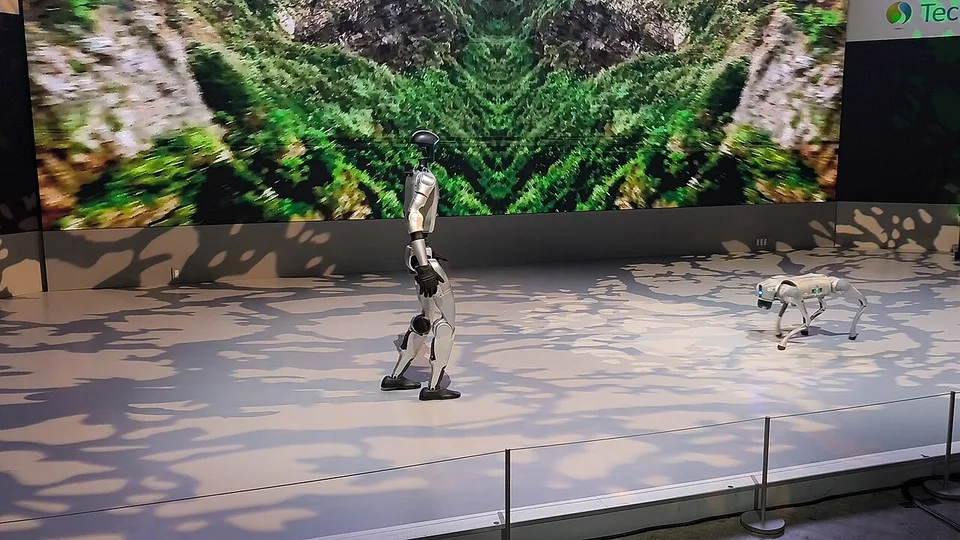
ZeroGantry analysis
The 72% heat reduction at 110% higher shoulder/waist torque suggests Unitree improved winding fill factor and airflow rather than simply upsizing motors, preserving the 35 kg envelope. This matters for multi-shift lab use where external power already removes the 2-hour battery limit. Watch for EDU adoption rates; standard units will likely dominate academic purchases while EDU variants target groups needing 7-DOF hands. Ship if your workload fits the 3 kg arm load; ignore only if you require higher absolute payload or proven multi-hour untethered cycles.
Neck Upgrade Expands Interaction Range
Unitree added two degrees of freedom to the G1+ neck on September 14, 2026, enabling pitch from -25° to +36° and yaw of ±110°. This mechanical change lets the head track people or objects more naturally during conversation or navigation tasks. Prior G1 models relied on torso or base movement for similar viewing angles, which increased energy use and reduced stability on uneven surfaces. The new range directly improves head-eye coordination for vision-based behaviors without requiring extra whole-body compensation.
The neck motors integrate into the same low-inertia PMSM architecture used elsewhere on the robot. Dual encoders and crossed-roller bearings maintain precision under the added load of head-mounted cameras and microphones. Service teams will appreciate the modular joint design that allows neck swaps without full torso disassembly, a practical gain for field repairs.
Motor Torque and Thermal Performance Gains
Shoulder and waist actuators deliver 110% higher peak torque while cutting heat output by 72% at identical loads. Arm motors gain 43% peak torque with 30% less heat, and thigh motors run 28% cooler under equivalent conditions. These figures come from Unitree’s internal testing and reflect improvements in winding design, local air cooling, and bearing selection rather than simple gear-ratio changes.
The thermal reductions matter for sustained operation. Earlier G1 units throttled during repeated lifting or locomotion cycles because joint temperatures rose quickly. Cooler running extends the time before derating occurs, which is critical for research sessions or light industrial trials that last beyond a single battery cycle. External DC power input at 54.6 V / 5.7 A further decouples runtime from the 9000 mAh pack, letting operators run the robot indefinitely when tethered.
Torque density improvements also affect gait dynamics. Higher shoulder and waist torque supports faster arm swing recovery and better balance correction during single-leg stance. The 35 kg mass remains unchanged, so the added output increases the ratio of available torque to inertia at key joints. This should translate into more stable recovery from pushes or uneven terrain without requiring software retuning of every gait parameter.
Vision and Sensing Hardware Additions
The G1+ pairs a binocular stereo camera (60 mm baseline, 2 MP, 110° horizontal FOV) with a chest-mounted wide-angle monocular sensor. Combined with the existing 3D LiDAR and abdominal camera, the system improves depth estimation at close range and expands peripheral awareness. Five touch points on the head allow simple tactile triggers for dialogue or action sequences.
A six-microphone array with front-four, rear-two layout supports direction-of-arrival estimation and noise suppression. Dual 10 W waist speakers provide louder, clearer audio feedback than the prior single-speaker setup. These changes reduce reliance on external microphones during demos and improve human-robot interaction in noisy environments such as labs or small factories.
Price Positioning and Variant Choices
The standard G1+ carries a listed price of roughly $15,000 before tax and shipping, or RMB 95,000 including tax in China. That represents a modest increase from the prior G1 listing yet keeps the platform among the lowest-cost humanoids available for purchase. The EDU variant expands to 25–45+ DOF depending on configuration, adds optional 7-DOF hands and 3-DOF waist, raises arm payload to about 4 kg, and extends warranty from 8 to 18 months.
Buyers focused on basic mobility and perception research can stay with the standard model. Those needing dexterous manipulation or longer development cycles will evaluate the EDU route, though its final pricing remains available only on request. Both versions retain the 25 kg-class weight class and 2-hour nominal battery, preserving transport and deployment simplicity.
Serviceability and Long-Term Ownership Implications
The motor upgrades emphasize crossed-roller bearings and dual encoders at every joint, which improve both load capacity and position feedback resolution. Local air cooling reduces the need for heavy liquid systems, lowering leak risk and maintenance complexity. Quick-release battery and external power port further simplify daily operation in fixed installations.
Cost of ownership calculations must factor in the 11% price step versus the original G1 and the unchanged two-hour untethered runtime. For academic labs running multiple units, the external power option and reduced thermal throttling can increase daily utilization hours enough to offset the incremental hardware cost. Field service teams gain from the modular joint approach, but harmonic-drive equivalents or spare actuator pricing have not yet been published, leaving long-term repair economics partially opaque.
Comparison Context Within Affordable Humanoids
Within the sub-$20,000 segment, the G1+ torque and neck additions close specific gaps that limited earlier low-cost platforms. Arm payload rises from roughly 2 kg to 3 kg, and head mobility now matches or exceeds several mid-tier research platforms. These changes keep the robot competitive against slightly larger or more expensive alternatives that still lack comparable neck freedom or documented thermal headroom.
The focus remains on hardware iteration rather than new locomotion paradigms. Gait stability benefits indirectly from the torque and cooling gains, yet the fundamental kinematic layout stays consistent with the original G1. Operators seeking higher absolute payload or fully untethered multi-hour operation will continue to watch higher-priced or specialized platforms.
Outlook for Researchers and Early Deployers
The September 14 launch positions the G1+ as an incremental but meaningful step for groups already using the G1 platform. The combination of neck DOF, higher-torque cooler motors, and expanded sensing directly addresses common fe
Sources
Who services this hardware
Topics
Manufacturers
Related articles
- Unitree Superman Humanoid Reaches 12.66 m/s and 2 m Jump — Unitree Robotics unveiled its Superman humanoid prototype on August 17, 2026. The 45 kg machine with 0.85 m legs achieved a claimed 12.66 m/s peak speed and 2 m
- Agility Digit 5 Launch Targets Barrier-Free Warehouse Work — Agility Robotics launched Digit 5 on September 15, 2026, its first humanoid designed for safe close-proximity work alongside humans in warehouses and factories
- Tuya Doova and OlloBot OlloNi SS1 Debut Elder Care Robots at IFA 2026 — Tuya Smart launched the wheeled Doova companion robot at IFA 2026 for seniors living alone, featuring fall response, LLM conversation, and smart-home control. O
- 1X NEO Beta Trial Program Starts Real-Home Household Testing — 1X Technologies has launched a limited NEO Beta Household Trial Programme. Select households worldwide will test the humanoid robot in their homes for three mon