Frontier · AI-derived
Ropedia W0 Open Release: Cross-Embodiment Loco-Manipulation Model
Ropedia released W0, an open egocentric world model trained on 13,000 hours of human and robot video. The model predicts future video for humans, robot arms, and humanoids like the Unitree G1 using unified camera poses and skeletons, outperforming NVIDIA Cosmos 3 across benchmarks from zero-shot to full post-training.
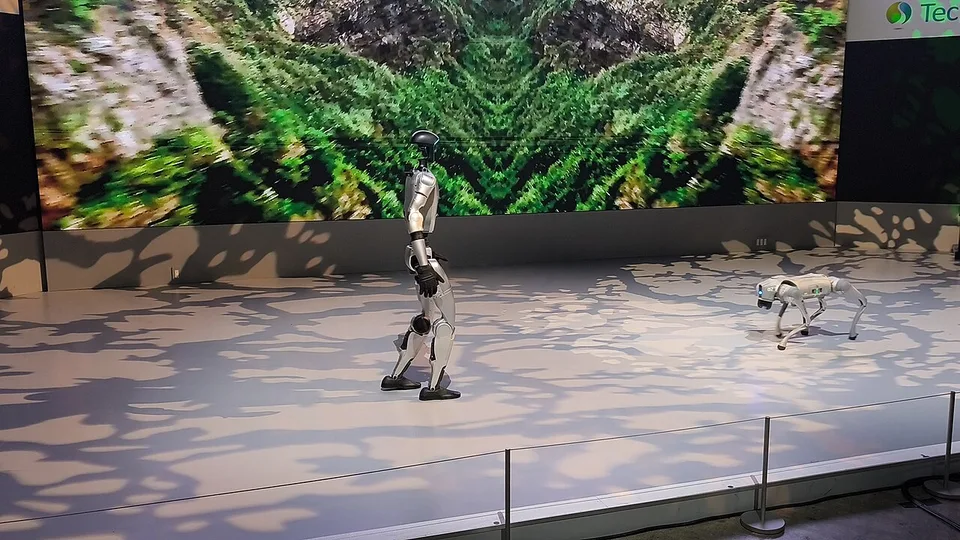
ZeroGantry analysis
W0's 0.996 policy-evaluation correlation and +10 pp planning gains on Unitree G1 suggest labs could cut physical trial budgets by half when screening checkpoints before deployment. The 21.3 fps distilled rollout supports live VR policy debugging, an operational advantage over slower diffusion baselines. Watch for adoption in open humanoid stacks; ignore if your workflow stays purely sim-to-real without world-model rollouts.
Unified Kinematics Bridge Human and Robot Data
Ropedia W0, submitted to arXiv on October 19, 2026, introduces a latent video diffusion model that generates future egocentric video conditioned on the initial frame, text prompts, and explicit kinematic actions. Locomotion is represented through dense Plücker-ray maps of relative camera poses, while manipulation uses projected hand or end-effector skeletons derived from forward kinematics for robots and manual annotations for humans. This shared interface allows a single set of weights to handle humans, parallel-gripper arms, and dexterous humanoids without embodiment-specific heads.
The training pipeline begins with 10,000 hours of egocentric human video curated into Xp-Data, followed by mid-training that mixes in 3,000 hours of robot footage from 13 public datasets plus proprietary multi-view recordings. Human pre-training scales performance on both human held-out clips and downstream robot benchmarks, with camera following error dropping steadily as human hours increase. Two model sizes were released: a 5-billion-parameter dense variant and an A14B mixture-of-experts model activating 14 billion parameters.
Benchmark Leadership Across Regimes and Embodiments
On the DreamDojo benchmark, Ropedia W0 A14B surpasses both DreamDojo 14B and the larger Cosmos 3-Super (64B) in PSNR after post-training on 1 percent, 10 percent, or 100 percent of GR-1 data. Zero-shot results on Ψ₀ reach 17.36 dB versus 15.73 dB for fully post-trained Cosmos 3-Super, while ω-HOME shows 19.55 dB against 18.46 dB. The model maintains its lead on held-out human egocentric video and the new Xp-Teleop long-horizon dexterous humanoid benchmark, as well as AgiBot and ω-HOME suites.
Qualitative rollouts demonstrate stable scene consistency during combined walking and manipulation sequences lasting up to one minute after distillation to a 4-step sampler. Real-time inference achieves 21.3 frames per second at 640×480 resolution on a single GPU, enabling live VR teleoperation sessions where operator head and hand motion drive minute-long coherent video streams.
Applications in Policy Evaluation and Model-Based Planning
When used as a proxy environment, W0 produces task-progress predictions that correlate with real Unitree G1 executions at r = 0.996, preserving checkpoint rankings without physical trials. Model-based planning that scores imagined action sequences raises task progress to 55 percent on physical hardware, compared with 45 percent for the best single fixed policy and 26 percent for random selection. Initializing a world-action model backbone from W0 5B lifts LIBERO-Plus success from 50.1 percent to 56.8 percent and improves real G1 progress from 33.3 percent to 56.7 percent under identical training budgets.
These metrics indicate immediate utility for reducing expensive real-world data collection in loco-manipulation research. The open release includes full weights on Hugging Face, training code, the Xp-Teleop dataset, and interactive demos, lowering the barrier for labs seeking to adapt the model to additional platforms.
Data Curation and Quality Controls
Xp-Data unifies 14 human and 13 robot public datasets under a single schema with synchronized RGB, metric camera trajectories, manipulator keypoints, and captions. Automated annotation pipelines receive targeted human review for hand-pose accuracy and trajectory consistency. Proprietary recordings used a four-fisheye rig to capture over 6,000 hours of multi-view egocentric footage later aligned into the common format. This systematic quality pipeline addresses common issues in prior egocentric corpora, such as missing metric poses or noisy hand annotations.
Scaling Laws and Embodiment Transfer
Ablations confirm that increasing human pre-training hours from a few thousand to the full 10k improves both human camera-following ATE and robot PSNR/LPIPS scores on held-out sets. The kinematic action representation transfers directly because any body can be rendered into the same Plücker and skeleton maps, eliminating the need for separate action tokenizers per platform. Post-training on a target robot such as the Unitree G1 requires only one epoch to reach competitive performance, suggesting efficient adaptation for new hardware.
Limitations and Open Questions
While distillation enables real-time use, full 50-step sampling remains slower and may limit online planning loops. Long-horizon coherence beyond one minute has not been exhaustively quantified outside controlled VR sessions. The current benchmarks focus on household and lab settings; generalization to outdoor or highly dynamic industrial scenes remains untested. Privacy considerations around large-scale egocentric human video collection are noted but not resolved in the release.
Implications for Embodied AI Pipelines
Ropedia W0 demonstrates that a single world model can serve as a reusable simulator layer across embodiments when kinematic interfaces are aligned. Labs working with Unitree G1, Fourier GR-1, or similar dexterous platforms can now evaluate policies or plan sequences in imagination before committing robot time. The open artifacts position the community to iterate on data scaling, distillation techniques, and integration with existing control stacks rather than training world models from scratch.
Future extensions could incorporate additional sensor modalities or tighter coupling with low-level controllers, but the current release already supplies concrete performance numbers and working code for immediate experimentation.
Sources
Who services this hardware
Topics
Manufacturers
Related articles
- NVIDIA GR00T N2 Preview at GTC 2026 Advances Physical AI — NVIDIA previewed GR00T N2 at GTC 2026, claiming more than double the success rate on novel tasks compared to prior VLA models. The announcement included Cosmos
- XPENG IRON Humanoid Shows Memory and Multilingual Showroom Skills — XPENG released a September 22 video of its IRON humanoid in a lab test simulating car dealership interactions. The robot tracked speakers, remembered customer p
- NVIDIA GR00T 1.7 and Agile ONE SN Launch at GTC Berlin — NVIDIA released GR00T 1.7, a 3-billion-parameter VLA model, and partnered with Agile Robots on the Agile ONE SN humanoid reference platform at GTC Berlin on Oct
- Unitree Stock Surges 16% on China Embodied AI Policy — Unitree Robotics shares rose 16.15% to ¥495.92 on October 19 after nine Chinese government departments issued guidance promoting embodied AI in household servic