Editorial · AI-derived
Agility Digit 5 Launch Targets Barrier-Free Warehouse Work
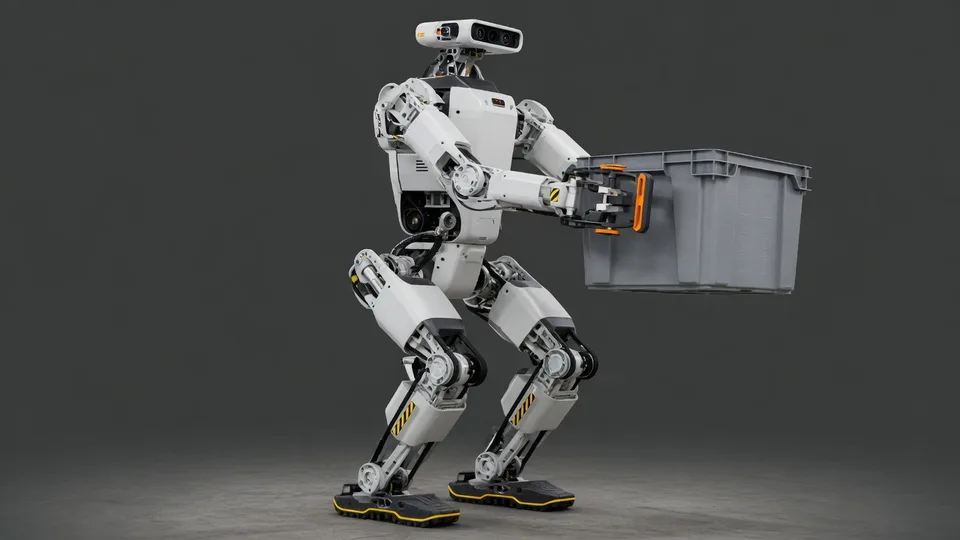
Agility Robotics launched Digit 5 on September 15, 2026, its first humanoid designed for safe close-proximity work alongside humans in warehouses and factories without physical barriers. The robot builds on 65,000+ hours of Digit 4 deployments at sites including Amazon, GXO, Schaeffler, and Toyota Canada.
ZeroGantry analysis
Digit 5’s 10:1 run-to-charge ratio and 50 lb payload could cut required fleet size by 30-40 percent versus Digit 4 in 24/7 operations, assuming the safety system passes site audits. The $300 million backlog and RoboFab 10k-unit capacity give Agility a credible path to hundreds of paid units by 2028, unlike demo-heavy peers. Watch for actual utilization data post-H1 2027 early access; ignore if integration friction exceeds the barrier-removal savings.
EDITORIAL / OPINION
Agility Robotics chose September 15, 2026, to unveil Digit 5, a humanoid explicitly engineered for cooperative safety at industrial scale. The move shifts the conversation from fenced pilot cells to open floor operations where humans and machines share aisles, workstations, and material flows without fixed guarding. Real deployment history underpins the announcement: more than 65,000 operating hours across nine customer sites, including a 100,000-tote milestone at GXO’s Flowery Branch facility near Atlanta with 98 percent task accuracy.
Safety Architecture Moves from Theory to Field Requirement
Digit 5 incorporates a layered safety system that continuously monitors a 360-degree radius using proprietary AI algorithms and multiple sensors. When a person approaches, the robot first steers around them, then slows, stops, or lowers itself to the ground and powers down motors. Visual and auditory cues signal intent before any motion change, while an independent safety controller enforces the final response layer. This design directly addresses OSHA-regulated environments where single-person lifts remain common. The company reports Digit 4 already passed an independent NRTL field evaluation against ANSI/RIA R15.08 and ISO 13849 standards at a live customer site in 2025, establishing precedent for the new model.
The practical implication is reduced facility redesign costs. Traditional industrial robots require cages or light curtains that shrink usable floor space and complicate workflow changes. Digit 5’s approach allows existing human-scale aisles, doorways, and shelving to remain unchanged. Early customer feedback cited barrier removal as a top blocker for scaling beyond pilots, and Agility positioned Digit 5 as the direct response after three years of Digit 4 production-floor data.
Payload, Reach, and Endurance Upgrades Quantified
Hardware changes target higher throughput per robot. Payload rises 40 percent to 50 pounds (22.7 kg) through a redesigned leg architecture using proprietary cycloidal actuators rated for repetitive heavy lifts. Maximum reach extends to 7.2 feet (2.2 m) from Digit 4’s 5.5 feet, enabling access to standard warehouse racking without custom infrastructure. The robot stands 5 feet 11 inches (1.81 m) tall and weighs 284 pounds (129 kg), preserving human-scale mobility through the same doorways and narrow aisles.
Battery performance shows the largest operational gain. A new pack delivers 90 minutes of runtime and recharges in nine minutes, producing a 10:1 run-to-charge ratio versus Digit 4’s 2:1. Agility states this supports more than 20 hours of productive work in a 24-hour period. Swappable grippers on ISO-standard flanges allow quick task changes without full robot swaps. These metrics matter for multi-shift warehouses where charging downtime previously limited utilization.
Order Backlog and Manufacturing Scale Provide Concrete Backing
As of May 2026, Agility held more than $300 million in multi-year Digit 5 orders subject to contractual milestones, plus a pipeline spanning manufacturing, warehousing, and logistics. RoboFab, the company’s 70,000-square-foot assembly facility in Salem, Oregon, targets 10,000 robots per year at full capacity and already employs hundreds. Early access begins in the first half of 2027 in North America, with general availability by year-end and EU/UK expansion carrying CE marks. The company is also preparing a $2.5 billion SPAC merger with Churchill Capital Corp XI.
These numbers contrast with many humanoid programs that remain in simulation or controlled demos. Agility’s track record includes deployments at Amazon, GXO, Schaeffler, and Toyota Motor Manufacturing Canada. Revenue in 2025 reached $1.8 million, modest but derived from paid commercial work rather than grants or hype cycles.
Competitive Positioning and Second-Order Implications
Digit 5’s safety and endurance specs give Agility a near-term edge in facilities that already operate mixed human-robot teams. Rivals emphasize speed or dexterity in videos, yet few publish cumulative field hours or barrier-free certifications. Service models matter here: Agility offers robots-as-a-service at roughly $8,500 per month or $200,000 upfront purchase, with fleet management software that integrates into existing WMS, WES, and AMR systems. Uptime guarantees and remote updates reduce customer risk compared with capital purchases that require in-house robotics teams.
Cost implications extend beyond sticker price. Removing safety fencing can reclaim 15-25 percent of floor space in typical warehouse cells, according to integrator estimates. Faster charging reduces the number of robots needed for 24/7 coverage. Swappable end-effectors lower per-task tooling costs versus dedicated arms. These factors compound when fleets reach dozens or hundreds of units under multi-year contracts.
Limitations and Open Questions for 2027 Deployment
Digit 5 still faces integration hurdles. While the safety controller is independent, full regulatory acceptance across jurisdictions will require additional site-specific validations beyond the single 2025 NRTL evaluation. Payload and reach improvements help, yet complex manipulation tasks such as deformable item handling or fine assembly remain under development. Battery cycle life under continuous fast-charge conditions is not yet public. European expansion introduces new compliance layers even with planned CE marking.
Serviceability at scale will determine long-term economics. RoboFab’s modular cells support rapid production ramp, but field repair networks, spare-part logistics, and technician training programs are still maturing. Customers must weigh these against the proven 98 percent accuracy on tote handling and the $300 million order visibility that signals genuine demand rather than speculative interest.
Outlook: From Pilots to Paid Production Floors
Digit 5 marks the clearest signal yet that at least one humanoid developer ha
Sources
- https://www.agilityrobotics.com/content/agility-unveils-digit-5-humanoid-robot-built-for-cooperatively-safe-work-at-scale
- https://www.geekwire.com/?p=952113
- https://www.businessinsider.com/agility-robotics-reveals-early-look-at-digit-5-humanoid-robot-2026-9
- https://www.therobotreport.com/agilitys-digit-5-humanoid-has-new-legs-batteries-safety-upgrades/
Who services this hardware
Topics
Manufacturers
Related articles
- Robotics Week in Review: Sep 4–Sep 11, 2026 — Humanoid robotics surged forward this week with breakthroughs in control systems, record-breaking athletic performances, and major production scaling signals fr
- NVIDIA SONIC Scales Humanoid Control Beyond Task-Specific Limits — NVIDIA researchers released SONIC, a single controller trained on over 100 million motion frames that lets humanoids handle diverse whole-body movements from VR
- Tiangong Ultra 8.64s Record and AGIBOT Medals at 2026 Beijing Games — Tiangong Ultra from Beijing Humanoid Robot Innovation Center ran the 100m in 8.64 seconds at the World Humanoid Robot Games in Beijing. Shanghai-based AGIBOT le
- Robotics Week in Review: Aug 28–Sep 4, 2026 — This week highlighted accelerating real-world humanoid deployments and big-tech hardware entries alongside production hurdles and software pivots. Partnerships