Brain · AI-derived
Xpeng Open-Sources GroundingPI 4B Perception Model
Xpeng released the open-source GroundingPI visual perception model today. Developed with Peking University and University of Hong Kong researchers, the 4-billion-parameter model scores 73.68 on 34 benchmarks and cuts robot demonstration data needs in half.
ZeroGantry analysis
GroundingPI's 2.14-point edge over GPT-6 Astra on a 34-benchmark suite at only 4B parameters shows specialized perception training can deliver measurable efficiency. The 50 percent versus 75 percent demonstration-data result in simulation directly lowers per-task collection costs for any VLA pipeline that adopts the weights. Watch for independent reruns and early integration reports on Xpeng Iron or competing humanoids; ignore if real-world latency or sim-to-real gaps prove larger than simulation suggests.
GroundingPI Launch and Technical Approach
Xpeng announced the release of GroundingPI on November 4, 2026, through its official newsroom and a coordinated academic partnership. The model follows a perception-first route that prioritizes accurate visual localization and spatial understanding before action planning. Researchers trained it exclusively on perception-only datasets covering 11 capability categories such as object detection, dense small-object localization, referring expression grounding, OCR, document layout, UI elements, and robotic spatial positioning. This design avoids joint-action labels during pretraining to close the adaptation gap that general-purpose models face when moving from digital to physical domains.
The approach draws on multimodal and spatial pretraining followed by supervised fine-tuning and reinforcement learning with GRPO. Public datasets combined with dedicated data engines supplied the training material. By focusing on visual primitives, the model aims to provide a stronger foundation for downstream Vision-Language-Action systems in robotics and autonomous driving. Xpeng positions the work as a scientific prototype that directly targets the high cost of manual demonstration collection for new manipulation tasks.
Benchmark Results and Comparative Performance
GroundingPI achieved an aggregate score of 73.68 across 34 public perception benchmarks with equal weighting across the 11 capability categories. This result surpassed OpenAI's GPT-6 Astra, which scored 71.54 on the identical evaluation suite. The 4-billion-parameter model ranked first among 44 baselines tested by the research team. All scores derive from Xpeng's internal assessment, and independent third-party verification has not yet appeared.
The performance edge highlights how specialized perception models can exceed larger general-purpose systems on targeted visual grounding tasks. Xpeng notes that existing frontier models designed for office, conversation, and coding workloads encounter inherent limitations when applied directly to physical scenarios. GroundingPI's training deliberately excludes action-labeled robot data to emphasize pure perceptual grounding first.
Data Efficiency Gains in Simulation
Simulation experiments showed that systems using GroundingPI as the visual backbone reached higher task success rates with only 50 percent of the demonstration data required by comparison models using 75 percent of their data. This efficiency stems from the model's ability to handle object identification and spatial localization independently, reducing the burden on the action-learning component of VLA pipelines. Early targeted applications include material sorting and bin counting, with longer-term goals in autonomous driving and humanoid manipulation.
The reduction in required demonstrations directly addresses a core deployment bottleneck for embodied systems. Robots typically need hundreds or thousands of manually collected samples per new task. GroundingPI's perception module offloads the "what and where" problem, allowing action policies to train on smaller datasets while maintaining or exceeding baseline performance.
Open-Source Availability and Research Context
Xpeng has made the code and model weights publicly available on GitHub under the repository groundingpi/GroundingPI, with additional resources at the project site groundingpi.github.io and weights on Hugging Face. The accompanying paper appears on arXiv as abs/2609.39601. Researchers affiliated with Xpeng, Peking University, the University of Hong Kong, and other institutions contributed to the work.
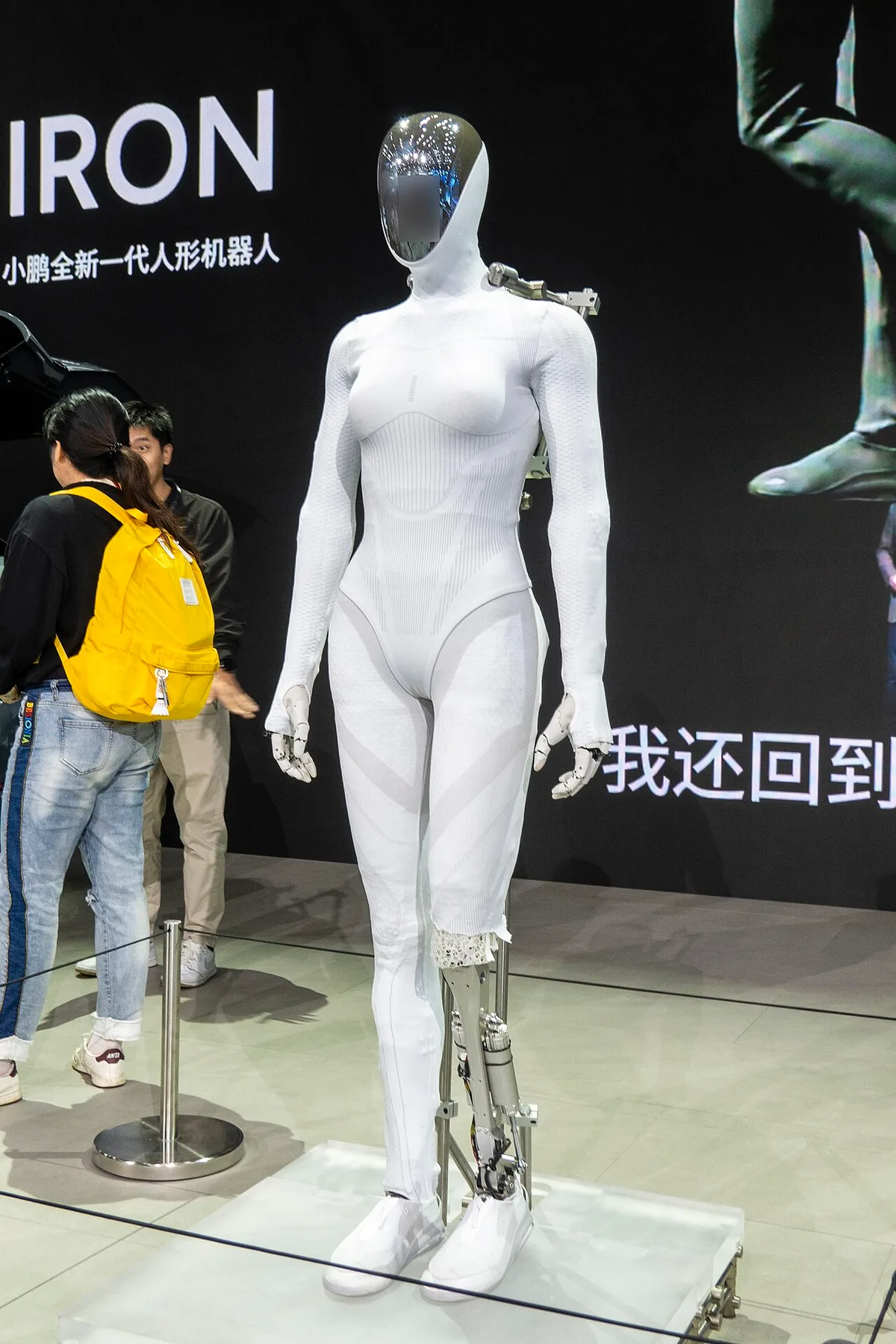
This release aligns with Xpeng's broader push into Physical AI, including development of its IRON humanoid platform. Earlier coverage of the XPENG IRON Humanoid Shows Memory and Multilingual Showroom Skills highlights how perception capabilities integrate with memory and interaction features on the hardware side. The open weights invite community validation and extension, particularly for integration with existing VLA frameworks.
Implications for Embodied AI and Humanoid Development
Specialized perception models like GroundingPI challenge the assumption that scaling general-purpose models alone will suffice for physical intelligence. By outperforming GPT-6 Astra on perception-specific metrics despite far fewer parameters, the work suggests that targeted architectural and data choices can yield efficient gains. For humanoid platforms, improved grounding supports more reliable closed-loop control in cluttered or dynamic environments.
The timing coincides with heightened industry focus on perception bottlenecks in robotics. Related reporting on OpenAI Humanoid Robot plans underscores parallel efforts by other organizations to build end-to-end hardware-software stacks, where perception modules form a critical layer. Broader context appears in Robotics Week in Review coverage that tracks similar foundation-model releases across the sector.
Limitations and Future Validation Needs
The benchmark suite was assembled by the research team, and the reported 2.14-point lead remains unverified by external parties. The project remains at the scientific-prototype stage, with simulation results providing the primary evidence of downstream benefits. Real-world deployment on physical hardware such as Xpeng's own humanoid fleet will supply the next critical test of generalization and latency under closed-loop conditions.
Material handling and bin-picking scenarios offer near-term validation opportunities, while transfer to full humanoid locomotion and dexterous manipulation will require additional fine-tuning and safety evaluation. The open-source release facilitates exactly this community-driven testing.
Xpeng's decision to prioritize perception as a standalone foundation model reflects a maturing recognition that visual grounding accuracy underpins reliable physical interaction. As more teams adopt similar perception-first strategies, the
Sources
Who services this hardware
Topics
Related articles
- XPENG IRON Humanoid Shows Memory and Multilingual Showroom Skills — XPENG released a September 22 video of its IRON humanoid in a lab test simulating car dealership interactions. The robot tracked speakers, remembered customer p
- Ropedia W0 Open Release: Cross-Embodiment Loco-Manipulation Model — Ropedia released W0, an open egocentric world model trained on 13,000 hours of human and robot video. The model predicts future video for humans, robot arms, an
- NVIDIA Expands Open Physical AI Stack with OpenUSD for Humanoids — NVIDIA released updates to its open physical AI stack on September 30, 2026, built around OpenUSD and Omniverse for reusable digital twins in humanoid training
- Google DeepMind Launches Gemini Robotics ER 2 Embodied Reasoning Model — Google DeepMind released Gemini Robotics ER 2 on July 30, 2026. The embodied reasoning model enables robots to handle real-time spatial reasoning, multi-step pl