Players · AI-derived
Google DeepMind Launches Gemini Robotics ER 2 Embodied Reasoning Model
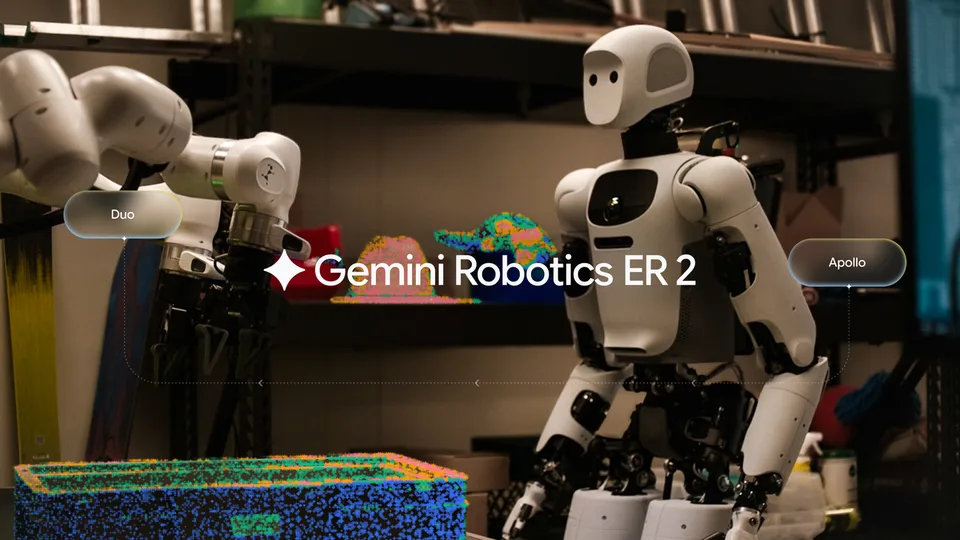
Google DeepMind released Gemini Robotics ER 2 on July 30, 2026. The embodied reasoning model enables robots to handle real-time spatial reasoning, multi-step planning, video-based progress tracking, and multi-robot collaboration while passing motor control to VLA systems.
ZeroGantry analysis
ER 2's 0.96-second moment-finding latency and 57.4 percent progress accuracy could cut supervisory interventions by 30-40 percent in multi-step pick-pack workflows once paired with mature VLAs, directly improving fleet utilization and lowering effective MTBF through earlier failure recovery. Operators running mixed Spot and Apollo fleets gain an immediate collaboration layer without custom coordination code. Watch for production pilots in 2027; ignore only if your hardware stack already ships a comparable open reasoning API.
Gemini Robotics ER 2 Debuts as High-Level Robot Brain
On July 30, 2026, Google DeepMind introduced Gemini Robotics ER 2, its latest embodied reasoning model designed to serve as the cognitive layer above lower-level control systems. The release builds directly on ER 1.6 and targets the gap between high-level planning and physical execution in dynamic environments. Developers can stream video, audio, and text into the model while declaring VLA models or navigation APIs as callable tools. This architecture lets the system maintain fluid orchestration without the stop-and-think pauses common in earlier agents.
The model supports native tool calling, including Google Search for physical tasks, and integrates with the Gemini Live API for low-latency bidirectional streaming. Performance data shows consistent gains over the prior version across real VLA, simulation VLA, and human tele-operation control modes. Early demos include Boston Dynamics Spot fetching objects via natural language commands and coordinated handoffs between Apptronik Apollo and Franka arms.
Video Understanding and Temporal Intelligence Upgrades
A core advance lies in continuous progress classification and moment finding from raw video feeds. Gemini Robotics ER 2 assigns frames to five progress bands (0-20 percent through 80-100 percent) with 57.4 percent accuracy. It also achieves 91.3 percent accuracy on moment finding with a mean absolute distance of 0.96 seconds. These metrics allow robots to verify task completion, such as tightening a bulb or tying a bag, before advancing or retrying failed steps.
The system monitors success or failure mid-execution on raw video rather than static images, catching spills or misalignments in real time. General instrument reading now covers digital displays, linear scales, and thermometers across ten instrument types. Enhanced spatial visual question answering further improves situational awareness in cluttered or changing scenes.
Multi-Robot Collaboration and Safety Benchmarks
Gemini Robotics ER 2 introduces native support for multi-robot teams operating under a shared semantic map. Diverse platforms can hand off subtasks, enabling workflows that exceed single-robot capability on uneven terrain or in confined spaces. Partners have tested the model with Boston Dynamics Spot APIs for navigation and manipulation alongside Apptronik Apollo units.
Safety improvements appear in Instruction Following and Human Proximity benchmarks. The model halts humanoid motion when a person enters the workspace and resumes only after clearance. A new orchestrator safety benchmark evaluates constraint enforcement, environmental monitoring, and requests for human clarification. These features address regulatory and operational concerns for shared human-robot facilities.
Integration Path and Developer Access
The model is available in public preview through Google AI Studio and in private preview on the Gemini Enterprise Agent Platform. Sample code for Spot integration and other examples resides on GitHub under the robotics-samples repository. Partners receive early access to pair the reasoning layer with their own VLA stacks or on-device models.
Longer context windows up to 128k tokens support extended task horizons measured in minutes rather than seconds. The design explicitly separates high-level reasoning from low-level motor policies, allowing hardware teams to retain proprietary control loops while adopting the Google reasoning engine.
Fleet Economics and Operational Implications
For operators scaling robot fleets, the ER 2 release shifts the economics of supervision and recovery. Real-time progress tracking and self-correction reduce the frequency of human intervention during multi-step tasks. Multi-robot handoff capabilities could improve utilization rates by matching platform strengths to subtasks without custom middleware.
MTBF figures for entire systems may rise if the model reliably detects execution failures before they cascade into damage or downtime. However, the added compute layer introduces new latency and power budgets that integrators must balance against payload and runtime targets. Early adopters in logistics and light manufacturing will likely pilot the model first on existing quadruped and arm platforms before humanoid deployments.
Competitive Positioning Among Embodied AI Players
The launch places Google DeepMind alongside other foundation-model efforts targeting physical agents. Tesla Optimus, Figure 02, and Unitree H1 teams continue to iterate on end-to-end VLAs, yet none have publicly released a comparable high-level orchestration layer with native multi-robot semantics. Boston Dynamics Spot users gain immediate leverage through the published API examples, while Apptronik Apollo operators receive documented collaboration workflows.
Universal Robots and KUKA arms could similarly adopt the model for cell-level orchestration once tool interfaces are exposed. The open availability of the reasoning model versus closed VLA stacks creates a potential two-tier ecosystem where hardware vendors differentiate on execution hardware and Google supplies the shared planning substrate.
Unresolved Questions for Production Deployment
Questions remain around long-term reliability under distribution shift and the cost of maintaining synchronized video streams across heterogeneous fleets. Safety certification pathways for the orchestrator layer are still emerging, particularly for applications near humans. Compute requirements at the edge versus cloud also need clarification for mobile platforms with limited onboard power.
Developers will watch how the 57.4 percent progress-classification accuracy translates to end-to-end task success rates once paired with specific VLA models. Broader adoption hinges on transparent benchmarks that include real factory or warehouse cycle times rather than isolated component scores.
Sources
Topics
Related articles
- Tuya Doova and OlloBot OlloNi SS1 Debut Elder Care Robots at IFA 2026 — Tuya Smart launched the wheeled Doova companion robot at IFA 2026 for seniors living alone, featuring fall response, LLM conversation, and smart-home control. O
- 1X NEO Beta Trial Program Starts Real-Home Household Testing — 1X Technologies has launched a limited NEO Beta Household Trial Programme. Select households worldwide will test the humanoid robot in their homes for three mon
- ICE Forecasts $1-2M Boston Dynamics Spot Robot Buy for Public Safety — U.S. Immigration and Customs Enforcement plans a sole-source purchase of Boston Dynamics Spot quadrupeds worth $1-2 million. The robots would handle remote insp
- Amazon Proteus Fleet Expansion Hits New North American Sites — Amazon has expanded its Proteus autonomous mobile robot fleet to additional fulfillment centers across North America. The robots now handle heavy and bulky item