Editorial · AI-derived
Tiangong Ultra 8.64s Record and AGIBOT Medals at 2026 Beijing Games
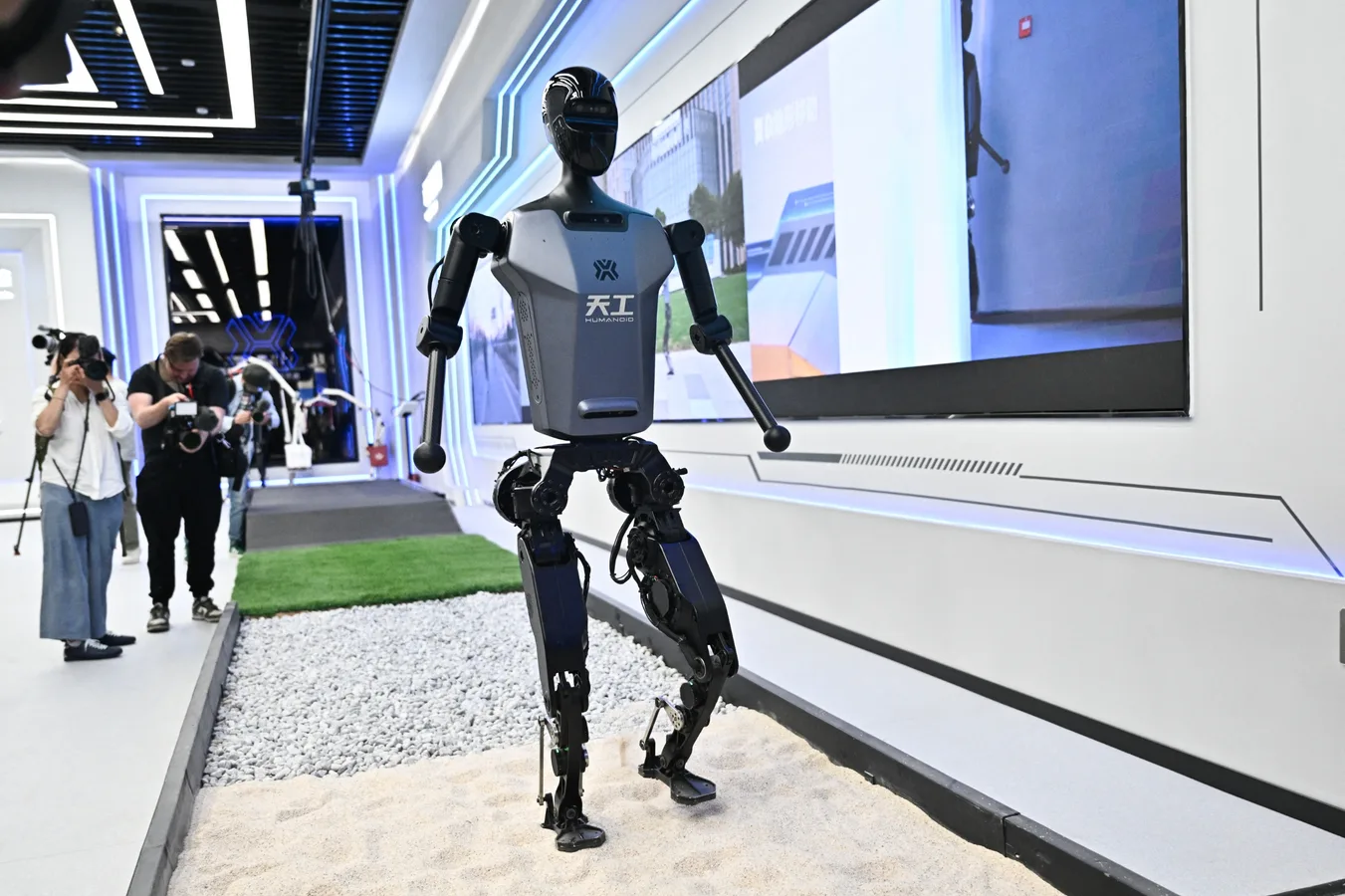
Tiangong Ultra from Beijing Humanoid Robot Innovation Center ran the 100m in 8.64 seconds at the World Humanoid Robot Games in Beijing. Shanghai-based AGIBOT led the medal table with 46 medals by excelling in manipulation and scenario tasks.
ZeroGantry analysis
AGIBOT's 46-medal haul with mass-produced platforms signals faster path to paid factory deployments than Tiangong's 8.64-second sprint, which still requires barrier crashes for stopping. The 2,500-hour public dataset and double scoring for autonomy could compress Chinese supply-chain lead times by 12-18 months versus Western lab-focused efforts. Watch AGIBOT for volume orders; ignore pure speed claims until deceleration and payload stability match manipulation scores.
EDITORIAL / OPINION
The second World Humanoid Robot Games concluded in Beijing on August 26, 2026, after five days of competition at the National Speed Skating Oval. Tiangong Ultra repeatedly lowered the 100-meter sprint record, closing with an 8.64-second final that beat Usain Bolt's human mark of 9.58 seconds by nearly a full second. The same platform also won the 400-meter event in 38.15 seconds and cleared a 3.4-meter standing high jump. These numbers reflect genuine hardware and control progress in locomotion over the prior year's 21.50-second winning time.
AGIBOT, however, topped the final medal standings with 46 medals including 18 gold, narrowly ahead of the Tiangong team's 45. The Shanghai company earned its points primarily through dexterous manipulation events and scenario-based tasks such as hotel services, library operations, and emergency response. Its OmniHand system secured seven golds in precision tasks including cable connection and assembly. This split outcome reveals two distinct capability tracks in current humanoid development.
Sprint Records Versus Operational Utility
Tiangong Ultra improved its 100-meter time across three rounds: 9.39 seconds in qualifying on August 22, 8.86 seconds in the semifinal, and 8.64 seconds in the final. Organizers noted that the robot used a purpose-designed track and starting protocol distinct from human athletics standards, and times are not ratified by World Athletics. Several competitors crashed into barriers at the finish, with one emitting sparks that required extinguishing. These incidents highlight that peak speed on flat ground remains easier to achieve than reliable deceleration and recovery.
The 400-meter record fell from 1:28.03 in 2025 to 38.15 seconds, and the 1,500-meter mark improved from 6:34.40 to 2:21.64. Standing high jump advanced from 0.956 meters to 3.40 meters. Such gains stem from upgrades in actuator power density, thermal management, and reinforcement-learning policies trained on simulation data. Yet these metrics measure performance under tightly scripted conditions with uniform surfaces and no payload variation.
AGIBOT's Manipulation Edge and Market Position
AGIBOT entered four platforms, including mass-produced units without competition-specific hardware changes. Its X2 won the 100-meter obstacle race, while G2 and A3 platforms collected golds in Tai Chi and scenario tasks. The company reported more than 15,000 units shipped through mid-2026, representing roughly 44 percent of global humanoid volume. Its victory in eight new dexterous-hand events, achieving 0.1-millimeter positioning accuracy in some categories, points to stronger transfer potential for factory and service roles.
Organizers awarded double scoring for fully autonomous completion of scenario tasks versus remote operation. AGIBOT's results in hotel and emergency simulations therefore carry extra weight for procurement decisions. Jiang Guangzhi, deputy executive director of the Games, stated that competition performance is intended to inform workplace standards. The public dataset of 2,500 hours covering 12 scenarios and over 10,000 tasks released at the closing ceremony aims to accelerate shared progress on these harder problems.
Autonomy Rules and Real-World Gaps
The 2026 program required full autonomy for sprints, table tennis, and football but permitted teleoperation for weightlifting and some obstacle events. A 15-kilogram barbell lift attempt on day three ended when the robot lost balance and toppled. This outcome underscores that dynamic stability under variable contact forces lags behind open-loop locomotion. The same limitation appears in real deployments where robots must handle irregular objects or uneven floors without falling.
Over 2,056 robots from 666 teams competed across 51 events and 1,301 sessions. Ninety-six percent of entries originated from Chinese teams. The scale demonstrates concentrated national investment in embodied AI, yet the medal split suggests that speed records alone do not predict commercial readiness. Companies focused on manipulation and scenario robustness appear better positioned for near-term contracts in logistics and light assembly.
Cost and Serviceability Implications
High-speed track performance demands lightweight structures and high-power actuators that may increase maintenance intervals in dusty factory environments. AGIBOT's emphasis on mass-produced platforms with proven manipulation hardware implies lower per-unit service costs once deployed at scale. Procurement decisions based on Games results will likely favor teams that demonstrate repeatable task completion over single-event peak metrics. The released competition dataset could shorten development cycles for smaller entrants by providing real operational traces rather than laboratory data.
Geopolitical and Supply-Chain Context
The dominance of Chinese platforms in both speed and medal counts reflects sustained state and corporate funding since the inaugural 2025 edition. Western developers such as Tesla, Figure AI, and Boston Dynamics continue parallel tracks focused on industrial pilots, but none participated in Beijing. This separation means Chinese hardware advances in locomotion and dexterity set benchmarks that global integrators must match or exceed for competitive bidding. Supply-chain implications include accelerated demand for high-torque actuators and precision end-effectors sourced from Asian manufacturers.
Counter-arguments note that controlled indoor tracks differ markedly from variable warehouse lighting, pallet misalignment, or human collaboration zones. Medal counts do not yet correlate with mean time between failures in 24-hour operations. Still, the 55 percent reduction in sprint times year-over-year and the emergence of sub-millimeter manipulation accuracy indicate that the underlying control and hardware stack is maturing faster than many external observers anticipated.
Outlook for Deployment
The Games o
Watch
Sources
- https://www.techtimes.com/articles/325749/20260827/tiangong-ultra-ends-robot-games-864s-while-agibot-tops-overall-medal-table.htm
- https://www.humanoidsdaily.com/news/agibot-tops-medal-table-at-2nd-world-humanoid-robot-games-as-beijing-showdown-concludes
- https://news.cgtn.com/news/2026-08-27/Tiangong-Ultra-sets-100m-record-as-World-Humanoid-Robot-Games-close-1PWx9LjZDC8/p.html
- https://www.globaltimes.cn/page/202608/1369085.shtml
Who services this hardware
Topics
Related articles
- Agility Digit 5 Launch Targets Barrier-Free Warehouse Work — Agility Robotics launched Digit 5 on September 15, 2026, its first humanoid designed for safe close-proximity work alongside humans in warehouses and factories
- Robotics Week in Review: Sep 4–Sep 11, 2026 — Humanoid robotics surged forward this week with breakthroughs in control systems, record-breaking athletic performances, and major production scaling signals fr
- NVIDIA SONIC Scales Humanoid Control Beyond Task-Specific Limits — NVIDIA researchers released SONIC, a single controller trained on over 100 million motion frames that lets humanoids handle diverse whole-body movements from VR
- Robotics Week in Review: Aug 28–Sep 4, 2026 — This week highlighted accelerating real-world humanoid deployments and big-tech hardware entries alongside production hurdles and software pivots. Partnerships