Players · AI-derived
AGIBOT Deploys 30+ Robots at WAIC 2026 Shanghai Venues
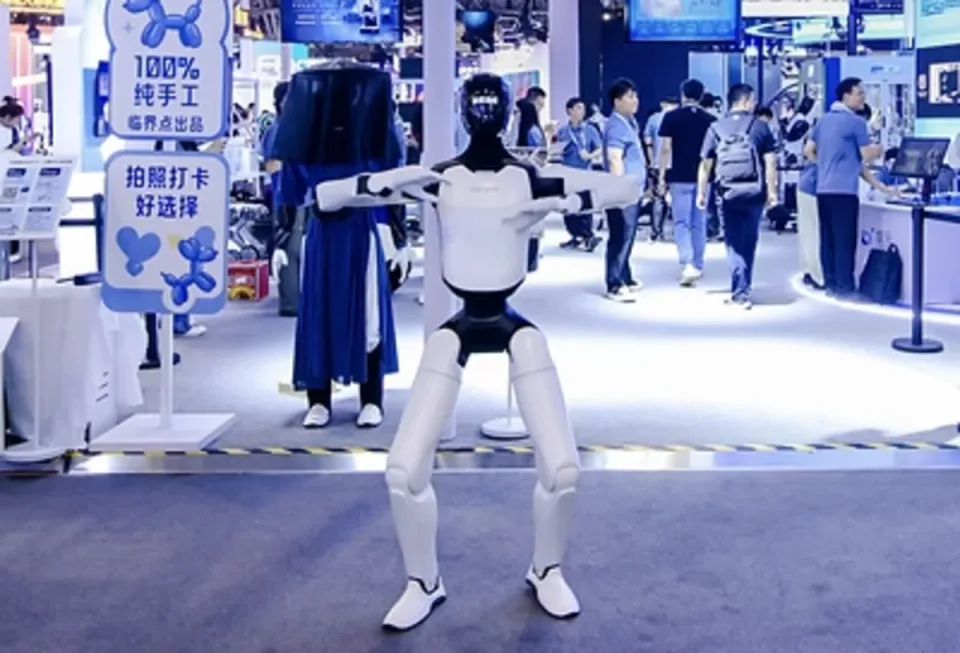
AGIBOT is operating more than 30 of its robots at the 2026 World Artificial Intelligence Conference in Shanghai starting mid-July. The deployment provides visitor guidance and support while showcasing scaled production from its June 15,000-unit milestone.
ZeroGantry analysis
AGIBOT’s 15,000-unit June milestone combined with a 30-plus robot WAIC deployment indicates a production-to-field cycle measured in weeks rather than years. The hybrid wheeled-plus-biped approach at a single venue offers direct cost-per-hour data that pure-humanoid programs still lack. Watch for published uptime numbers; if they exceed 85 % over the event, AGIBOT becomes the default low-risk option for service fleets in 2027.
AGIBOT Scales Public Deployment at WAIC 2026
AGIBOT placed more than 30 robots into active service across the Shanghai World Expo Exhibition and Convention Center for the 2026 World Artificial Intelligence Conference. The robots handle visitor guidance, information services, demonstrations, and on-site support starting around July 17-18. This marks one of the larger coordinated public uses of Chinese humanoid and semi-humanoid platforms at a major international AI event.
The deployment draws on AGIBOT’s June 2026 production milestone when the company’s 15,000th robot rolled off the line. Most of those units have been G2-series wheeled mobile manipulators rather than full bipedal humanoids. The WAIC operation therefore tests how quickly a high-volume production base can translate into repeatable field hours at a high-visibility venue.
Production Ramp and Model Mix
AGIBOT reported the 15,000-unit mark on June 28, 2026. The milestone unit was a G2 wheeled semi-humanoid with a humanoid torso and arms aimed at industrial tasks. Cumulative output accelerated from the 1,000-to-5,000 range into the current scale, reflecting expanded factory throughput in Shanghai.
At WAIC the company is also introducing the A3 Ultra full-size humanoid alongside the G2 Max heavy-payload variant and the OmniHand 3 Ultra-M dexterous end-effector. The A3 Ultra stands 1.74 meters tall, weighs 60 kilograms, and carries 51 active degrees of freedom with a 5 kg payload per arm. It is rated for up to eight hours of combined operation and uses NVIDIA Thor for high-level embodied AI processing. Perception includes 3D LiDAR, RGB-D cameras, fisheye cameras, and binocular vision plus GPS/RTK/UWB positioning.
Operational Details at the Conference
More than 30 AGIBOT platforms are distributed across key public areas of the venue rather than confined to a single booth. They perform navigation between halls, answer attendee queries, and execute short demonstrations. The setup emphasizes endurance and coordination over isolated showcase routines. AGIBOT’s 200-square-meter exhibition space at Booth H3-C101 features live manipulation demos and industrial case studies that complement the roaming fleet.
The event timing aligns with broader industry interest in moving embodied AI from laboratory validation into measurable service hours. AGIBOT’s approach pairs high-volume wheeled platforms with a smaller number of full-size bipeds, allowing direct comparison of task suitability and maintenance demands under the same operating conditions.
Technical Specifications of the A3 Ultra
The A3 Ultra targets long-duration public-facing and commercial roles. Its 51 degrees of freedom support both locomotion and upper-body manipulation. Five-kilogram arm payloads enable handling of typical service items such as tablets, signage, or small packages. Eight-hour runtime with options for direct charging, battery swap, or autonomous docking reduces downtime compared with shorter-cycle demonstration robots.
Perception hardware supports 360-degree situational awareness and multi-environment navigation. NVIDIA Thor provides the onboard compute backbone for real-time decision making. The combination of LiDAR, multiple camera types, and positioning systems allows the robot to maintain maps and coordinate with other units without constant human oversight.
Comparison with Peers in the Catalog
AGIBOT’s A3 Ultra shares the full-size humanoid form factor with platforms such as the Figure 02 and Tesla Optimus Gen 2, yet differs in payload, runtime, and compute choices. Unitree’s H1 and G1 models emphasize agility and lower cost, while Boston Dynamics’ electric Atlas focuses on dynamic locomotion. AGIBOT’s emphasis on eight-hour service shifts and NVIDIA Thor integration positions the A3 Ultra for sustained venue or retail workflows rather than high-speed parkour or factory-floor speed.
The G2 Max variant, a heavy-payload wheeled platform, competes more directly with Agility Robotics Digit and Apptronik Apollo in logistics and material-handling niches. Its force-controlled arms and omnidirectional mobility target palletizing and repetitive industrial tasks where bipedal balance is unnecessary.
Fleet Economics and Scaling Implications
Fifteen thousand units produced by June 2026 implies AGIBOT has already moved past low-volume pilot runs. If even a modest percentage of that installed base achieves 4–6 productive hours per day, the cumulative operational data generated would exceed most Western humanoid programs still in the dozens or low hundreds of units. The WAIC deployment therefore serves as both a public demonstration and a live stress test of logistics, charging infrastructure, and remote supervision at scale.
Operators watching the event will note the mix of wheeled and bipedal platforms. Wheeled units reduce balance-related failures and energy consumption for flat-floor environments, while the A3 Ultra proves the company can field bipeds when needed. This hybrid strategy may lower per-task cost compared with an all-biped fleet.
Outlook for Embodied AI at Scale
The WAIC operation coincides with AGIBOT’s release of four new products explicitly designed for real-world work rather than research demos. Continued production growth and multi-venue deployments will generate the usage statistics needed to refine reliability metrics such as mean time between interventions. Observers should watch whether the company publishes uptime or maintenance-interval figures from the conference run.
For buyers evaluating humanoid or semi-humanoid platforms, AGIBOT’s combination of volume production and immediate field hours provides a concrete data point against slower-ramping competitors. The Shanghai deployment shows that at least one Chinese manufacturer has reached the stage where robots can be assigned routine public-service duties without requiring constant engineering escort.
Sources
Who services this hardware
Topics
Related articles
- Tuya Doova and OlloBot OlloNi SS1 Debut Elder Care Robots at IFA 2026 — Tuya Smart launched the wheeled Doova companion robot at IFA 2026 for seniors living alone, featuring fall response, LLM conversation, and smart-home control. O
- 1X NEO Beta Trial Program Starts Real-Home Household Testing — 1X Technologies has launched a limited NEO Beta Household Trial Programme. Select households worldwide will test the humanoid robot in their homes for three mon
- ICE Forecasts $1-2M Boston Dynamics Spot Robot Buy for Public Safety — U.S. Immigration and Customs Enforcement plans a sole-source purchase of Boston Dynamics Spot quadrupeds worth $1-2 million. The robots would handle remote insp
- Amazon Proteus Fleet Expansion Hits New North American Sites — Amazon has expanded its Proteus autonomous mobile robot fleet to additional fulfillment centers across North America. The robots now handle heavy and bulky item