Frontier · AI-derived
AGIBOT Leads Humanoid Shipments with 9,700 Units in H1 2026
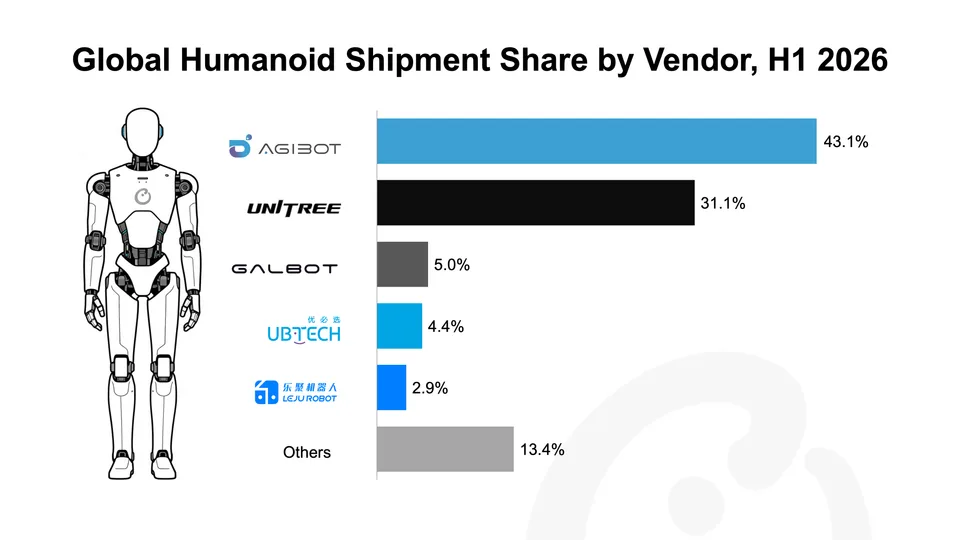
AGIBOT shipped about 9,700 humanoid robots in the first half of 2026 to capture over 43% global market share. Counterpoint Research data shows total shipments exceeded 22,000 units worldwide, nearly tripling from the prior year.
ZeroGantry analysis
AGIBOT's 9,700-unit H1 run at >43% share implies actuator and battery supply chains now support monthly output above 1,500 units, a threshold few Western programs have crossed. The A3's 0.218 kW/kg ratio and 100-unit UWB fleet sync enable rental economics at £1,999/day that amortize faster than lower-volume competitors once utilization exceeds 60%. Ship/watch: monitor actuator MTBF data from the first 5,000 A3 deployments; ignore only if European RaaS uptake stays below 200 units by Q4.
AGIBOT Expedition A3 Production Scale and Market Position
AGIBOT Innovation (Shanghai) Technology Co., Ltd. reported shipping approximately 9,700 units of its humanoid platforms during the first half of 2026 according to Counterpoint Research released August 20. This volume secured the company more than 43 percent of global shipments, outpacing competitors including Unitree Robotics. The milestone follows the June 2026 rollout of the company's 15,000th robot overall, confirming sustained high-volume manufacturing of wheeled and bipedal variants. Global shipments reached over 22,000 units in the period, representing nearly 300 percent year-over-year growth, with full-year forecasts exceeding 50,000 units as pilot programs scale to commercial fleets.
Production velocity at this level implies tight integration between supply-chain logistics and iterative hardware refinement. AGIBOT's ability to deliver thousands of units monthly points to standardized assembly lines capable of handling magnesium-titanium exoskeletons and dual-battery packs rated at 1,152 Wh each. European expansion via RaaS models priced from £1,999 per day further signals that the hardware has reached sufficient reliability for paid deployment contracts rather than pure research grants.
Technical Specifications of the AGIBOT Expedition A3
The Expedition A3 stands 173 cm tall and weighs 55 kg, constructed from magnesium alloy, titanium structural elements, and TPU covers for a power-to-weight ratio of 0.218 kW/kg. Peak actuator current reaches 150 A with total system power of 12 kW, enabling sustained high-torque maneuvers such as aerial kicks and mid-air spins documented in independent footage. Dual full-tab battery packs support up to 10 hours of operation with 10-second hot-swap capability, while UWB positioning achieves single-unit accuracy below ±10 cm for coordinated fleet operation of 100+ units.
Actuation relies on high-density electric motors paired with lightweight exoskeleton leg linkages that improve dynamic balance during rapid directional changes. Payload capacity at the tool center point reaches 3 kg with Cartesian speeds up to 2 m/s, metrics that directly support interactive service scenarios in retail and entertainment venues. Sensor latency remains a critical variable; the A3's real-time control loop must fuse proprioceptive data from joint encoders with external UWB ranging to maintain stability during 360-degree spins without external motion capture.
Deployment Implications and European RaaS Rollout
AGIBOT's UK rental pricing at £1,999 daily positions the A3 as a turnkey solution for short-term brand activations and live events where traditional performers face scheduling constraints. Fleet synchronization across 100 units enables choreographed performances that would otherwise require extensive human coordination overhead. The 15,000-unit cumulative production milestone reached in June 2026 demonstrates that earlier G2 industrial variants have already transitioned from validation batches into sustained revenue-generating deployments.
Counterpoint data also highlights Chinese manufacturers accounting for the overwhelming majority of global volume, with AGIBOT, Unitree, Galbot, UBTECH, and Leju occupying the top five slots. This concentration reflects domestic advantages in rare-earth magnet supply and high-volume motor winding capacity that reduce per-unit actuator costs compared with Western or Japanese equivalents. Operators evaluating total cost of ownership must weigh the A3's 0.218 kW/kg efficiency against potential tariff exposure and spare-part lead times when scaling beyond domestic Chinese facilities.
Sensor Fusion and Control Architecture Considerations
The A3's UWB-based positioning system operates at update rates sufficient for sub-centimeter relative localization within warehouse-scale environments, reducing reliance on vision-only SLAM that can degrade under variable lighting. Dual-battery architecture isolates power delivery for high-current bursts from sustained compute loads, mitigating voltage sag during simultaneous leg and arm actuation. Fleet control protocols support coordinated trajectories across 100+ robots, implying a centralized planner that solves multi-agent optimization problems with latency constraints below 100 ms round-trip.
Reproducibility of these performance metrics across thousands of shipped units depends on tight manufacturing tolerances for joint stiffness and battery cell matching. Any drift in power-to-weight ratio or UWB ranging accuracy would compound across large fleets, directly affecting synchronization quality in entertainment or logistics applications. Continued iteration on actuator thermal management will determine whether the current 10-hour endurance holds under continuous 12 kW peak loads in real customer environments.
Competitive Context and Scaling Trajectory
AGIBOT's 43 percent share in H1 2026 contrasts with slower volume ramps reported by non-Chinese developers, underscoring differences in capital allocation toward production tooling versus pure research prototypes. The company's earlier 15,000-unit cumulative milestone in June already exceeded many competitors' annual targets, setting a benchmark for embodied-AI commercialization timelines. Full-year projections above 50,000 units globally suggest the market is moving from demonstration projects into measurable operational economics where daily rental or lease models become viable.
Operators considering A3 deployments should model utilization rates against the £1,999 daily rate to determine payback periods relative to human labor equivalents in high-engagement settings. Continued monitoring of sensor calibration drift and actuator longevity across the installed base will provide the clearest signals on whether current hardware architectures support multi-year service contracts at scale.
Sources
- https://www.agibot.com/article/231/detail/89.html
- https://counterpointresearch.com/en/insights/global-humanoid-robot-shipments-soar-nearly-300-percent-yoy-in-h1-2026
- https://www.therobotreport.com/agibot-produces-15000th-robot-marking-milestone-embodied-ai-deployment/
- https://www.agibot.com/products/A3
Who services this hardware
Topics
Related articles
- XPENG IRON Humanoid Shows Memory and Multilingual Showroom Skills — XPENG released a September 22 video of its IRON humanoid in a lab test simulating car dealership interactions. The robot tracked speakers, remembered customer p
- Universal Robots Repair Costs: UR Cobot Maintenance Plans Compared — Universal Robots provides UR Care service plans with fixed annual fees covering preventive maintenance, 24/7 support, parts, and repairs for its cobots. Owners
- Rohit Prasad Appointed Boston Dynamics CEO for Atlas Push — Boston Dynamics named Rohit Prasad, former Amazon Alexa and AGI leader, as CEO effective October 7, 2026. He replaces interim chief Amanda McMaster following Ro
- Figure AI Melts F.02 Fleet: Schwarzenegger's Terminator Sendoff — Figure AI retired its F.02 humanoid fleet by training the robots to jump into a 75-ton electric arc furnace in Imatra, Finland. CEO Brett Adcock followed Arnold