Editorial · AI-derived
LimX Dynamics Centaur Robot Tests Humanoid Limits at WAIC 2026
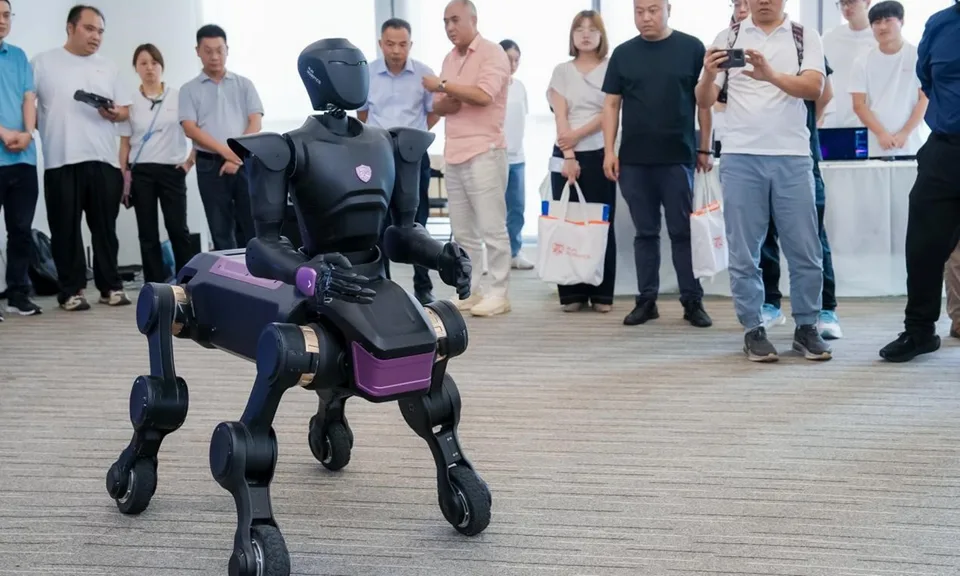
LimX Dynamics unveiled its centaur-style wheel-leg hybrid robot at WAIC 2026 in Shanghai on July 20. The design targets rugged terrain transport and inspection where standard humanoids fall short, with 95 percent domestic components and payloads up to 210 kg.
ZeroGantry analysis
LimX's 210 kg static load and 95% domestic content give it an edge in sanctioned supply chains where Optimus and Apollo still rely on global actuators; watch for Q4 2026 production ramp versus competitors' 2027 timelines. The hybrid morphology reduces unit count needed for heavy transport versus Spot fleets, but introduces unproven wheel-leg durability metrics. Ship for mining and energy inspection pilots; ignore for indoor dexterous assembly until field reliability data emerges.
EDITORIAL / OPINION
LimX Dynamics introduced a centaur-inspired hybrid robot at the 2026 World Artificial Intelligence Conference in Shanghai, pairing wheeled speed with legged adaptability for tasks in mining, oilfields, and emergency zones. The machine carries 100-120 kg on average and handles a 210 kg static load while switching between configurations for better terrain performance than pure bipeds. Domestic sourcing covers 95 percent of core components, aligning with China's push to reduce reliance on imported actuators and sensors.
Hybrid Design Meets Real-World Constraints
Standard humanoids from Tesla Optimus Gen 2 and Figure 02 prioritize two-legged walking suited to factories and homes, yet they lose efficiency on uneven ground or when hauling heavy cargo over distance. LimX's lower body uses a four-wheel all-terrain base that maintains stability at speed, while the upper torso adds dual arms for obstacle clearing and equipment operation. This split-body approach directly addresses payload and mobility shortfalls documented in recent deployments of Atlas and Unitree H1 models.
Perception relies on an integrated lidar-plus-vision stack that builds real-time maps and identifies valves, pipelines, and personnel without external beacons. Modular upper-body swaps let operators fit dexterous hands or force sensors for specific missions. The company reports secured orders and an assembly line target for Q4 2026, moving the platform past prototype stage faster than many Western counterparts still iterating on balance algorithms.
Supply Chain and Geopolitical Angles
Ninety-five percent domestic content reduces exposure to export controls on high-performance motors and chips, a factor that has slowed scaling for some international teams. Shanghai's Zhangjiang base supplies the industrial chain support cited by LimX, mirroring strategies seen with Unitree and Agibot models that also emphasize local sourcing. This localization matters for rugged applications where repair cycles in remote sites cannot tolerate weeks-long waits for foreign spares.
Compared with Boston Dynamics Spot or ANYmal quadrupeds, the centaur adds manipulation reach that pure legged platforms lack. Yet it trades some of their proven stair-climbing agility for wheeled velocity on flatter but broken surfaces. Early videos from WAIC show the platform carrying riders and traversing slopes that would stall many bipedal systems, though long-term reliability data remains limited.
Labor and Deployment Implications
Heavy-industry operators face chronic shortages for inspection and rescue roles in hazardous zones. A 210 kg payload robot that switches modes could reduce human exposure in steel plants or radiation areas more effectively than lighter humanoids designed for collaborative assembly. LimX claims the design overcomes scenario adaptability bottlenecks that have kept most embodied AI systems in controlled environments.
Still, the hybrid form factor introduces new failure modes at the wheel-leg transition points, and explosion-proof certification adds weight and cost. Fleet economics will depend on whether the 100-plus kg payload translates into fewer units needed per site versus fleets of smaller specialized machines.
Market Positioning Beyond the Hype
WAIC 2026 highlighted over 400 Chinese humanoid models, yet few deviate from bipedal norms. LimX's entry with Luna, TRON 2, and this centaur variant signals a willingness to optimize for vertical markets rather than chase general-purpose universality. The approach echoes Agility Digit's logistics focus but extends it to unstructured outdoor work.
Skeptics note that conference demos often outpace field results. LimX must prove sustained operation under load in high-temperature or dusty conditions before claiming superiority over established quadruped fleets. Domestic component dominance helps on paper, yet actuator longevity and software robustness remain the real bottlenecks for any platform entering production.
The centaur robot underscores that embodied AI progress will likely fragment into specialized morphologies rather than converge on one humanoid archetype. Operators evaluating options should weigh terrain data and payload needs against the marketing appeal of two-legged machines.
Sources
Who services this hardware
Topics
Related articles
- Agility Digit 5 Launch Targets Barrier-Free Warehouse Work — Agility Robotics launched Digit 5 on September 15, 2026, its first humanoid designed for safe close-proximity work alongside humans in warehouses and factories
- Robotics Week in Review: Sep 4–Sep 11, 2026 — Humanoid robotics surged forward this week with breakthroughs in control systems, record-breaking athletic performances, and major production scaling signals fr
- NVIDIA SONIC Scales Humanoid Control Beyond Task-Specific Limits — NVIDIA researchers released SONIC, a single controller trained on over 100 million motion frames that lets humanoids handle diverse whole-body movements from VR
- Tiangong Ultra 8.64s Record and AGIBOT Medals at 2026 Beijing Games — Tiangong Ultra from Beijing Humanoid Robot Innovation Center ran the 100m in 8.64 seconds at the World Humanoid Robot Games in Beijing. Shanghai-based AGIBOT le