Players · AI-derived
South Korea Navy Tests Pibot Humanoid as Ship Helmsman
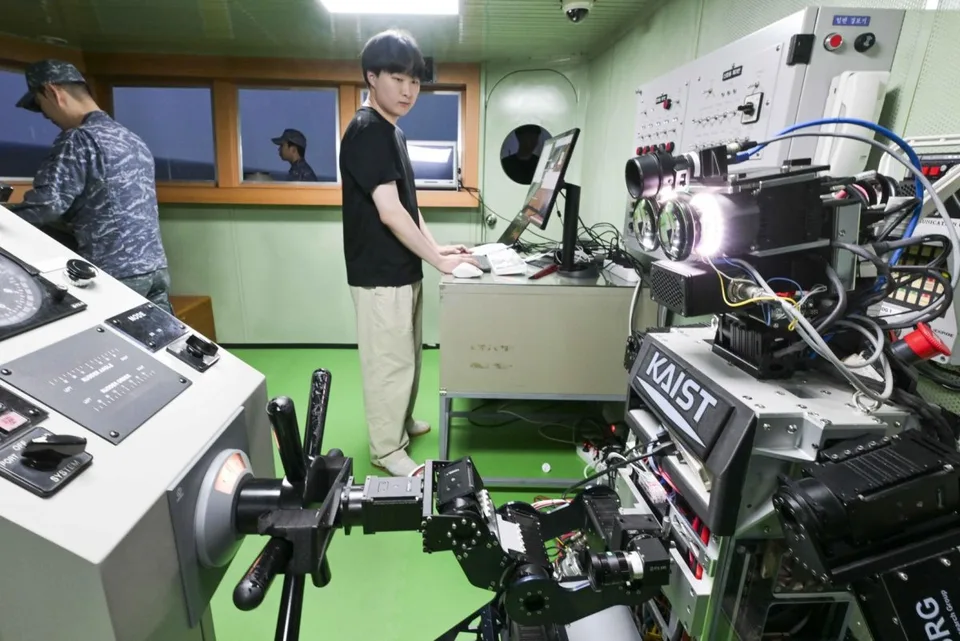
On July 23, 2026, the South Korean Navy ran its first combat experiment with KAIST's Pibot humanoid robot performing helmsman duties on a warship bridge simulator in Changwon. The test explored robotics to ease military manpower shortages without ship modifications.
ZeroGantry analysis
The Changwon simulator run validates LLM-driven command loops for bridge tasks but provides zero MTBF or sea-state reliability data; at roughly $4 million in development spend, the program could yield crew-reduction economics only if Stage 3-4 trials confirm sub-second response times and fault tolerance under real motion. Watch Stage 2 moored-vessel results expected later in 2026; ignore until metrics appear.
The July 2026 Simulator Test at Changwon
On July 23, 2026, the Republic of Korea Navy completed its first combat experiment with a humanoid robot serving as helmsman aboard a simulated destroyer bridge. The test occurred at the Naval Education and Training Command’s ship-handling facility in Changwon, South Gyeongsang Province, roughly 300 kilometers southeast of Seoul. Pibot, developed by a KAIST team led by Professor Shim Hyun-chul, received spoken steering orders from a bridge watch officer assigned to the destroyer Seoae Ryu Seong-ryong. The robot repeated each command for confirmation, turned the ship’s wheel to adjust course, and reported when the vessel steadied on the new heading.
Scenarios included narrow waterways, inclement weather with high waves pushing the vessel off course, and nighttime operations. Pibot executed the full sequence of acknowledgment, physical manipulation, and status reporting required of a human helmsman. The Navy described the event as Stage 1 of a four-stage program that will later move the robot to a moored vessel, daytime sea trials, and extended day-night operations at sea.
Pibot’s Development Background and Funding
Pibot originated as a physical AI humanoid designed to pilot aircraft by reading manuals and operating cockpit controls built for humans. The same form factor now allows it to use existing ship controls without hardware changes to warships. Development falls under a defense technology project funded by the Agency for Defense Development with 5.7 billion won, approximately 3.9 to 4.1 million USD at mid-2026 exchange rates. Professor Shim’s team integrated a large language model to interpret standard naval commands and generate appropriate responses.
The Navy frames the effort within its Sea GHOST initiative for a hybrid manned-unmanned fleet. Rear Adm. Kim Hyung-jun, head of the Force Analysis, Test and Evaluation Group, stated that ship handling has traditionally been a crew-only responsibility and that the experiment marks the first step in determining whether a robot can perform the task without error.
Technical Capabilities Demonstrated
Pibot processes verbal orders through its LLM, repeats the instruction verbatim, grips and turns the wheel with mechanical hands, and issues a confirmation report once the heading stabilizes. This closed-loop interaction mirrors human bridge protocol and aims to reduce miscommunication risks. The robot operated under frequent close-quarters maneuvers and maintained course despite wave-induced disturbances in the simulator.
Because Pibot retains a humanoid morphology, it interfaces directly with legacy steering wheels and panels. No vessel modifications were required during the land-based trial. Researchers plan to measure response latency, steering accuracy, and operator workload in post-test analysis before advancing to Stage 2.
Manpower Shortages Driving Military Robotics Adoption
South Korea faces one of the world’s lowest fertility rates, creating a shrinking pool of draft-age personnel. The Navy views robotic crew members as a way to offload repetitive or physically demanding tasks and sustain operational readiness. Assigning helmsman duties to Pibot could free human sailors for higher-value roles or reduce overall complement sizes on future platforms.
The experiment aligns with broader defense trends in East Asia where demographic pressures accelerate unmanned and manned-unmanned teaming programs. Success here could influence similar trials for other bridge positions or engineering tasks aboard surface combatants.
Path to Sea Trials and Reliability Assessment
The remaining three stages will expose Pibot to real vessel motion, variable sea states, and continuous operations. Safety and reliability remain the Navy’s top concerns before any at-sea deployment. Data from the Changwon test on command-to-action timing and error rates will guide refinements.
If later phases succeed, Pibot could serve as a template for additional humanoid roles in naval environments where space constraints favor bipedal forms over specialized machinery.
Comparisons to Other Humanoid Military Efforts
While Pibot focuses on precise control interfaces in confined bridge spaces, other programs explore logistics or maintenance tasks. The South Korean approach emphasizes zero-modification compatibility with existing warships, a practical constraint for fleet integration.
Future evaluations will need to address vibration tolerance, saltwater exposure, and electromagnetic compatibility once testing moves beyond the simulator.
Outlook for Defense Robotics Deployment
The July 23 experiment represents an early but concrete step toward operational humanoid crew members. Continued progress through the four-stage plan will determine whether Pibot or similar systems can deliver measurable reductions in crew workload or total personnel requirements. Defense planners will watch response-time metrics and failure modes closely as the program advances.
Sources
- https://www.upi.com/Top_News/World-News/2026/07/24/navy-humanoid-robot-ship-helmsman/1321784930446/
- https://en.yna.co.kr/view/AEN20260723011600315
- https://www.koreatimes.co.kr/southkorea/defense/20260724/faced-with-shrinking-population-koreas-navy-tests-humanoid-helmsman
- https://www.aa.com.tr/en/asia-pacific/south-korean-navy-tests-humanoid-robot-as-ships-helmsman-for-first-time/4008521
Topics
Related articles
- Tesla Optimus Gen 3 Design Renders Leak in Android App Update — Tesla's Android app version 4.61.0 contains official renders of Optimus Gen 3 showing enclosed joints and matte black shin fairings. The leak offers the first d
- Vesoma Launches Self-Improving Humanoid in Munich — Vesoma emerged from stealth on September 22 with a European humanoid that learns tasks through its own physical interactions rather than human demonstrations. T
- Mercedes-Benz Apollo Humanoid Pilots Advance at Berlin and Kecskemét Plants — Mercedes-Benz continues its Apptronik Apollo humanoid pilots at the Digital Factory Campus in Berlin-Marienfelde and the Kecskemét plant in Hungary. The robots
- UBTECH UWORLD U1 First Deliveries Begin in China — UBTECH has started shipping the first UWORLD U1 consumer humanoid robots to Chinese buyers after 13,000 pre-orders. The move tests whether full-size emotional c