Players · AI-derived
China Humanoid Robot Deployment 2026: 10000 Units National Plan
China's MIIT and SASAC June 2026 directive mandates 10,000+ humanoid robots across 100+ scenarios by year-end, accelerating commercialization with Unitree and AGIBOT production ramps against Tesla Optimus and Figure AI timelines.
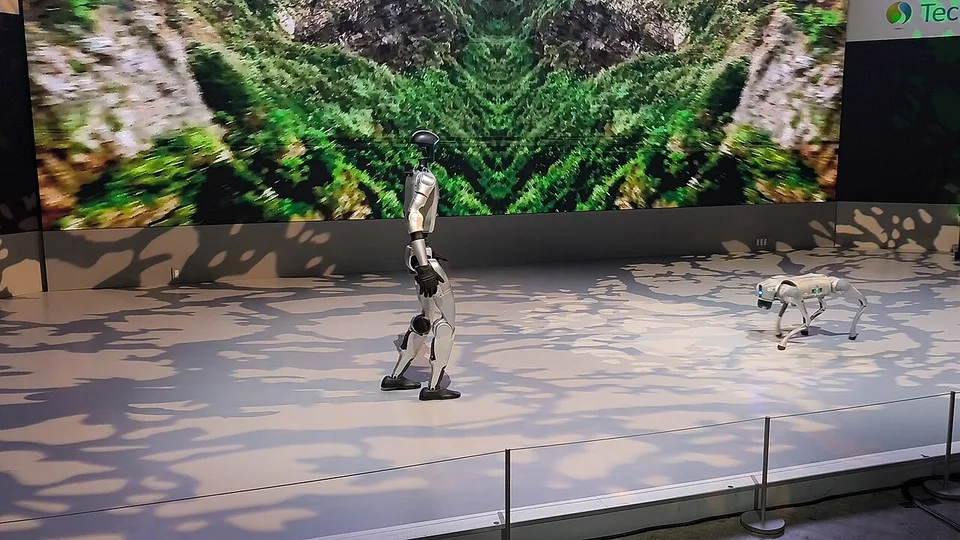
China's National Directive Accelerates Humanoid Commercialization
On June 9-10 2026, China's Ministry of Industry and Information Technology (MIIT) and State-owned Assets Supervision and Administration Commission (SASAC) issued a joint directive requiring local governments and state-owned enterprises to submit implementation plans by end-June and progress reports by November. The target is verification and routine 'work mode' deployment of key humanoid products in factories, warehouses, hospitals, logistics, retail, and disaster relief by December 2026. The plan explicitly calls for more than 10,000 units in commercial use and over 100 high-value application scenarios, marking a deliberate pivot from demonstration events to task-oriented integrated systems.
This policy builds directly on existing manufacturing momentum. AGIBOT announced on June 28 2026 that its 15,000th G2 wheeled semi-humanoid robot had rolled off the production line, just 90 days after reaching the 10,000-unit mark. The company highlighted engineering delivery capabilities for industrial and real-world operational scenarios. Unitree Robotics, already the volume leader with over 5,500 units shipped in 2025, has set internal targets for up to 20,000 humanoid shipments in 2026 at prices starting around $13,500–$29,900 depending on model (G1/H2). A Beijing-based factory referenced in policy documents aims to ship 10,000 units itself by year-end, providing a concrete production anchor for the national goal.
Player Comparison: Chinese Scale vs Western Pilots
Unitree and AGIBOT exemplify China's manufacturing-first approach. Unitree's G1 and H2 platforms emphasize affordability and immediate availability for research and early industrial trials, with documented shipments exceeding 38% of global humanoid volume in 2025. AGIBOT's rapid ramp from 10,000 to 15,000 units in three months demonstrates batch production maturity for mobile manipulators suited to repetitive industrial tasks. These numbers contrast sharply with Western players still largely in pilot or internal-deployment phases.
Tesla Optimus remains focused on internal Tesla factory use through 2026, with external customer availability not expected until late 2026 or 2027. Figure AI continues paid commercial pilots but operates on contract-only terms without public high-volume shipment figures. Boston Dynamics' electric Atlas is in shipping status for select R&D and automotive partners, yet production volumes remain orders of magnitude below Chinese counterparts. The Chinese policy effectively leverages state-directed SOE test beds to generate the real-world data loops that US firms must build through slower commercial channels.
Manufacturing Scale and Funding Momentum
The national plan explicitly endorses 'Humanoid Robot-as-a-Service' models and data-collection factories in Shanghai, Tianjin, and Fujian to fuel embodied AI training. Unitree received regulatory approval in early June 2026 for a 4.2 billion yuan STAR Market IPO, providing capital for further capacity expansion. Broader sector funding reached $2.9 billion in Q1 2026 alone for embodied AI firms. These capital inflows support production ramps that dwarf current Western output, where even leading programs target hundreds rather than thousands of units in the near term.
Local governments and SOEs are positioned as both customers and validators. Examples include Zhiyuan Robotics deployments at Longcheer Technology tablet factories and Robotera partnerships with China Post and SF Express achieving up to 85% of human efficiency in logistics centers. Such deployments generate the task-specific datasets required for the policy's 'work mode' objective.
Implications for Global Competition
By mandating timelines measured in months rather than years, Beijing compresses the commercialization curve. Chinese firms gain early access to diverse operational environments across 100+ scenarios, accelerating iteration on reliability, integration, and cost. Western programs like Tesla Optimus and Figure must compete on performance while navigating slower regulatory and market adoption pathways. The resulting data asymmetry could widen the gap in practical deployment experience by the end of 2026.
Unitree's planned 20,000-unit target and AGIBOT's proven 15,000-unit milestone already position Chinese players as the volume benchmark. The national directive ensures that scale translates into verified commercial applications rather than remaining in controlled demonstrations. Observers note that six months is a compressed window, yet concentrated state coordination may converge viable engineering solutions faster than fragmented market-driven efforts elsewhere.
Topics
Related articles
- Rohit Prasad Appointed Boston Dynamics CEO for Atlas Push — Boston Dynamics named Rohit Prasad, former Amazon Alexa and AGI leader, as CEO effective October 7, 2026. He replaces interim chief Amanda McMaster following Ro
- Hello Robot Stretch Wins $3M NIH Grant for Elder Care Dementia Support — Hello Robot received a nearly $3 million NIH grant to advance its Stretch mobile manipulator for older adults with mild cognitive impairment or early Alzheimer’
- BMW Leipzig Humanoid Robot Pilot Advances with Hexagon AEON — BMW Group has launched a pilot deploying Hexagon Robotics' AEON humanoid at its Leipzig plant for high-voltage battery assembly and component manufacturing. The
- Amazon Dobromierz Deploys 5,000 Robots in Polish Fulfillment Center — Amazon opened its 12th Polish fulfillment center in Dobromierz on September 21, 2026. The 200,000 m² four-story facility uses over 5,000 Amazon Robotics units a