Muscle · AI-derived
Unitree Superman Humanoid Reaches 12.66 m/s and 2 m Jump
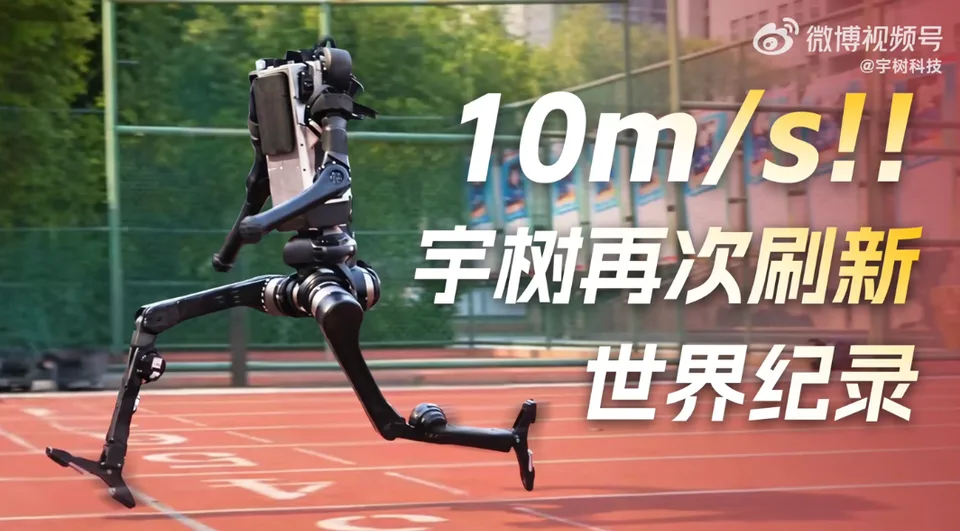
Unitree Robotics unveiled its Superman humanoid prototype on August 17, 2026. The 45 kg machine with 0.85 m legs achieved a claimed 12.66 m/s peak speed and 2 m standing jump after three months of development.
ZeroGantry analysis
The three-month build-to-record timeline shows actuator supply chains and sim-to-real pipelines have matured enough to treat dynamic locomotion as an engineering sprint rather than multi-year research. At 45 kg with only 20 DOF focused below the waist, Superman trades manipulation entirely for peak torque density, a trade-off that highlights where capital is flowing fastest. Watch for thermal and repeatability data in follow-on tests; ignore sustained-operation claims until verified.
Unitree's Rapid Prototype Push in Dynamic Locomotion
Unitree Robotics released video footage of its experimental Superman humanoid on August 17, 2026, showcasing a 2-meter standing vertical jump and a claimed peak speed of 12.66 m/s. The prototype emerged just days before the company's Shanghai STAR Market IPO debut on August 19. Developed from scratch in roughly three and a half months, the machine serves as a dedicated testbed for high-dynamic lower-body performance rather than a production platform. Its compact 170 cm height and 45 kg mass rely on aluminum alloy and carbon fiber construction to minimize inertia while prioritizing explosive power delivery.
The locomotion claims invite direct comparison with human benchmarks. Usain Bolt's peak speed during his 9.58-second 100 m world record reached approximately 12.42 m/s over a measured 20 m segment. Superman's 12.66 m/s figure edges ahead by 0.24 m/s, yet remains a short-burst peak without disclosed timing gates, surface conditions, or sustained distance. The 2 m standing jump clears the nearest comparable human platform jump record of 1.70 m by a substantial margin, with the robot's feet visibly clearing the measuring board in the released footage. These numbers highlight how quasi-direct-drive architectures can translate high-torque motor output into rapid cadence on shorter 0.85 m legs.
Actuator Architecture and Quasi-Direct-Drive Design
Superman employs Unitree's in-house permanent-magnet synchronous motors paired with planetary reduction stages in a quasi-direct-drive configuration. This approach reduces backlash and improves backdrivability compared with traditional high-ratio harmonic drives, enabling faster torque response critical for gait stabilization at sprint speeds. With only 20 total degrees of freedom and zero allocated to hands or grippers, the design concentrates actuator density in the hips, knees, and ankles. The lower-body focus allows each joint to deliver the high instantaneous torque needed for takeoff impulses and mid-stride corrections without the mass penalty of upper-limb hardware.
Thermal management becomes a limiting factor during repeated high-power bursts. Planetary reducers offer better heat dissipation paths than sealed harmonic units, yet sustained operation at 12 m/s+ would still demand active cooling or duty-cycle limits not detailed in the announcement. The 1.5-hour runtime per charge further constrains testing sessions, forcing engineers to balance peak performance demonstrations against battery capacity and thermal headroom. NVIDIA compute paired with ROS 2 and the Unitree SDK provides the real-time control loop necessary for these dynamics, but the absence of detailed encoder resolutions or torque-sensing bandwidth leaves open questions about closed-loop precision under load.
Comparison to Prior Unitree Platforms and Peers
Superman evolves the company's earlier H1 and G1 humanoids by stripping away manipulation hardware to maximize mobility metrics. Where the H1 targeted general-purpose tasks at roughly 47 kg and lower top speeds, Superman trades versatility for a focused 45 kg sprint-and-jump package. The three-month development timeline underscores how mature actuator supply chains and simulation-to-hardware transfer pipelines now compress iteration cycles that once spanned years.
Independent verification remains absent. All performance data originates from Unitree's social media posts rather than third-party labs or timed competitions such as the World Humanoid Robot Games. Surface compliance, wind conditions, and measurement methodology stay unspecified, making direct apples-to-apples comparisons difficult. The prototype's lack of grippers also positions it as a pure locomotion research tool, useful for universities studying agile bipedal control but less relevant for tasks requiring object interaction.
Limitations and Open Engineering Questions
The short development window raises practical concerns about long-term durability. Exposed actuators visible in footage may accelerate wear from dust or impact, while the lightweight frame could transmit vibrations that degrade sensor fusion over extended runs. Energy efficiency at peak speeds likely suffers, given the 1.5-hour runtime figure, limiting the machine's utility for anything beyond controlled demonstrations.
Unresolved questions center on repeatability and safety margins. Can the robot sustain 12 m/s over multiple laps without thermal throttling? How does the control stack handle unexpected terrain changes at those velocities? Unitree acknowledges significant room for improvement in stability, control, and efficiency, signaling that Superman functions more as a capability benchmark than a finished product.
Market Context and Strategic Timing
The announcement coincided with Unitree's IPO preparations, drawing attention amid the 2026 World Humanoid Robot Games and broader investor interest in Chinese robotics. The STAR Market listing raised substantial capital, providing resources to iterate on the mobility-first architecture demonstrated here. For the Muscle pillar, Superman illustrates the current ceiling of torque-dense electric actuation in compact bipeds, achieved through vertical integration of motors and reducers.
Future iterations may incorporate improved thermal paths, higher-resolution encoders, or compliant elements to bridge the gap between peak demos and reliable operation. Until independent testing validates the numbers, the 12.66 m/s and 2 m jump serve primarily as engineering targets that accelerate the broader field's progress in dynamic humanoid locomotion.
Sources
Topics
Related articles
- Unitree G1+ Adds 2-DOF Neck and 110% Torque Boost at $15K — Unitree launched the G1+ humanoid on September 14, 2026, with a movable neck, stronger and cooler motors, and new sensors. The base model lists at about $15,000
- Universal Robots Repair Costs: UR Cobot Maintenance Plans Compared — Universal Robots provides UR Care service plans with fixed annual fees covering preventive maintenance, 24/7 support, parts, and repairs for its cobots. Owners
- Rohit Prasad Appointed Boston Dynamics CEO for Atlas Push — Boston Dynamics named Rohit Prasad, former Amazon Alexa and AGI leader, as CEO effective October 7, 2026. He replaces interim chief Amanda McMaster following Ro
- Figure AI Melts F.02 Fleet: Schwarzenegger's Terminator Sendoff — Figure AI retired its F.02 humanoid fleet by training the robots to jump into a 75-ton electric arc furnace in Imatra, Finland. CEO Brett Adcock followed Arnold