Brain · AI-derived
ThorArena Benchmark Exposes Force-Aware Gaps in Humanoid Controllers
ThorArena, a new benchmark from TU Munich, tests how humanoid robots handle physical contact by replaying real human forces in simulation. The results expose major gaps in balance and tracking for VLA and RL controllers under load.
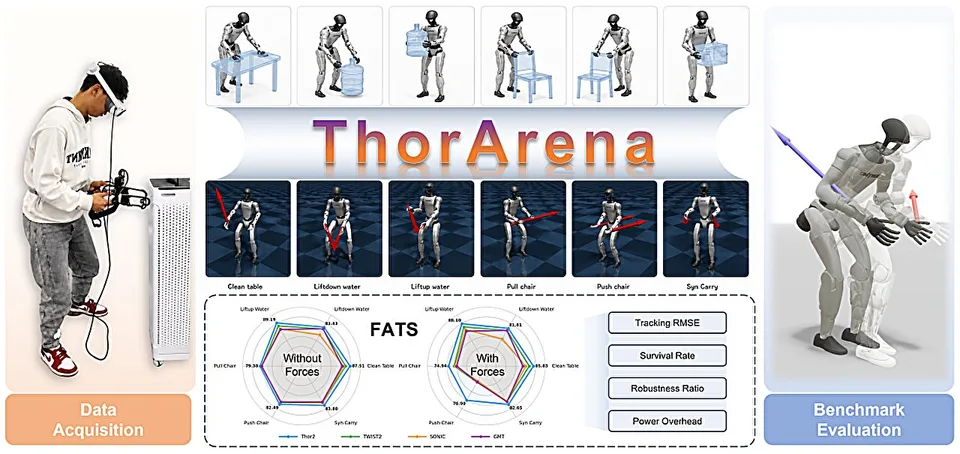
ThorArena Introduces Force-Aware Evaluation for Humanoids
ThorArena arrives as humanoid deployments accelerate into factories and warehouses, where physical contact with objects and humans becomes inevitable. Submitted to arXiv on July 7 2026 by a Technical University of Munich team led by Chenhao Yu and Alois Knoll, the benchmark replays synchronized hand forces from real human demonstrations onto simulated robots across six contact-rich tasks. These include lifting and lowering water containers, pushing and pulling chairs, and collaborative object carrying. Unlike prior kinematic-only suites, ThorArena maps measured wrist and hand forces directly into the physics simulator, exposing how external loads disrupt whole-body tracking and stability.
Conventional no-force tests masked critical weaknesses across tested controllers. Every policy maintained near-perfect balance and low tracking error when external forces were absent. Once the recorded interaction forces were replayed, performance diverged sharply. Balance failures increased, tracking errors spiked, and survival rates dropped, demonstrating that force feedback loops—not just motion imitation—are the decisive factor in real-world readiness. The new Force-Aware Tracking Score (FATS) quantifies this combined effect of tracking accuracy, robustness across force magnitudes, control effort, and episode survival.
Neural Controllers and Torque Mapping Under Load
The benchmark evaluates representative whole-body control policies, including vision-language-action transformers and reinforcement-learning agents optimized for manipulation. Thor2, the authors’ own system, achieved the highest average FATS and maintained near-perfect balance across all tasks even when forces reached peak recorded values. Other baselines showed pronounced degradation, with some policies losing stability within seconds of force application. These results highlight limitations in current torque-mapping strategies that rely primarily on visual or kinematic inputs without explicit force sensing or predictive compensation.
Reinforcement-learning policies trained in force-free environments struggle to generalize zero-shot to loaded conditions because they never encountered the torque disturbances that alter center-of-mass dynamics and joint loading. VLA models, dominant in recent humanoid stacks such as NVIDIA GR00T and π₀ derivatives, similarly underperform when contact forces exceed training distributions. The gap underscores the need for neural architectures that close the loop between visual-language planning and real-time torque feedback rather than treating force as an afterthought.
Simulation Protocol and Reproducibility
ThorArena provides a unified force-replay protocol and policy-adapter interface that standardizes evaluation across different humanoid morphologies and controllers. Human demonstrations were captured using VR motion tracking paired with 3D-printed sensorized hand tools that recorded directional forces at both wrists. These trajectories and force profiles are then replayed in a physics engine while the policy attempts to track the reference motion. The protocol ensures that every controller faces identical external disturbances, enabling direct comparison of neural feedback efficacy.
Diagnostic metrics beyond FATS track per-joint torque deviations, center-of-pressure shifts, and energy expenditure, revealing where specific neural modules fail to compensate for external loads. This granular view supports targeted improvements in torque-mapping networks and predictive force estimators. The framework is designed for easy extension to additional tasks and real-robot validation planned by the authors.
Implications for Safety and Scalable Deployment
Safety concerns drive interest in ThorArena as companies move humanoids from pilots to production lines. Force-unaware controllers risk sudden instability when a human collaborator applies guiding forces or when payloads shift unexpectedly. The benchmark quantifies these risks quantitatively, moving beyond qualitative marketing videos toward measurable readiness criteria. Policymakers and integrators can now demand FATS thresholds before approving collaborative workflows.
The results also inform research priorities in the Brain pillar: strengthening neural feedback loops that integrate multimodal force signals, improving zero-shot generalization across force regimes, and refining torque-mapping layers that predict and counteract disturbances before they propagate to the base. Thor2’s superior performance suggests that explicit force-aware training or architecture choices can close much of the observed gap.
Future Directions and Open Challenges
The TU Munich team intends to expand the dataset with more diverse force profiles, including dynamic impacts and multi-contact scenarios, and to port the evaluation to physical humanoid platforms. Integration with emerging VLA models that incorporate tactile or wrist-force tokens remains an open question. Whether scaling laws observed in language and vision domains will translate to force-aware robotic controllers is still unclear.
ThorArena sets a new standard for contact-rich evaluation at a moment when humanoid fleets are scaling. By surfacing performance differences invisible to prior benchmarks, it accelerates the development of safer, more reliable neural controllers capable of trustworthy physical interaction in unstructured environments.
Sources
Topics
Related articles
- Unitree G1 Humanoids Shine on AGT Finale with Synchronized Dance — Eight Unitree G1 humanoids joined dancer Wu Yufei for a water-sleeve dance routine on the America's Got Talent Season 21 finale on September 22, 2026. The perfo
- Google DeepMind Gemini Robotics 2 Scales via Software Partnerships — Google DeepMind released Gemini Robotics 2 on July 30, 2026, delivering vision-language-action models for whole-body humanoid control, dexterity, and multi-robo
- NVIDIA Expands Open Physical AI Stack with OpenUSD for Humanoids — NVIDIA released updates to its open physical AI stack on September 30, 2026, built around OpenUSD and Omniverse for reusable digital twins in humanoid training
- Skild AI S1 Soccer Skills Emerge from 140 Years of Self-Play — Skild AI announced September 23 that its S1 foundation model learned complex humanoid soccer behaviors through self-play in NVIDIA Isaac Sim. The policy, traine