Muscle · AI-derived
CHRT Certification Debuts for Humanoid Robot Repair Service
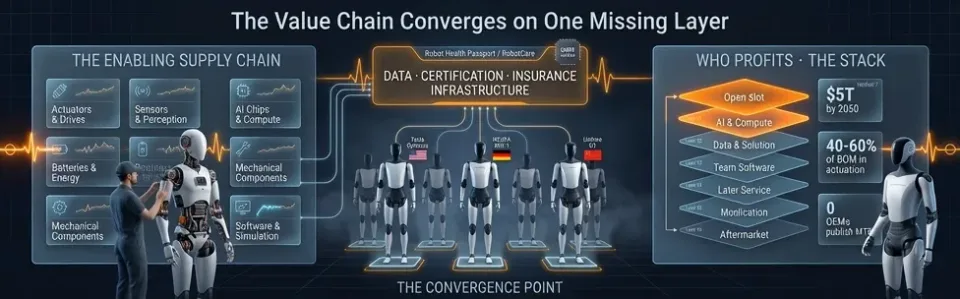
RobotCare launched the Certified Humanoid Robot Technician program and Robot Health Passport to support maintenance of humanoid fleets. The 15-week credential covers 15 OEM platforms with AR workflows and creates verifiable service records aligned to ANSI and ISO standards.
ZeroGantry analysis
The CHRT program’s 210-hour scope across 15 platforms positions it to cut mean-time-to-repair on actuator swaps from days to hours once the technician network reaches critical mass. Fleet operators using mixed platforms (Digit + NEO + Optimus) gain the largest immediate benefit because a single credential replaces multiple OEM-specific trainings. Watch for early adoption by RaaS providers; ignore only if your fleet remains under 20 units and fully covered by one OEM warranty.
The Maintenance Bottleneck in Humanoid Deployments
Humanoid robot fleets are moving from pilots into paid commercial use, yet the hardware that drives their performance—high-torque actuators, harmonic drives, precision encoders, and multi-axis force-torque sensors—requires specialized service that most facilities cannot yet deliver. RobotCare’s new CHRT credential and Robot Health Passport directly address this gap by creating a neutral, cross-OEM technician standard and cryptographically signed lifecycle record. The 15-week, 210-hour curriculum trains technicians on actuator calibration, thermal monitoring of motor windings, and sensor fusion diagnostics across 15 major platforms. Without such infrastructure, operators face extended downtime when a single harmonic drive fails or an encoder drifts beyond tolerance.
Deployments already underway at sites operated by Agility Robotics, Figure AI, and Tesla highlight the urgency. Agility’s Digit units, for example, rely on custom high-ratio harmonic drives paired with brushless motors that demand exact preload settings during replacement. A miscalibrated encoder on the knee joint can cascade into unstable gait cycles that only a certified technician following AR-guided steps can safely correct. The CHRT program embeds these procedures so that every torque specification and thermal limit check is documented in the Robot Health Passport.
CHRT Curriculum Focus on Actuator and Sensor Systems
The CHRT syllabus dedicates multiple modules to the physical components that define humanoid performance. Technicians learn to service strain-wave gearing, measure backlash in real time, and interpret temperature rise curves on motor housings under varying loads. They practice AR overlays that project torque curves directly onto the joint while the robot performs standardized gait cycles. Battery management and high-voltage safety procedures are included because actuator regeneration during walking can push pack currents beyond nominal limits.
Sensor work covers six-axis force-torque units at the feet and wrists, IMU drift compensation, and joint-level absolute encoders that must maintain sub-arcminute accuracy after thermal cycling. The program requires demonstrated competence on live platforms rather than simulators, ensuring graduates can execute a full actuator swap and update the Robot Health Passport with PKI-signed entries. This level of hands-on verification distinguishes CHRT from generic robotics certificates.
Robot Health Passport and Lifecycle Data Integrity
Every CHRT-attested service event writes directly into the Robot Health Passport, creating an immutable chain of custody for actuator hours, encoder recalibrations, and thermal events. Fleet operators can query historical torque margins or sensor health trends before scheduling a unit for heavy logistics duty. Insurers gain auditable data to price coverage for machines whose value depends on documented maintenance rather than OEM self-reporting.
The system supports predictive elements by logging telemetry that flags impending harmonic drive wear or encoder signal degradation 12–48 hours in advance. Parts routing under a 4-hour SLA is tied to the same verified record, reducing the risk of counterfeit components entering the supply chain. For platforms such as the 1X NEO or Unitree H1, whose actuator designs differ markedly in reduction ratio and thermal mass, the passport normalizes service history across vendors.
Standards Alignment and Industry Endorsement
RobotCare designed both offerings to satisfy ANSI/A3 R15.06-2025 and ISO 13482 requirements from the outset. The July 2026 policy framework issued by Agility Robotics CEO Peggy Johnson explicitly called for technician training pipelines and RaaS financing models, underscoring that hardware scale alone is insufficient. CHRT graduates receive a digital badge and directory listing at chrttechnician.com that fleet operators and insurers can verify instantly.
This neutral third-party layer mirrors the automotive aftermarket model, where ASE certification and Carfax-style records enabled financing and insurance at scale. Humanoid operators currently lack equivalent tools, leaving high-value assets exposed when an actuator reaches end of life or a sensor calibration drifts.
Implications for Fleet Economics and Technician Pipeline
As annual humanoid shipments approach the hundreds of thousands, the absence of certified service capacity will constrain utilization rates. A single certified technician can support multiple platforms because the credential spans 15 OEMs rather than locking knowledge to one manufacturer. This portability matters for regional service networks that must respond to mixed fleets containing Agility Digit, Figure 02, and Tesla Optimus units.
Trade schools and community colleges are the intended delivery partners for the 210-hour program, creating a replicable pipeline that existing industrial maintenance curricula can adopt. The AR-guided workflows lower the barrier for technicians transitioning from automotive or CNC backgrounds, where harmonic drive and encoder experience already exists.
Technical Realities of Humanoid Actuator Service
Harmonic drives in humanoids typically operate at ratios between 50:1 and 160:1 with continuous torque densities exceeding 100 Nm/kg in the latest designs. Thermal limits on the flexspline and circular spline become critical during repeated stair-climbing or load-carrying cycles; a 15 °C rise above baseline can accelerate lubricant breakdown and increase backlash by several arcminutes within weeks. CHRT technicians are trained to measure these parameters in situ using portable dynamometers and infrared thermography before approving a unit for continued operation.
Encoder integrity is equally vital. Absolute magnetic or optical encoders on hip and knee joints must retain sub-0.1° accuracy after thousands of gait cycles. Drift caused by thermal expansion or contamination directl
Sources
Who services this hardware
Topics
Related articles
- Tesla Optimus Hand Durability and Magnet Supply Issues Slow Ramp — Elon Musk addressed ongoing Tesla Optimus hand engineering problems during an October 10 interview at the X Takeover event. China's 2025 rare-earth magnet expor
- Boston Dynamics Atlas GR3 Hand: 13-DOF Specs for Tool Use — Boston Dynamics unveiled the GR3 hand for its electric Atlas humanoid on October 1, 2026. The four-fingered design delivers 13 degrees of freedom with direct ac
- Unitree G1+ Adds 2-DOF Neck and 110% Torque Boost at $15K — Unitree launched the G1+ humanoid on September 14, 2026, with a movable neck, stronger and cooler motors, and new sensors. The base model lists at about $15,000
- Google DeepMind Cambridge Lab Expands Gemini Robotics Hardware — Google DeepMind is building a new robotics lab in the Cambridge area to house its growing hardware team. Aaron Saunders, who joined from Boston Dynamics in late