Players · AI-derived
Tesla Optimus Production Starts at Fremont with 2027 Delivery Target
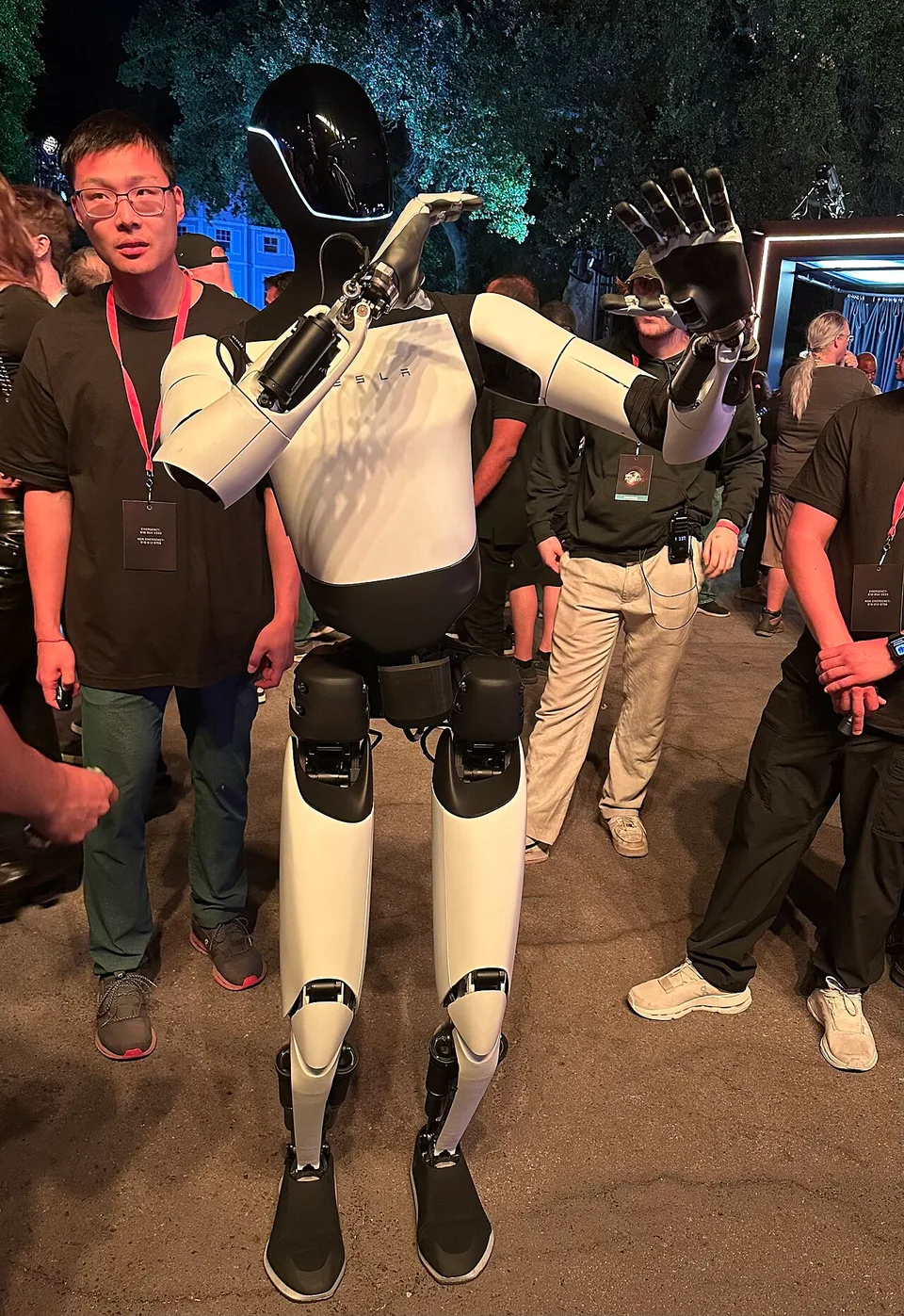
Tesla began early production of Optimus humanoid robots on a high-volume line at its Fremont factory during Q3 2026. External deliveries are targeted for late 2027 once durability, safety, hands, and AI issues are resolved.
ZeroGantry analysis
Tesla's 46-day conversion of the Model S/X line at Fremont shows manufacturing agility that could keep capex intensity lower than new-build competitors, yet the shallow early ramp and unresolved hand/AI durability issues point to elevated per-robot validation and service costs in the first 10k-20k internal units. Watch internal uptime and maintenance data through mid-2027 before assuming external 2027 volumes materialize at scale; ship interest only after clear reliability benchmarks, ignore broad fleet replacement claims until actuator longevity metrics appear.
Production Milestone at Fremont Factory
Tesla confirmed in its third-quarter 2026 shareholder update and earnings call that Optimus humanoid robots have begun rolling off a repurposed high-volume assembly line at the Fremont, California factory. The units are described as the first production-quality bots manufactured by the company, marking a shift from prototype builds to a process deemed suitable for commercial output. The line occupies space previously used for Model S and Model X assembly, which Tesla decommissioned and converted in just 46 days earlier in 2026. Most equipment for a line rated at one million units annually is now installed, though current output remains in an early ramp phase with no specific weekly production figures released for Q3.
The rapid repurposing highlights Tesla's ability to reallocate existing automotive manufacturing footprint rather than construct new facilities from scratch. Sources including the official Q3 update note that the current manufacturing process has been proven viable for a commercial product, even as iteration on hardware and processes continues. This milestone occurred amid broader factory adjustments, including the end of Model S and Model X production to free capacity. Analysts from JPMorgan noted the setup implies a pre-external-sale run of 10,000 to 20,000 units for internal validation before wider shipments.
Ramp Timeline and Capacity Targets
CEO Elon Musk stated during the October 21, 2026 earnings call that reaching a rate of 20,000 Optimus units per week would take at least one year, possibly longer, due to the radically new nature of the product. This equates to roughly one million units annually, aligning with the Fremont line's nameplate capacity. Musk described the initial ramp as having a shallow slope and being somewhat bumpy, with roughly 10,000 elements needing to align correctly for smooth production. External customer deliveries are now targeted around the end of 2027, starting with industrial applications involving dangerous, repetitive, or continuous-operation tasks.
Tesla plans a second Optimus facility at Gigafactory Texas, currently listed as under construction in shareholder materials. The Fremont operation is labeled Early Ramp while Texas remains in Construction status. Musk emphasized that design tweaks are still required for long-duration reliability, noting robots cannot wear out after a month of use. A video demonstrating non-pre-programmed tasks is expected within one to two months, providing further visibility into progress. The AI5 chip, offering roughly an order of magnitude more compute than the current AI4 hardware, is slated for integration around April 2027.
Financial Context and Investment Scale
The production announcement coincided with challenging financial results for Tesla. Net income fell 43 percent year-over-year to $787 million, while operating expenses rose 39 percent to $4.776 billion. Capital expenditures more than doubled to $4.732 billion in the quarter, driven in part by AI, robotics, and new product initiatives. Revenue remained nearly flat at $28.05 billion. These figures reflect heavy spending on Optimus development and related infrastructure, with no external sales or pricing details disclosed for the robot.
Free cash flow stayed positive at $1.531 billion despite the outlays. The absence of a commercial price, confirmed outside buyers, or firm delivery schedule means the full cost burden currently rests with shareholders and internal cash generation. Tesla's Q3 update and call transcripts highlight ongoing work on AI integration and hardware refinements as key areas absorbing resources. This spending profile positions Optimus as a long-term bet rather than a near-term revenue driver.
Technical Hurdles and Design Iterations
Musk identified persistent challenges in hands and fingers, durability, safety certification, and AI capabilities for open-ended tasks. Each hand incorporates over 100 components, with some assembly still requiring manual intervention due to precision limits in automated stations. Reliability testing must ensure consistent performance over extended periods without rapid wear. Tesla lacks a large existing fleet for real-world data collection comparable to its vehicle fleet, prompting plans to deploy 10,000 to 20,000 early units in an internal Optimus Academy for task practice and iteration.
The company continues to refine the electromechanical architecture alongside software. Integration of the AI5 chip represents a major upcoming hardware upgrade expected to enhance onboard processing. Safety and regulatory compliance for industrial deployment add further layers of validation required before external handoff. These elements explain the extended timeline to late 2027 for first outside deliveries.
Fleet Economics, Serviceability, and Market Implications
Early production volumes will likely support internal Tesla operations first, allowing cost data collection on maintenance, energy use, and uptime before scaling to customers. Actuator complexity and multi-component hands suggest higher per-unit service costs than simpler industrial arms, potentially influencing total cost of ownership calculations for fleet buyers. The 46-day line conversion demonstrates manufacturing flexibility that could lower capital intensity compared to greenfield robot factories, yet the one-year-plus ramp indicates significant learning-curve expenses ahead.
Competitive pressure remains limited according to Musk, who stated no other entity is close on a general-purpose humanoid. However, the delayed external timeline provides runway for rivals to advance their own platforms. For Tesla, successful internal deployment metrics in 2027 will be critical indicators of whether the economics support broader adoption in logistics, manufacturing, and hazardous environments.
Outlook for 2027 and Beyond
With production underway and a defined path to higher volumes, Tesla has moved Optim
Sources
Who services this hardware
Topics
Manufacturers
Related articles
- AgiBot Sets Guinness Record with 110 Expedition A3 Dancing — On October 24, 2026, AgiBot's 110 Expedition A3 humanoids performed a synchronized dance in Jinan, setting the Guinness World Record for the most humanoid robot
- Figure 04 Design Lock Advances Custom Actuators — Figure AI CEO Brett Adcock announced during an October 22 all-hands that Figure 04 has reached full design lock. Parts are now shipping while the team character
- Figure 03 vs Tiangong Ultra: 2026 Capabilities and Costs — Figure 03 targets home and factory tasks with Helix AI showing 56% zero-shot success in unseen homes. Tiangong Ultra prioritizes speed and endurance after setti
- Unitree Stock Surges 16% on China Embodied AI Policy — Unitree Robotics shares rose 16.15% to ¥495.92 on October 19 after nine Chinese government departments issued guidance promoting embodied AI in household servic