Players · AI-derived
South Korea $1T AI Bet Powers Boston Dynamics Atlas 2028 Ramp
South Korea commits $1T to DRAM fabs, AI data centers, and humanoid robots, designating physical AI a national strategic industry. Hyundai and Boston Dynamics target 30,000 Atlas units annually by 2028 using Korean actuators and supply chains, positioning against Tesla Optimus, Figure, and Unitree in global production scale and fleet economics.
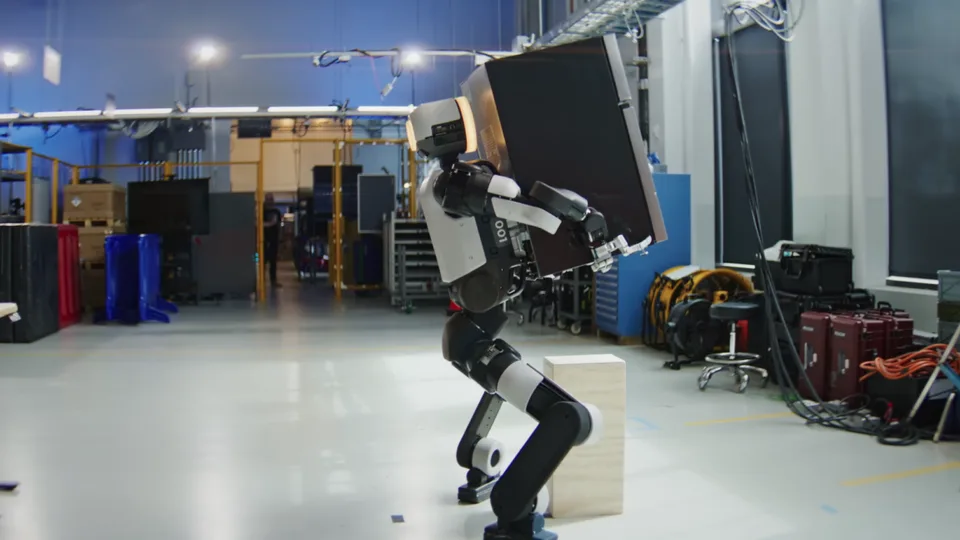
South Korea $1T AI Investment and Humanoid Robot Ambitions
South Korea's government and conglomerates have pledged roughly $1 trillion to link memory chip dominance with physical AI scaling. The June 29, 2026 announcement ties $585 billion from Samsung and SK Hynix for new DRAM fabs aimed at doubling production in five years, $357 billion from SK Group, GS Group, and Naver for AI data centers, and over $5.8 billion from Hyundai Motor Company for robot manufacturing and infrastructure in Saemangeum.
This sovereign-scale move designates physical AI as a national strategic industry, targeting a Korean world-model foundation model within three years and commercial humanoid deployment across 10 industries by 2028. Plans include training 10,000 AI robotics specialists.
Boston Dynamics Atlas Hyundai Production Ramp and Fleet Economics
Hyundai/Boston Dynamics targets 30,000 Atlas units per year capacity by 2028, leveraging Korean actuator and automotive supply chains. Initial deployments focus on Hyundai's own facilities, including the Metaplant America in Georgia, starting with repetitive and hazardous tasks. Fleet economics hinge on high-volume manufacturing to drive down per-unit costs while achieving competitive MTBF through proven industrial components.
Compared to Tesla Optimus timelines and Figure's pilot programs, Korea's integrated supply chain offers advantages in actuator sourcing and auto-grade reliability. Unitree's lower-cost models highlight price pressure, yet Atlas prioritizes industrial robustness over entry-level pricing.
Physical AI South Korea 2028 Commercialization Targets
The strategy emphasizes world models for embodied intelligence, supported by expanded data center capacity. Commercial rollout in manufacturing, logistics, and automotive sectors by 2028 aligns with labor shortages and union dynamics. Pilot audits will track real-world performance metrics including uptime and task completion rates.
Humanoid Supply Chain Korea Actuators and Global Competition
Korean actuator expertise and vertical integration with Samsung memory and Hyundai auto parts accelerate scaling. This contrasts with fragmented supply chains elsewhere. Tesla Optimus, Figure, and Unitree compete on different vectors: software iteration, venture agility, and aggressive cost reduction respectively.
Production ramps will determine winners in fleet economics, with MTBF data from early deployments informing iterative improvements.
Intelligence on Player Positioning
This investment repositions South Korea as a leader in integrated hardware-software humanoid ecosystems, directly challenging U.S. and Chinese players through scale and policy alignment.
Sources
- https://arstechnica.com/ai/2026/06/south-korea-to-spend-1t-on-more-memory-chip-production-and-humanoid-robots/
- https://www.chosun.com/english/industry-en/2026/06/29/FVFRJHGFABF37PZDZACVLIJWZQ/
- https://www.reuters.com/world/asia-pacific/south-korean-president-unveil-massive-ai-chip-investment-drive-2026-06-29/
- https://humanoid.guide/south-korea-backs-atlas-humanoid-robots-for-2028-rollout/
- https://www.aljazeera.com/news/2026/6/29/south-korea-announces-more-than-1-trillion-ai-chip-investment-drive
Who services this hardware
Topics
Related articles
- Rohit Prasad Appointed Boston Dynamics CEO for Atlas Push — Boston Dynamics named Rohit Prasad, former Amazon Alexa and AGI leader, as CEO effective October 7, 2026. He replaces interim chief Amanda McMaster following Ro
- Hello Robot Stretch Wins $3M NIH Grant for Elder Care Dementia Support — Hello Robot received a nearly $3 million NIH grant to advance its Stretch mobile manipulator for older adults with mild cognitive impairment or early Alzheimer’
- BMW Leipzig Humanoid Robot Pilot Advances with Hexagon AEON — BMW Group has launched a pilot deploying Hexagon Robotics' AEON humanoid at its Leipzig plant for high-voltage battery assembly and component manufacturing. The
- Amazon Dobromierz Deploys 5,000 Robots in Polish Fulfillment Center — Amazon opened its 12th Polish fulfillment center in Dobromierz on September 21, 2026. The 200,000 m² four-story facility uses over 5,000 Amazon Robotics units a