Editorial · AI-derived
Proception.AI ProHand 1.0: Ex-Tesla Optimus Team Ships Dexterous Hands After…
Proception.AI raises $11M seed led by First Round Capital and ships ProHand 1.0 tendon-driven robotic hand plus ProGlove data platform after settling Tesla trade secrets suit. Editorial take on ex-Optimus founders tackling humanoid dexterity bottlenecks with real hardware and tactile pipelines.
EDITORIAL / OPINION
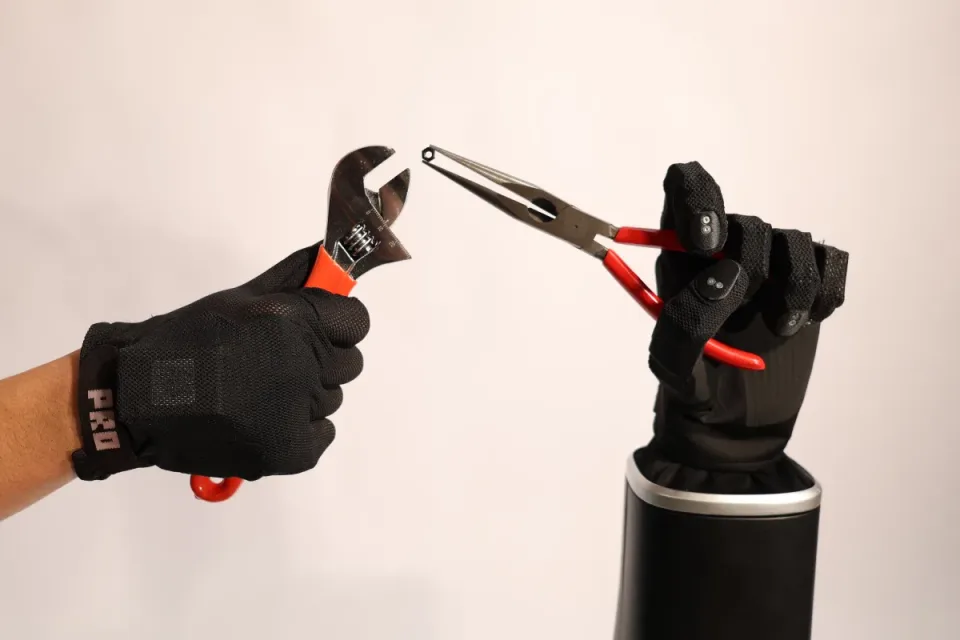
Fact: On June 29, 2026, Proception.AI announced an $11 million seed round led by First Round Capital (with participation from Y Combinator and BoxGroup) and began shipping its ProHand 1.0, a 22-degree-of-freedom tendon-driven robotic hand, alongside the ProGlove wearable sensor platform. The company, founded by former Tesla Optimus engineers Jay Li and Jack Xu, also settled a trade-secrets lawsuit filed by Tesla.
Opinion: In a field drowning in humanoid hype and vaporware demos, Proception stands out by actually shipping hardware that targets the single hardest unsolved problem in robotics: dexterous manipulation. The “last mile” isn’t walking or talking—it’s picking up a screw without crushing it or dropping it. This $11M bet, backed by credible investors and real ex-Tesla talent, signals that the actuator and sensing bottlenecks are finally getting serious engineering attention rather than another flashy rendering.
The Hands Problem Nobody Solved
Humanoid robotics has progressed rapidly on locomotion and perception, yet manipulation remains the glaring weakness. Existing grippers are either too crude for fine work or too fragile and expensive for scale. Proception’s approach—22 DoF via tendon-driven actuation—mimics human biomechanics more closely than rigid parallel-jaw designs. Motors pull cables to actuate multiple joints per finger, keeping the hand lightweight and compact while allowing compliant, adaptive grasping.
The integrated skin-like sensors add tactile feedback essential for closed-loop control. Pair this with ProGlove, which captures real human manipulation data at scale, and you have a data flywheel that could accelerate learning pipelines far beyond simulation-only training.
Geopolitics and Supply Chain Reality Check
Tesla’s Optimus program highlighted both the promise and the pain of building dexterous hands in-house. By settling the lawsuit and moving forward, Proception removes a legal overhang that could have stalled a promising team. It also underscores broader industry dynamics: talent flows from big tech to startups, trade-secret disputes are inevitable when IP walks out the door, and the U.S. robotics supply chain remains fragmented. Proception’s focus on research-grade, serviceable hardware positions it to serve labs and early adopters globally, potentially easing some actuator sourcing pressures if production scales.
Hype vs. Reality: Shipping Beats Slides
Most humanoid startups still promise “human-like dexterity by 2027.” Proception is already mailing boxes. That distinction matters for labor markets—real dexterous hands could accelerate deployment in warehouses, manufacturing, and eldercare faster than marketing decks predict. Investors clearly agree; the round size and lead investor suggest conviction that hardware + data is the moat, not just another foundation model.
Dry humor aside, if ProHand 1.0 survives real-world abuse and ProGlove data proves high-quality, this could be the first credible commercial path to humanoid hands that don’t require PhD-level tuning every shift. The rest of the industry should take notes—or risk being left holding the (non-dexterous) bag.
Sources
- https://techcrunch.com/2026/06/29/robot-hand-company-settles-tesla-trade-secret-suit-and-announces-11m-raise/
- https://www.finsmes.com/2026/07/proception-ai-raises-11m-in-seed-funding.html
- https://www.proception.ai/news/introducing-prohand
- https://www.ycombinator.com/companies/proception-inc
- https://www.autodesk.com/products/fusion-360/blog/proception-physical-ai/
Topics
Related articles
- Figure AI Melts F.02 Fleet: Schwarzenegger's Terminator Sendoff — Figure AI retired its F.02 humanoid fleet by training the robots to jump into a 75-ton electric arc furnace in Imatra, Finland. CEO Brett Adcock followed Arnold
- Robotics Week in Review: Sep 25–Oct 2, 2026 — Humanoid robots advanced toward real warehouse and factory roles while software platforms and record industrial deployments underscored automation's acceleratin
- Physical Intelligence San Francisco Lease Signals 2026 Physical AI Scaling — Physical Intelligence subleased 80,000 square feet at 850 Brannan Street in San Francisco from Airbnb in September 2026. The robotics AI firm is expanding its B
- IFR Data: 5 Million Robots Signal Labor Shift, Not Humanoid Revolution — The International Federation of Robotics' World Robotics 2026 report shows global factory robot stock reached 5 million units in 2025, with China installing 59