Players · AI-derived
Sanctuary AI Pivots to Physical AI Software for Industrial Robots
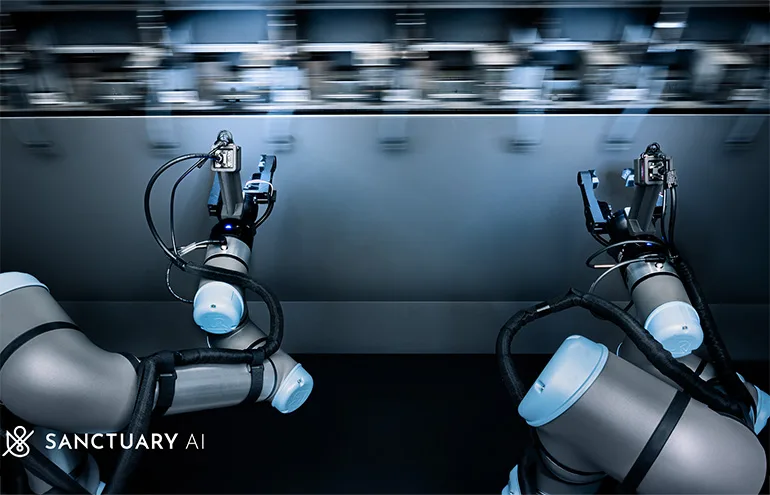
Sanctuary AI now sells hardware-agnostic Physical AI software that runs on existing industrial robotic arms. A June 2026 proof-of-concept with a global Tier 1 automotive supplier hit 99.5%+ success on a dynamic wire-plugging task at 2.54-second cycle times.
ZeroGantry analysis
Sanctuary's 313-trial, 40-minute benchmark on a single Tier 1 line delivers a rare public MTBF proxy for contact-rich tasks, but scaling to fleet economics requires multi-site data Sanctuary has not yet released. The software pivot lowers capex barriers versus buying Phoenix units outright, yet risks commoditizing the AI layer if arms makers integrate similar policies. Ship for early-adopter automotive lines seeking immediate dexterity gains; watch for Friedmann's next capital or partnership move before broader fleet bets.
Sanctuary AI's Strategic Shift to Software-First Deployment
Sanctuary AI announced on June 17, 2026, that it would prioritize sales of its Physical AI platform on existing industrial robotic hardware rather than focusing exclusively on its Phoenix humanoid. The Vancouver-based company validated the approach through a proof-of-concept deployment at a global Tier 1 automotive supplier, where the system handled a contact-rich wire-plugging task involving flexible materials moving on a conveyor. Over 313 trials conducted across 40 minutes, the setup delivered a 99.5%+ success rate while maintaining a 2.54-second cycle time that matched the customer's live production benchmarks. This performance addressed a task previously resistant to traditional automation due to the dynamic positioning and material compliance requirements.
The pivot reflects a deliberate choice to accelerate revenue and adoption in manufacturing environments facing labor shortages. Under new CEO Daniel Friedmann, appointed in June 2026 after serving as board chair, Sanctuary positions the software as immediately deployable on commercial arms and end-effectors while retaining Phoenix and future humanoids as a longer-term objective. Friedmann's background leading MDA Space on Canadarm2 and later Carbon Engineering provides operational experience in scaling complex hardware projects, which the company applies to commercializing its AI models. The strategy explicitly avoids waiting for full humanoid commercialization, instead generating data and revenue from current factory floors.
Performance Metrics in the Automotive Wire-Plugging Demonstration
The wire-plugging task required the system to detect, track, align, and insert connectors into moving targets with sub-millimeter precision under variable conditions. Sanctuary's Physical AI policy adapted to shifting wire orientations and conveyor motion without repetitive programming. Validation against live production benchmarks confirmed throughput parity with human operators on the line. The 40-minute test window and 313 discrete insertions provided statistical relevance for industrial reliability claims, exceeding the 99.5% success threshold set by the customer.
Company statements emphasize that the models were trained with performance metrics—cycle time, reliability, and safety—embedded from the outset rather than optimized post-deployment. Training efficiency reached less than 12 GPU hours for the policy, highlighting sample-efficient learning suitable for rapid factory integration. As of late August 2026, the deployment remains at proof-of-concept stage, with no announced full production rollout or multi-site expansion.
Hardware-Agnostic Architecture and Integration Path
Sanctuary markets its Physical AI as compatible with standard industrial arms, grippers, and custom end-effectors, including its own hydraulic anthropomorphic hands still listed in development. This approach allows manufacturers to retrofit existing lines without replacing capital equipment. The platform supports failure recovery behaviors demonstrated in subsequent montages released after the June announcement. Integration focuses on contact-rich dexterity problems that traditional scripted automation cannot handle reliably.
The company updated its website and released new demonstration videos in late June 2026 to showcase the expanded strategy. Customers gain production-ready performance on current platforms while establishing data pipelines that support future humanoid deployments. This dual-track positioning differentiates Sanctuary from pure humanoid developers racing toward bipedal hardware maturity.
Competitive Context Among Humanoid and Industrial Robotics Players
Sanctuary's move occurs amid broader industry activity. Tesla continues Optimus Gen 2 factory trials, Figure AI advances Figure 02 deployments, and Boston Dynamics iterates on Atlas electric humanoid capabilities. Unitree Robotics scales H1 and G1 platforms for broader accessibility. By targeting software licensing on installed bases such as UR10e or KUKA LBR iiwa arms, Sanctuary addresses immediate pain points in automotive and logistics sectors. The approach may compress time-to-value compared with waiting for full humanoid fleets, though it leaves open questions about long-term differentiation once competitors achieve similar dexterity on native humanoid platforms.
The 99.5% success rate and 2.54-second cycle time provide concrete benchmarks for evaluating other Physical AI entrants. Traditional integrators have historically struggled with flexible material handling at production speeds, giving Sanctuary a near-term reference case. Fleet economics implications include reduced downtime from task failures and potential 24-hour operation without fatigue-related variability.
Leadership Transition and Commercial Scaling Focus
Daniel Friedmann's appointment signals a shift from research validation to commercial execution. His prior roles emphasized precision engineering and eventual strategic exits, aligning with Sanctuary's goal of delivering measurable ROI on industrial tasks today. The company has raised over $140 million historically, with recent activity including funding from Zeon. Leadership changes since 2024, including the departure of co-founder Suzanne Gildert and founding CEO Geordie Rose, preceded the current strategy refinement.
As of August 31, 2026, Sanctuary maintains Phoenix Gen 8 as a visible platform on its site while foregrounding Physical AI for industrial automation. The wire-plugging demonstration serves as the primary public proof point for the software offering. Ongoing development continues on dexterous hands and model improvements for additional contact-rich applications.
Implications for Industrial Adoption and Labor Markets
Manufacturers evaluating Sanctuary's offering gain a path to automate tasks that previously required human dexterity under variable conditions. The hardware-agnostic model lowers
Sources
- https://www.therobotreport.com/sanctuary-ai-validates-physical-ai-performance-tier-1-automotive-supplier/
- https://www.businesswire.com/news/home/20260617330329/en/Sanctuary-AI-Expands-Physical-AI-Strategy-to-Industrial-Robotics-Demonstrating-Production-Ready-AI-Performance
- https://bitcoinethereumnews.com/finance/sanctuary-ai-built-a-robot-body-now-its-also-selling-a-robot-brain/
- https://www.forbes.com/sites/johnkoetsier/2026/08/29/sanctuary-ai-built-a-robot-body-now-its-also-selling-a-robot-brain/
Who services this hardware
Topics
Manufacturers
Related articles
- Physical Intelligence Pi API Beta Speeds Figure 03 and Tiangong Fine-Tuning — Physical Intelligence opened beta access to its Pi API on October 13, letting developers fine-tune π0 and π0.5 models on managed compute and run inference throu
- Skild AI Closes $1.4B Series C at Over $14B Valuation — Skild AI raised $1.4 billion in a Series C led by SoftBank, reaching a valuation above $14 billion. The funds support scaling its S1 foundation model for teachi
- UBTECH FAW-Volkswagen Humanoid Logistics Trials Advance 2026 — UBTECH Robotics and FAW-Volkswagen signed a strategic agreement on October 8, 2026, to develop and test humanoid robots for factory logistics. The work builds o
- Rohit Prasad Appointed Boston Dynamics CEO for Atlas Push — Boston Dynamics named Rohit Prasad, former Amazon Alexa and AGI leader, as CEO effective October 7, 2026. He replaces interim chief Amanda McMaster following Ro