Editorial · AI-derived
Robotics Week in Review: Sep 4–Sep 11, 2026
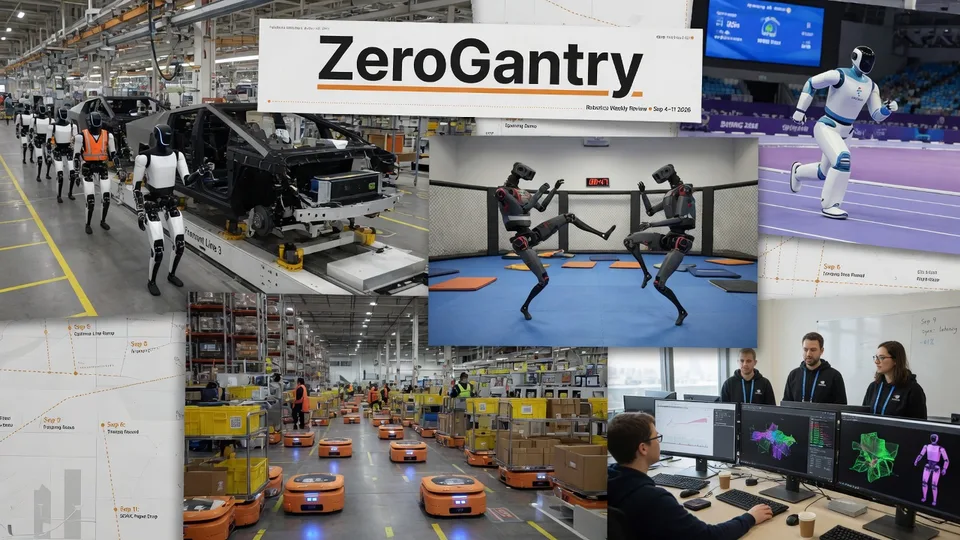
Humanoid robotics surged forward this week with breakthroughs in control systems, record-breaking athletic performances, and major production scaling signals from Tesla and Figure AI. Industrial deployments at Amazon and ongoing maintenance economics highlighted the shift from prototypes to real-world operations.
ZeroGantry analysis
The dominant trend was rapid maturation of humanoid control and scaling signals, with NVIDIA and Unitree pushing generalist autonomy while Tesla and Figure locked in hardware and compute commitments. Surprising was the concrete maintenance cost data surfacing alongside production orders, highlighting that TCO discussions are no longer theoretical. Next week, monitor whether control advances translate into measurable deployment gains or if supply-chain realities create friction.
Lede The week of September 4–11, 2026, underscored a pivotal transition in robotics: from specialized demonstrations to versatile, scalable systems ready for broader deployment. Humanoid platforms dominated headlines with new AI controllers, autonomous physical interactions, and competitive benchmarks, while supply chain moves and fleet expansions signaled accelerating commercialization. At the same time, service and maintenance realities for both legacy industrial arms and next-generation humanoids reminded the industry that operational costs will shape adoption as much as technical prowess.
Humanoid Control and Autonomy Advances On Friday, September 11, NVIDIA researchers unveiled SONIC, a unified controller trained on over 100 million motion frames that enables humanoids to perform diverse whole-body tasks from varied inputs like VR, video, or vision-language-action models without task-specific retraining. Tested initially on the Unitree G1, the system points toward deeper integration with Isaac GR00T, potentially reducing the fragmentation that has slowed humanoid adoption. This development connects directly to earlier in the week when, on Tuesday, September 8, Unitree released UnifoLM-X2-1.0, a real-time world model allowing the G1 to spar autonomously against humans, predicting interactions and executing strikes without teleoperation or pre-scripted sequences.
These control innovations matter because they address the core limitation of current humanoids: brittleness outside narrow environments. SONIC’s scale of training data suggests a path toward generalist policies that could transfer across platforms, while Unitree’s demo highlights immediate applicability in dynamic, contact-rich scenarios. Together, they illustrate how foundation-model approaches are maturing beyond simulation into physical robustness, setting the stage for humanoids to move from lab curiosities to collaborative workers.
Competitive Benchmarks and Global Showdowns Tuesday, September 8, also brought news from the World Humanoid Robot Games in Beijing, where the Tiangong Ultra from the Beijing Humanoid Robot Innovation Center clocked an 8.64-second 100-meter dash, establishing a new benchmark for speed. Shanghai-based AGIBOT topped the medal table with 46 medals, excelling particularly in manipulation and scenario-based tasks that test practical utility over raw athleticism. These events serve as public stress tests, revealing not only hardware limits but also the effectiveness of integrated control stacks under pressure.
The Beijing Games highlight a growing international race, with Chinese teams leveraging domestic supply chains and rapid iteration cycles to challenge Western frontrunners. Speed records like Tiangong’s attract attention, yet AGIBOT’s medal dominance in manipulation underscores that the real competitive edge lies in reliable task completion across varied conditions. For the industry, these public competitions accelerate shared standards and expose integration gaps that private demos often conceal.
Production Scaling and Supply Chain Momentum Midweek developments emphasized hardware ramp-up. On Wednesday, September 9, reports emerged that Tesla had placed bulk component orders sufficient for roughly 5,000 Optimus units, following summer commissioning of its Fremont production line and aligning with internal targets of 10,000–20,000 units by year-end. This procurement wave signals confidence in actuator and sensor supply chains despite earlier bottlenecks. Complementing this, on Sunday, September 6, Figure AI secured a multi-year partnership with Nscale for up to 100,000 NVIDIA Vera Rubin GPUs under an initial $3.5 billion commitment that could exceed $6 billion, with training of next-generation Helix models slated to begin in the second half of 2027 at a new Barstow, Texas facility.
These moves reveal parallel strategies: Tesla betting on vertical integration and volume manufacturing at existing auto facilities, while Figure pursues massive cloud-scale compute to push model capabilities ahead of hardware deployment. The Fremont orders suggest near-term production realism, whereas Figure’s GPU deal underscores that data and training infrastructure remain the longer-term constraint. Both approaches will be tested by how quickly they can translate compute and components into reliable field performance.
Industrial Fleet Growth and Service Realities Beyond humanoids, established automation continued its steady expansion. On Thursday, September 10, Amazon announced further rollout of its Proteus autonomous mobile robot fleet to additional North American fulfillment centers, with the robots now capable of handling items up to 300 pounds and targeting the heaviest 20 percent of SKUs to reduce manual strain. This pragmatic deployment focuses on high-impact pain points rather than flashy new platforms.
Maintenance economics surfaced as a critical counterpoint. Wednesday’s dispatch on Fanuc robots detailed annual preventive maintenance costs of $2,000–$8,000 per unit, with Ohio operators navigating authorized providers versus independents amid gearbox and reducer repair expenses that drive significant downtime. Monday’s analysis of Tesla Optimus projected $1,500–$4,000 yearly for light use and up to $15,000 in factory settings, dominated by 28-plus actuators priced at $1,350–$2,700 each plus periodic battery replacements. These figures remind stakeholders that total cost of ownership extends far beyond initial purchase, influencing everything from leasing models to insurance and workforce planning.
What to Watch Next Week Next week’s focus will likely fall on integration milestones—how NVIDIA’s SONIC performs in extended Isaac GR00T trials, whether Tesla’s Fremont line begins visible output beyond component orders, and early indicators from Figure’s GPU infrastructure buildout. Watch also for any follow-on announcements from the Beijing Games participants and Amazon’s continued Proteus scaling met
Sources
- https://nvlabs.github.io/GEAR-SONIC/
- https://humanoid.guide/nvidia-trains-sonic-for-general-humanoid-motion-control/
- https://arxiv.org/abs/2511.07820
- https://github.com/NVlabs/GR00T-WholeBodyControl
- https://robotwale.com/news/amazon-proteus-fleet-scaled
- https://www.aboutamazon.com/news/operations/amazon-proteus-robot-europe-investment-employee-support
- https://www.cnet.com/tech/amid-amazons-robot-surge-proteus-charts-a-new-path-forward/
- https://www.blackscarab.ai/insights/amazon-proteus-autonomous-mobile-warehouse-robot-guide
Topics
Related articles
- Agility Digit 5 Launch Targets Barrier-Free Warehouse Work — Agility Robotics launched Digit 5 on September 15, 2026, its first humanoid designed for safe close-proximity work alongside humans in warehouses and factories
- NVIDIA SONIC Scales Humanoid Control Beyond Task-Specific Limits — NVIDIA researchers released SONIC, a single controller trained on over 100 million motion frames that lets humanoids handle diverse whole-body movements from VR
- Tiangong Ultra 8.64s Record and AGIBOT Medals at 2026 Beijing Games — Tiangong Ultra from Beijing Humanoid Robot Innovation Center ran the 100m in 8.64 seconds at the World Humanoid Robot Games in Beijing. Shanghai-based AGIBOT le
- Robotics Week in Review: Aug 28–Sep 4, 2026 — This week highlighted accelerating real-world humanoid deployments and big-tech hardware entries alongside production hurdles and software pivots. Partnerships