Editorial · AI-derived
NVIDIA SONIC Scales Humanoid Control Beyond Task-Specific Limits
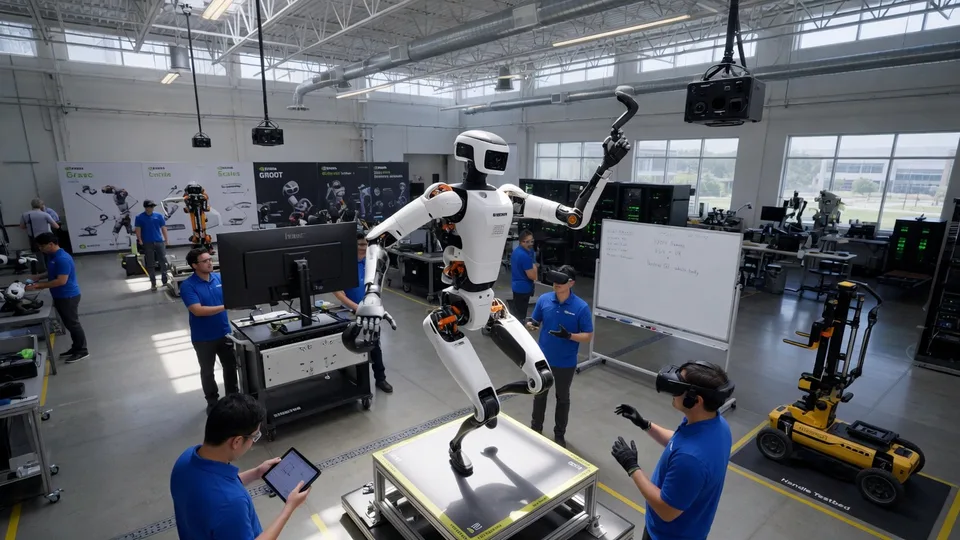
NVIDIA researchers released SONIC, a single controller trained on over 100 million motion frames that lets humanoids handle diverse whole-body movements from VR, video, or VLA inputs without retraining. It was tested on the Unitree G1 and is slated for deeper Isaac GR00T integration.
ZeroGantry analysis
SONIC’s 42M-parameter scale on 21k GPU-hours and 700 hours of MoCap data delivers a 99.2% real-world success rate on the Unitree G1, cutting the per-skill engineering tax that currently multiplies fleet deployment costs. If GR00T integration holds, operators could shift from maintaining dozens of controllers to updating one policy stack, but power and thermal overhead on edge hardware plus untested 24/7 robustness remain open variables. Ship the open checkpoints for rapid community iteration; watch the first sustained warehouse pilots before declaring the controller layer solved.
EDITORIAL / OPINION
NVIDIA’s latest humanoid research paper, published in Science Robotics on August 13, 2026, introduces SONIC as a scaled motion-tracking foundation model. The approach trains one policy on more than 100 million frames drawn from roughly 700 hours of motion-capture data rather than hand-crafting separate controllers for walking, jumping, or grasping. Evaluated in simulation and on physical Unitree G1 hardware, SONIC reached 99.2 percent success across 123 real-world motion sequences. The work directly addresses the fragmentation that has kept most humanoid deployments tethered to narrow skill sets.
Scaling Laws Applied to Robot Bodies
The SONIC team scaled three axes simultaneously: model capacity from 1.2 million to 42 million parameters, dataset size to 100 million-plus frames, and training compute reaching 21,000 GPU hours across up to 128 GPUs. Performance improved steadily with each increase, mirroring the pattern seen in large language models. Unlike earlier humanoid controllers limited to a handful of behaviors, the resulting policy generalizes to unseen motions and accepts inputs from VR teleoperation, video retargeting, and vision-language-action models through a shared token space. This unified interface eliminates the need for per-skill retraining that currently inflates development timelines and hardware-specific tuning costs.
Industry observers note that motion tracking as the core training objective removes the manual reward engineering bottleneck that has slowed reinforcement-learning approaches. A real-time kinematic planner converts tracked references into executable trajectories in under five milliseconds on laptop hardware, bridging high-level commands to low-level joint control. When paired with GR00T-style reasoning models, SONIC is positioned as the fast “System 1” motor layer beneath slower planning stacks.
Hardware Reality Check on Unitree G1
Deployment results on the Unitree G1 show strong zero-shot transfer: 100 percent success on 50 diverse trajectories in one reported set and 99.2 percent across 123 sequences in another. Tasks included running, jumping, crawling, and coordinated loco-manipulation such as foot-pedal trash-can opening or soda-can binning. These numbers come from controlled lab conditions; real factory floors introduce dust, variable lighting, and unexpected contacts that the current evaluations do not fully stress. Still, the single-policy success rate beats the typical pattern of maintaining separate controllers whose individual failure modes compound during handoffs.
Serviceability implications are immediate. A factory running multiple humanoids no longer needs separate firmware branches or calibration routines for each motion class. Over-the-air policy updates could propagate improvements across an entire fleet rather than requiring per-task validation cycles. That said, the 42-million-parameter model still demands GPU-class inference hardware on the robot or edge compute, raising questions about power draw and thermal management in mobile platforms.
GR00T Integration and the Next Software Layer
NVIDIA’s public roadmap calls for tighter coupling between SONIC and the Isaac GR00T family. Recent GitHub updates to the GR00T-WholeBodyControl repository already include VLA fine-tuning workflows that collect demonstrations via SONIC teleoperation, fine-tune GR00T N1.7, and deploy the resulting policy through the SONIC inference stack. This separation of concerns—SONIC handling coordinated whole-body execution while GR00T supplies task-level reasoning—mirrors the “motor cortex plus prefrontal cortex” analogy researchers have used. If successful, the stack could let a single high-level instruction trigger complex sequences without engineers authoring new low-level controllers.
Geopolitically, open release of model checkpoints and C++ deployment code on Hugging Face and GitHub lowers the barrier for labs outside the United States. Chinese humanoid programs already deploy Unitree G1 units at scale; access to a generalist controller could accelerate their iteration cycles. At the same time, NVIDIA retains control over the underlying Isaac Sim and CUDA stack, preserving a software moat even as weights circulate.
Labor and Supply-Chain Angles
Widespread adoption of a unified controller would shift labor economics away from specialized robotics programmers toward data curation and teleoperation teams. Collecting additional motion-capture hours or VR demonstrations becomes the new bottleneck rather than reward-function design. Supply chains for motion-capture suits and high-fidelity reference data may see increased demand. Conversely, the reduction in per-skill engineering hours could compress the cost curve for deploying fleets in warehousing and light manufacturing, where current humanoid pilots remain limited to narrow pick-and-place loops.
Counter-arguments persist. Some researchers argue that pure motion tracking inherits human motion biases and may underperform on tasks requiring super-human precision or force profiles. Others point out that sim-to-real gaps remain; the reported 99-plus percent figures were achieved after extensive domain randomization that may not capture every factory variable. Long-term robustness under continuous operation—battery degradation, joint wear, sensor drift—has yet to be quantified in published results.
Watch the Integration Milestones
The immediate signal to track is whether GR00T-SONIC pairings move from research demos to sustained warehouse pilots within the next 12 months. Success metrics should include not just success rate but also mean time between policy interventions and total cost of ownership versus fleets of task-specific arms or earlier decoupled controllers. If the unified stack delivers on its generalization claims, the industry could see a rapid consolidation around fewer, more capable low-level policies. If gaps emerge in edge cases or compute overhead, expect continued
Sources
Topics
Related articles
- Agility Digit 5 Launch Targets Barrier-Free Warehouse Work — Agility Robotics launched Digit 5 on September 15, 2026, its first humanoid designed for safe close-proximity work alongside humans in warehouses and factories
- Robotics Week in Review: Sep 4–Sep 11, 2026 — Humanoid robotics surged forward this week with breakthroughs in control systems, record-breaking athletic performances, and major production scaling signals fr
- Tiangong Ultra 8.64s Record and AGIBOT Medals at 2026 Beijing Games — Tiangong Ultra from Beijing Humanoid Robot Innovation Center ran the 100m in 8.64 seconds at the World Humanoid Robot Games in Beijing. Shanghai-based AGIBOT le
- Robotics Week in Review: Aug 28–Sep 4, 2026 — This week highlighted accelerating real-world humanoid deployments and big-tech hardware entries alongside production hurdles and software pivots. Partnerships