Editorial · AI-derived
Robotics Week in Review: Sep 18–Sep 25, 2026
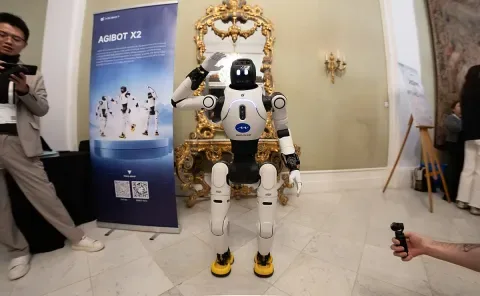
This week showcased explosive humanoid deployments in entertainment, services, and homes alongside major AI training leaps. AGIBOT hit 300 robots at Chimelong while Figure AI and Skild AI delivered impressive zero-shot and self-play results.
ZeroGantry analysis
The dominant trend was the rapid transition of humanoids from pilots to paid, multi-hundred-unit operations, with AI generalization gains removing previous barriers. The surprise was the speed of consumer deliveries and service-subscription models appearing alongside industrial pilots. Next week we will watch for early utilization data from these fleets and whether European self-improving approaches like Vesoma’s gain traction against data-heavy methods.
Lede The robotics sector accelerated its shift from lab prototypes to operational fleets this week, with September 18–25, 2026, delivering concrete evidence that embodied AI is scaling across commercial venues, factories, and even consumer households. Deployments reached hundreds of units in a single park, service subscriptions launched for rapid robot repairs, and foundation models achieved 56% zero-shot success in unseen homes. Automotive players and new European entrants added momentum, while NVIDIA’s software update signaled deeper factory integration. The through-line: real-world data loops are tightening, turning yesterday’s demos into today’s revenue-generating operations.
Large-Scale Commercial and Consumer Deployments Accelerate On Friday, September 25, AGIBOT and Chimelong Group marked a milestone with the first phase of a massive embodied AI rollout at Chimelong Spaceship Park in Zhuhai, China. More than 300 AGIBOT robots now handle entertainment, education, guidance, retail, and hotel services, coinciding with delivery of the company’s 20,000th production A3 Ultra unit. This deployment illustrates how theme parks and hospitality venues are becoming proving grounds for fleets that combine mobility, interaction, and task execution at scale.
Monday’s news from UBTECH added a consumer dimension. The company began shipping its first UWORLD U1 full-size emotional companion humanoids to Chinese buyers after securing 13,000 pre-orders. The move tests whether household-scale humanoids can transition from novelty to everyday presence in 2026, with early adopters providing the interaction data needed for rapid iteration. Together, the AGIBOT and UBTECH stories show parallel tracks: one optimizing for high-traffic public spaces, the other for intimate domestic environments.
Thursday brought a service-layer innovation from GMO AI & Robotics. The Tokyo-based firm launched a mobile humanoid “ambulance” service that reaches sites within one to two hours and swaps in spare robots under a 70,000 yen monthly subscription. Initial targets include JAL Ground Service at Haneda Airport, where downtime reduction is critical. This model reframes robot ownership as a managed service, lowering barriers for operators wary of maintenance complexity.
AI Foundation Models Deliver Breakthrough Generalization Saturday’s release from Figure AI underscored how quickly generalization is improving. Helix 2.5, pretrained on the Index dataset, enabled Figure 03 humanoids to tidy rooms, fold towels, and make beds across 30 previously unseen Bay Area homes with zero additional data or fine-tuning. Full-task success jumped from 9% to 56%, a leap that directly addresses the data scarcity bottleneck that has slowed home robotics. The result validates the strategy of training on diverse, high-quality priors rather than narrow task-specific datasets.
On Friday, Skild AI revealed that its S1 foundation model acquired complex humanoid soccer behaviors after 140 years of simulated self-play inside NVIDIA Isaac Sim. The policy transferred zero-shot to a Unitree G1, enabling real-world matches against humans and other robots. The training pipeline—starting with basic drills before optimizing solely for goal scoring—demonstrates that self-play can produce emergent athletic skills without human teleoperation data, a promising route for dynamic, unstructured environments.
Tuesday’s NVIDIA Isaac ROS 5.0 update ties these advances together. The release added agentic AI workflows, improved FoundationPose tracking, and standalone pick-and-place skills optimized for GR00T on Jetson platforms. Magna is already deploying the stack for manufacturing automation, showing that the same simulation-to-real techniques powering soccer skills are migrating to factory floors where reliability and speed matter most.
Automotive and Industrial Pilots Deepen Integration Tuesday updates from Mercedes-Benz highlighted sustained progress with Apptronik Apollo humanoids at the Digital Factory Campus in Berlin-Marienfelde and the Kecskemét plant in Hungary. The robots perform intralogistics, kitting, and inspection tasks, leveraging teleoperation and AR training integrated with the MO360 digital ecosystem. The pilots, running since 2024 with 2025 equity backing, illustrate how legacy manufacturers are embedding humanoids into existing production systems rather than treating them as isolated experiments.
Thursday’s leak of Tesla Optimus Gen 3 design renders from the Android app 4.61.0 offered the first detailed look at production-intent hardware, including enclosed joints and matte black shin fairings. The timing aligns with anticipated factory deployments, suggesting Tesla is iterating toward a design optimized for high-volume manufacturing and serviceability.
Also on Tuesday, XPENG released video of its IRON humanoid demonstrating memory, multilingual conversation, and coordinated head-waist-leg movements in a simulated car dealership. The robot tracked speakers, recalled customer preferences across multiple testers, and switched between Mandarin and English—skills directly relevant to retail and service roles within XPENG’s own ecosystem.
New Entrants and European Momentum Build Thursday’s emergence of Vesoma from stealth added a distinctly European perspective. The Munich and Limassol startup, now over 60 people, unveiled a humanoid that learns tasks through its own physical interactions instead of human demonstrations. Early prototypes have already demonstrated walking, with manufacturing and logistics customers targeted. Vesoma’s self-improving approach contrasts with demonstration-heavy methods and could reduce the data-collection burden that currently limits rapid adaptation.
What to Watch Next Week Next week’s focus will likely center on whether the week’s deployment momentum translates into measurable ROI metrics from operators, and whether consumer early-adopter feedback from UBTECH begins shaping firmware updates. Watch for further
Sources
- https://theaiinsider.tech/2026/09/24/agitbot-deploys-more-than-300-robots-at-chinas-chimelong-theme-park/
- https://www.koreaherald.com/article/10884238
- https://www.globaltimes.cn/page/202609/1370949.shtml
- https://www.humanoidsdaily.com/news/agibot-chimelong-theme-park-300-robots
- https://finance.biggo.com/news/3fdeb1db-1521-48f5-8061-ea49f56bad6d
- https://www.skild.ai/blogs/physical-self-play
- https://www.humanoidsdaily.com/news/skild-ai-s1-learns-soccer-through-140-years-of-simulated-self-play
- https://cryptobriefing.com/skild-ai-robot-football-self-play/
Topics
Related articles
- AGIBOT Chimelong Deployment Hits 300 Robots, Delivers 20,000th A3 Ultra — AGIBOT and Chimelong Group launched the first phase of a large-scale embodied AI deployment at Chimelong Spaceship Park in Zhuhai, China, on September 24, 2026.
- NVIDIA Isaac ROS 5.0 Pushes Agentic Robotics Toward Factory Floors — NVIDIA released Isaac ROS 5.0 on September 22, 2026, adding agentic AI workflows, FoundationPose for faster tracking, and standalone pick-and-place skills. The
- Robotics Week in Review: Sep 11–Sep 18, 2026 — Humanoid hardware upgrades, factory-scale deployment plans, and new service infrastructure dominated robotics news this week. Companies like Toyota, Unitree, Ag
- Toyota LBM Robots: ELEY's 400,000-Unit Factory Push from 2028 — Toyota announced plans to invest ¥1 trillion annually from 2028 to deploy around 400,000 LBM-powered robots across 60 global factories and supplier sites. The w