Editorial · AI-derived
Robotics Week in Review: Sep 11–Sep 18, 2026
Humanoid hardware upgrades, factory-scale deployment plans, and new service infrastructure dominated robotics news this week. Companies like Toyota, Unitree, Agility, and 1X advanced real-world applications while AI models and elder-care platforms gained traction.
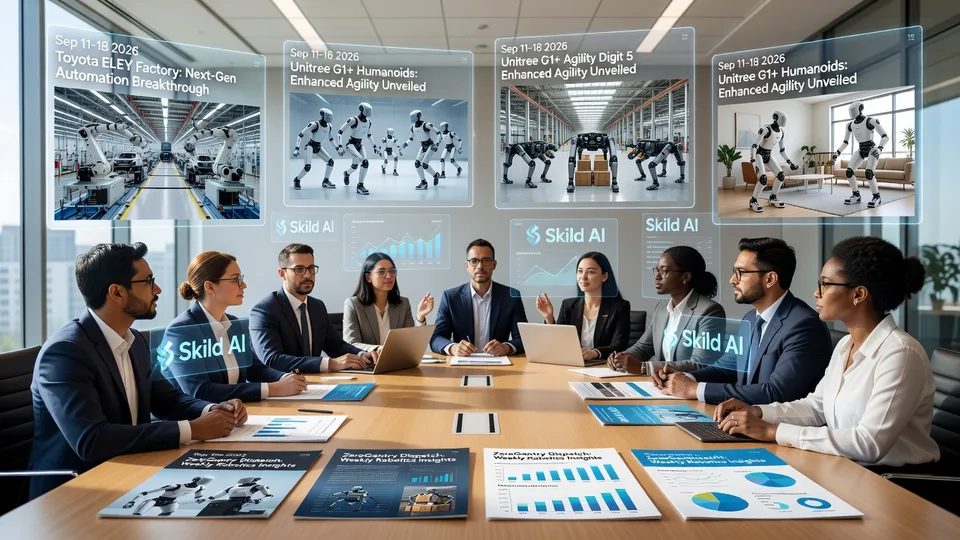
ZeroGantry analysis
The dominant trend was the convergence of refined humanoid hardware with scalable AI and dedicated service infrastructure, moving the industry decisively from pilots to fleet-level planning. Skild AI’s rapid $100M ARR run rate surprised with its speed, while Toyota’s ¥1T commitment and GMO’s ambulance van showed how volume and support are now co-equal priorities. Next week, monitor trial data releases and any actuator cost transparency that could accelerate or slow enterprise purchases.
Lede
The week of September 11–18, 2026, showcased accelerating momentum in humanoid robotics, with hardware refinements, massive industrial commitments, and emerging support ecosystems taking center stage. From Toyota’s trillion-yen factory automation push to Unitree’s affordable G1+ upgrade and 1X’s home trials, the industry shifted from prototypes to operational realities. Service innovations like GMO’s robot ambulance and Boston Dynamics’ actuator focus addressed practical deployment hurdles, while AI foundation models and specialized care robots rounded out a week of tangible progress.
Humanoid Hardware Refinements Drive Accessibility
On Wednesday, September 16, Unitree unveiled the G1+ with a 2-DOF neck, 110% torque boost, and enhanced sensors while maintaining the $15,000 price point and 35 kg frame of its predecessor. This iteration targets broader adoption by improving dexterity and thermal performance without sacrificing battery life. The move signals a maturing consumer-grade humanoid market where incremental motor and sensing upgrades can unlock new tasks in logistics and research.
Tuesday’s launch of Agility Robotics’ Digit 5 emphasized barrier-free warehouse collaboration, building on 65,000+ hours of prior deployments at Amazon, GXO, Schaeffler, and Toyota Canada sites. The design prioritizes safe human proximity, removing physical cages that have limited earlier automation. These hardware evolutions connect directly to Thursday’s Boston Dynamics Atlas updates, where electric actuators and sub-three-minute battery swaps aim to improve total cost of ownership during 2026 Hyundai and DeepMind rollouts, even as exact MTBF figures remain guarded.
Meanwhile, Monday’s announcement of 1X’s NEO Beta Household Trial Programme introduced real-home testing across select global households for three-month cycles. This hands-on data collection on safety and daily utility bridges the gap between factory-focused humanoids and domestic applications, highlighting how this week’s hardware tweaks collectively lower barriers for both industrial and residential use.
Industrial Scale and AI Foundations Accelerate Deployment
Friday’s Toyota announcement of ¥1 trillion annual investments starting in 2028 to field 400,000 LBM-powered ELEY robots across 60 global factories and supplier sites represents the week’s most ambitious scaling vision. The wheeled platforms learn tasks such as T-shirt folding via human demonstration with centralized data sharing, positioning Toyota as a leader in high-volume, learn-from-demonstration automation. This commitment underscores how hardware and learning systems are converging to make factory-wide humanoid fleets economically viable.
Saturday’s report on Skild AI’s S1 model reaching a $100 million ARR run rate just ten months after initial commercial deployments further illustrates the enabling role of foundation models. The in-context learning system allows robots to perform unseen tasks up to ten minutes long from a single video demo, already powering operations at over 60 sites including Foxconn and Mitsui & Co. Together, Toyota’s volume targets and Skild’s rapid revenue growth point to an industry where AI accelerates the path from pilot to production at unprecedented speed.
Service Infrastructure Emerges as Critical Enabler
Thursday’s debut of GMO Internet Group’s humanoid robot ambulance van in Tokyo provides a practical response to downtime concerns for Unitree and similar platforms. The vehicle carries engineers, spares, diagnostics, and replacement units, minimizing operational interruptions during on-site repairs—the first such dedicated service fleet in Japan. This development pairs with Boston Dynamics Atlas coverage on the same day, which detailed four-hour battery runtimes and modular Hyundai Mobis actuators designed for field swaps, even as full TCO and service plan details stay limited.
These service-focused stories reveal a maturing ecosystem where hardware sales alone are insufficient; robust maintenance networks and rapid-response capabilities will determine which platforms achieve sustained adoption. The week’s emphasis on real-world logistics for humanoids suggests that 2026 will be remembered as the year support infrastructure began catching up to deployment ambitions.
Specialized Applications Expand Beyond Factories
Monday’s IFA 2026 launches by Tuya Smart and OlloBot introduced elder-care platforms tailored for aging populations. Tuya’s wheeled Doova offers fall detection, LLM-driven conversation, and smart-home integration for seniors living alone, while OlloBot’s OlloNi SS1 brings emotional AI for sustained family interaction across Europe. These platforms demonstrate how robotics is moving into sensitive social domains with features that prioritize companionship alongside safety.
Sunday’s ICE sole-source procurement forecast for $1–2 million worth of Boston Dynamics Spot quadrupeds for remote inspection and hazard assessment in high-risk public-safety scenarios adds another layer of specialized utility. The deployments aim to shield officers from danger, illustrating robotics’ expanding role in government operations beyond commercial logistics.
What to Watch Next Week
Expect further details on Toyota’s ELEY rollout timelines and potential cost disclosures from Boston Dynamics Atlas programs. Watch for early feedback from 1X NEO home trials and any new Skild AI site announcements that could push its revenue trajectory even higher. Elder-care robot regulatory discussions at upcoming European events may also shape adoption curves for platforms like Doova and OlloNi SS1.
Sources
- https://asia.nikkei.com/business/technology/toyota-to-deploy-400-000-robots-to-work-alongside-factory-staff
- https://www.automotiveworld.com/news/toyota-plans-to-deploy-400000-factory-robots-from-2028/
- https://www.reuters.com/business/autos-transportation/toyota-estimates-factory-automation-could-cost-64-billion-per-year-2028-2026-09-18/
- https://www.therundown.ai/news/gmo-humanoid-ambulance-robot-maintenance
- https://www.euronews.com/2026/09/11/japanese-company-unveils-robot-ambulance-for-on-site-humanoid-repairs
- https://creedtec.online/the-robot-maintenance-cost-model-every-procurement-team-gets-wrong/
- https://techorange.com/2026/09/10/cost-of-humanoid-robot-factory-worker-agility-robotics-digit-v5/
- https://bostondynamics.com/blog/boston-dynamics-unveils-new-atlas-robot-to-revolutionize-industry/
Topics
Related articles
- Toyota LBM Robots: ELEY's 400,000-Unit Factory Push from 2028 — Toyota announced plans to invest ¥1 trillion annually from 2028 to deploy around 400,000 LBM-powered robots across 60 global factories and supplier sites. The w
- Agility Digit 5 Launch Targets Barrier-Free Warehouse Work — Agility Robotics launched Digit 5 on September 15, 2026, its first humanoid designed for safe close-proximity work alongside humans in warehouses and factories
- Robotics Week in Review: Sep 4–Sep 11, 2026 — Humanoid robotics surged forward this week with breakthroughs in control systems, record-breaking athletic performances, and major production scaling signals fr
- NVIDIA SONIC Scales Humanoid Control Beyond Task-Specific Limits — NVIDIA researchers released SONIC, a single controller trained on over 100 million motion frames that lets humanoids handle diverse whole-body movements from VR