Editorial · AI-derived
Robotics Week in Review: Oct 16–Oct 23, 2026
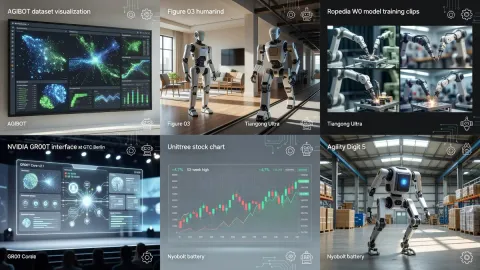
This week highlighted rapid progress in embodied AI models, cross-embodiment world models, and hardware optimizations alongside China's policy push boosting Unitree. Humanoid comparisons between Figure 03 and Tiangong Ultra underscored diverging regional strategies in capabilities and costs.
ZeroGantry analysis
The dominant trend was the convergence of open AI tools with policy and hardware enablers, particularly China's embodied AI guidance lifting Unitree while Western model releases like GR00T 1.7 and Ropedia W0 target generalization. Surprises included the speed of battery optimization for 20-hour operations and the explicit regional capability split between Figure and Tiangong. Next week watch earnings reactions and early integration results from the new datasets and models, which could accelerate commercial pilots.
Lede The robotics sector accelerated this week with foundational AI releases, policy tailwinds from China, and practical hardware gains that signal a shift from research prototypes toward scalable deployment. From open datasets sharpening decision-making to battery tech enabling near-continuous warehouse operation, the October 16–23 period revealed interconnected advances in software, hardware, and market forces. ZeroGantry sees these developments as evidence that 2026 is the year when general-purpose humanoids move from demos to differentiated commercial bets.
AI Models and Datasets Fueling Adaptive Robots On Friday, October 23, AGIBOT unveiled its AGIBOT WORLD 2026 Release 4 physical reasoning dataset on Hugging Face, targeting robots that must adjust actions amid changing environments during tasks like restocking shelves or searching cluttered spaces. This open resource directly informs the company's upcoming agent framework and foundation model, emphasizing real-world variability over static training. The release connects to broader industry momentum around data quality for robust autonomy.
Thursday's Ropedia W0 open release further amplified this trend. The egocentric world model, trained on 13,000 hours of mixed human and robot video, unifies camera poses and skeletons across embodiments including the Unitree G1 humanoid. It outperforms NVIDIA Cosmos 3 in zero-shot and post-training benchmarks, enabling better future-video prediction for loco-manipulation. These tools collectively lower barriers for developers building adaptable systems.
NVIDIA's Wednesday, October 21, GR00T 1.7 launch at GTC Berlin reinforced the software layer. The 3-billion-parameter VLA model, paired with the Agile ONE SN reference platform, delivers Jetson Thor inference at 25 Hz and Isaac Lab 3.0 updates. Together with an open runtime, these elements compress the data-to-deployment pipeline for general-purpose humanoids. ZeroGantry notes that the week's model releases form a virtuous cycle: better datasets train stronger world models, which in turn accelerate hardware integration.
Humanoid Platforms Diverge by Region and Use Case Friday's comparison of Figure 03 versus Tiangong Ultra highlighted strategic splits. Figure 03 leverages Helix AI for 56% zero-shot success in unseen home environments, targeting mixed domestic and factory roles. Tiangong Ultra emphasizes raw speed and endurance, evidenced by its 8.64-second 100m record at the Beijing games. Buyers now weigh RaaS pricing models against aggressive Chinese hardware cost advantages for high-volume orders.
This divergence matters because it reflects differing priorities: Western developers focus on generalization and safety in unstructured spaces, while Chinese platforms optimize for throughput and affordability. The week's stories suggest these paths will coexist rather than converge quickly, creating segmented markets.
Policy and Market Momentum in China Tuesday's Unitree stock surge of 16.15% to ¥495.92, lifting market cap above 200 billion yuan, stemmed directly from October 19 guidance by nine Chinese government departments promoting embodied AI in household services and logistics. New humanoid standards and the company's October 22 conference ahead of October 29 earnings amplified investor enthusiasm. The policy explicitly targets real-world applications, providing regulatory clarity that accelerates domestic scaling.
ZeroGantry views this as a pivotal differentiator. While Western firms navigate fragmented incentives, China's coordinated approach could compress timelines for volume deployment in logistics and services, pressuring global competitors on price and speed.
Hardware Breakthroughs for Operational Endurance Monday's announcement that Agility Robotics selected Nyobolt battery technology for the Digit 5 humanoid targets 90 minutes of runtime from a nine-minute charge, supporting over 20 hours of daily warehouse shifts. This addresses a core deployment barrier: downtime in high-utilization environments. The October 15 selection aligns with broader efforts to make humanoids viable for multi-shift operations without extensive infrastructure changes.
These hardware gains complement the AI advances earlier in the week. Reliable energy systems allow the new models and datasets to demonstrate value in continuous settings rather than short demos.
What to Watch Next Week Expect follow-through on NVIDIA's GTC announcements, potential Unitree earnings reactions, and early benchmarks from adopters testing Ropedia W0 or AGIBOT datasets. Watch for pricing updates in the Figure-Tiangong debate and any additional Chinese policy details that could reshape supply chains. The interplay between open models and closed hardware platforms will likely define the coming month's competitive landscape.
Sources
- https://www.unite.ai/agibot-world-release-4-physical-reasoning-dataset/
- https://www.humanoidsdaily.com/news/agibot-world-release-4-physical-reasoning-dataset
- https://finance.sina.com.cn/tjhz/2026-10-22/doc-iniwavxi5174924.shtml
- https://roboticsandautomationnews.com/2026/10/19/the-robot-group-opens-uk-enquiries-for-x-humanoid-robots/106030/
- https://www.insidedeeptech.com/humanoid-robots-2026-full-guide/
- https://humanoidmetric.com/
- https://hellomarvisaitoday.com/articles/47b3d9b3-30ae-4939-ba64-3feaae63f8bb
- https://theresarobotforthat.com/humanoid-reality-index/tiangong-ultra/
Topics
Related articles
- AGIBOT Dataset Sharpens Robot Decision-Making in Shifting Scenes — AGIBOT released its AGIBOT WORLD 2026 Release 4 physical reasoning dataset on October 22. The open Hugging Face resource trains robots to adapt actions to chang
- Robotics Week in Review: Oct 9–Oct 16, 2026 — AI training breakthroughs and record funding dominated robotics this week, as models like Gemini 4 Argon slashed humanoid learning times while NVIDIA and others
- Gemini 4 Argon Cuts Apptronik Apollo Cornhole Training to Hours — Google DeepMind's Gemini 4 Argon model analyzed a human cornhole video on October 13, 2026, built a MuJoCo simulation, and trained an Apptronik Apollo 2 humanoi
- Google DeepMind Cambridge Lab Expands Gemini Robotics Hardware — Google DeepMind is building a new robotics lab in the Cambridge area to house its growing hardware team. Aaron Saunders, who joined from Boston Dynamics in late