Editorial · AI-derived
Robotics Week in Review: Oct 9–Oct 16, 2026
AI training breakthroughs and record funding dominated robotics this week, as models like Gemini 4 Argon slashed humanoid learning times while NVIDIA and others poured billions into Figure AI and Skild AI. Hardware advances at Boston Dynamics and Tesla highlighted both progress and persistent supply hurdles.
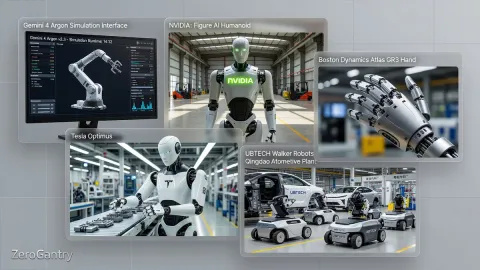
ZeroGantry analysis
The dominant trend this week was the tight coupling of AI training efficiency gains with unprecedented funding, creating a flywheel that is rapidly advancing humanoids beyond research. Surprising was the simultaneous visibility of supply-chain vulnerabilities at Tesla alongside polished hardware reveals like the Atlas GR3 hand, reminding the industry that software progress outpaces hardware execution. Next week we will watch whether the NVIDIA–Figure talks close and how Physical Intelligence’s API beta performs in real fleet adaptations.
Lede
The week of October 9–16, 2026, underscored a pivotal acceleration in embodied AI, where simulation-driven training and massive capital infusions are converging to push humanoids from lab demos toward factory floors. From Google DeepMind’s rapid cornhole mastery with Apptronik Apollo to NVIDIA’s potential $1 billion stake in Figure AI, the narrative centered on scaling intelligence and hardware in tandem. Supply-chain friction at Tesla and new lab expansions at DeepMind revealed the real-world complexities behind the hype, while partnerships like UBTECH with FAW-Volkswagen signaled tangible logistics deployments.
AI Training Breakthroughs Shrink Development Cycles
On Friday, October 16, Google DeepMind’s Gemini 4 Argon model demonstrated how video-to-simulation pipelines can compress weeks of manual programming into hours. The system ingested a human cornhole video on October 13, generated a MuJoCo environment, and trained an Apptronik Apollo 2 humanoid to achieve seven consecutive successful throws in physical tests, earning an 87 percent score on the ERQA embodied reasoning benchmark. This Video-to-Sim-to-Real approach directly addresses the data bottleneck that has long plagued humanoid developers.
Thursday’s beta launch of Physical Intelligence’s Pi API further amplifies this trend. Developers can now fine-tune π0 and π0.5 models on managed compute and deploy inference via hosted gateways, reducing custom task adaptation from weeks to days. The service explicitly targets fleets such as Figure 03 and Tiangong Ultra, illustrating how foundation-model APIs are democratizing access to advanced control policies. Together, these developments suggest that 2027 could see exponential growth in task-specific humanoid deployments as the simulation-to-reality gap narrows.
Record Valuations Fuel Humanoid Ambitions
Capital markets signaled strong conviction in humanoid platforms this week. On Friday, October 16, NVIDIA entered talks for an additional $1 billion investment in Figure AI at a $38 billion pre-money valuation, expanding its existing stake to support large-scale compute for advanced control models. Just one day earlier, Skild AI closed a $1.4 billion Series C led by SoftBank, pushing its valuation above $14 billion to scale its S1 foundation model, which teaches long-horizon tasks from single video demonstrations.
These rounds are not isolated; they reflect a broader pattern where compute providers and investors are betting that data-efficient training will unlock commercial viability. The NVIDIA–Figure linkage, in particular, positions GPU infrastructure as the backbone for next-generation humanoid fleets, while Skild’s video-demonstration approach complements the simulation methods highlighted by DeepMind. Analysts at ZeroGantry view this capital surge as validation that 2026 marks the inflection point from research prototypes to pre-commercial scaling.
Hardware Progress Meets Supply-Chain Realities
Hardware teams delivered both innovation and sobering reminders of execution challenges. On Monday, October 12, Boston Dynamics unveiled the GR3 hand for its electric Atlas humanoid. The four-fingered, 13-degree-of-freedom design features direct actuation and dense tactile sensing optimized for in-hand manipulation and factory tool use, with explicit attention to mass-manufacturing reliability.
In contrast, Tuesday’s report on Tesla Optimus revealed ongoing headwinds. During an October 10 interview at the X Takeover event, Elon Musk cited hand durability issues compounded by China’s 2025 rare-earth magnet export restrictions, which delayed the program two to three months and left some units without arms. These parallel stories highlight a maturing industry where mechanical sophistication advances rapidly even as global supply chains introduce friction. The GR3 hand’s emphasis on manufacturability may offer lessons for Optimus as both programs target 2027 production ramps.
Lab Expansions and Factory Deployments Signal Broader Adoption
Organizational moves reinforced the week’s momentum. Tuesday’s announcement of Google DeepMind’s new Cambridge-area robotics lab, led by former Boston Dynamics executive Aaron Saunders who joined in late 2025, aims to expand hardware capacity supporting Gemini models. Meanwhile, Saturday’s update on UBTECH’s October 8 strategic agreement with FAW-Volkswagen extends Walker S Lite quality-inspection trials at the Qingdao plant into full logistics workflows for flexible smart manufacturing.
These developments connect the AI and funding threads to physical outcomes: DeepMind’s hardware push complements its simulation wins, while UBTECH’s automotive partnership demonstrates how foundation models and capital are translating into site-specific deployments. The through-line is clear—2026 is transitioning from isolated pilots to coordinated ecosystem scaling.
What to Watch Next Week
Expect further clarity on NVIDIA’s Figure investment terms and early results from Physical Intelligence’s Pi API beta users. Watch for any updates on Tesla’s magnet sourcing strategy and Boston Dynamics’ first GR3-equipped Atlas deployments. Continued lab-build announcements and additional automotive or logistics partnerships could reinforce the week’s dominant themes of accelerated training and capital-backed commercialization.
Sources
- https://blog.google/innovation-and-ai/models-and-research/gemini-models/introducing-gemini-4-argon/
- https://humanoid.guide/google-demonstrates-gemini-4-argon-robotics-on-apollo-humanoid/
- https://www.humanoidsdaily.com/news/gemini-4-argon-apollo-cornhole-robotics
- https://developers.googleblog.com/gemini-4-argon-for-robotics/
- https://www.eweek.com/news/nvidia-figure-ai-1-billion-investment-humanoid-robots/
- https://embodiedwire.com/nvidia-figure-1b-investment-talks
- https://www.techtimes.com/articles/328801/20261013/nvidias-reported-1b-figure-ai-investment-prices-startup-above-goldman-sachs-2035-humanoid-market.htm
- https://www.unite.ai/physical-intelligence-opens-pi-api-beta-for-robot-foundation-models/
Topics
Related articles
- Gemini 4 Argon Cuts Apptronik Apollo Cornhole Training to Hours — Google DeepMind's Gemini 4 Argon model analyzed a human cornhole video on October 13, 2026, built a MuJoCo simulation, and trained an Apptronik Apollo 2 humanoi
- Google DeepMind Cambridge Lab Expands Gemini Robotics Hardware — Google DeepMind is building a new robotics lab in the Cambridge area to house its growing hardware team. Aaron Saunders, who joined from Boston Dynamics in late
- Robotics Week in Review: Oct 2–Oct 9, 2026 — Humanoid pilots expanded in factories while AI software leaps and maintenance realities surfaced. Leadership changes and regulatory scrutiny rounded out a week
- Figure AI Melts F.02 Fleet: Schwarzenegger's Terminator Sendoff — Figure AI retired its F.02 humanoid fleet by training the robots to jump into a 75-ton electric arc furnace in Imatra, Finland. CEO Brett Adcock followed Arnold