Editorial · AI-derived
Robotics Week in Review: Oct 30–Nov 6, 2026
This week featured hardware upgrades for logistics, open AI perception models, China's first humanoid standards, and a major robotics SPAC debut. NVIDIA's Cosmos and Xpeng's GroundingPI highlighted accelerating AI foundations while Boston Dynamics and Agility advanced real-world deployments.
ZeroGantry analysis
The dominant trend this week was the convergence of practical hardware iteration with open AI infrastructure and regulatory formalization, moving the industry from experimental demos toward commercial scalability. The surprise was China's swift publication of national humanoid standards months ahead of expected timelines, which could reshape global competition. Next week, watch for capital deployment signals from Agility's public listing and any early adoption metrics tied to the new open models.
Lede
The robotics sector advanced on multiple fronts during the week of October 30 to November 6, 2026, with practical hardware refinements, open-source AI tools, regulatory standardization in China, and a high-profile public market entry. Logistics-focused machines gained efficiency, perception models reduced data requirements, and national standards signaled China's intent to lead humanoid development. These stories collectively point to an industry shifting from prototypes toward scalable, regulated commercial systems.
Logistics Hardware Refinements Drive Efficiency Gains
On Thursday, November 5, Boston Dynamics unveiled the Stretch Gen 2 trailer-unloading robot, built on more than 100,000 operating hours of real-world data. The redesign slashes internal cabling by 81 percent, enables roughly one-hour swerve-drive swaps, achieves up to 1,000 cases per hour, and supports two-shift battery life. [Boston Dynamics Stretch Gen 2](/articles/boston-dynamics-stretch-gen-2-cuts-trailer-unload-downtime) represents iterative engineering that directly addresses warehouse downtime, a persistent pain point in e-commerce fulfillment.
This hardware evolution matters because trailer unloading remains one of the most variable and labor-intensive segments in supply chains. By prioritizing field-proven reliability over flashy new features, Boston Dynamics demonstrates how accumulated operational data can compress development cycles. The result is a machine that integrates more seamlessly into existing logistics workflows rather than requiring extensive facility retrofits.
Open-Source AI Models Lower Barriers to Entry
Wednesday's release of Xpeng's GroundingPI 4B visual perception model, developed with Peking University and University of Hong Kong researchers, marked a significant step toward democratizing robot vision. The 4-billion-parameter model achieved 73.68 on 34 benchmarks while halving the volume of robot demonstration data needed for training. [Xpeng Open-Sources GroundingPI 4B Perception Model](/articles/xpeng-open-sources-groundingpi-4b-perception-model) arrives at a moment when perception remains a core bottleneck for mobile manipulators.
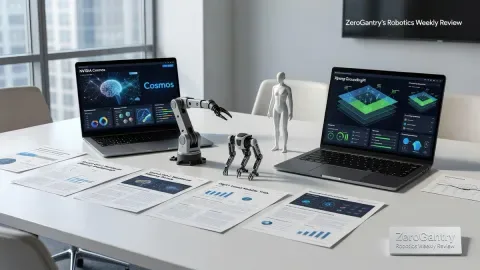
Complementing that effort, NVIDIA launched the Cosmos Framework on Monday, November 2, an open toolkit for training and running world models in robotics and physical AI, explicitly supporting GR00T and similar systems. [NVIDIA Cosmos Framework Boosts GR00T World Model Training](/articles/nvidia-cosmos-framework-boosts-gr00t-world-model-training) provides developers with standardized pipelines that could accelerate simulation-to-reality transfer across platforms.
Together these releases illustrate how open AI components are compressing the gap between research labs and commercial teams. Smaller robotics firms can now leverage high-performing perception and world models without building everything from scratch, potentially speeding deployment timelines by months or years.
China Establishes Foundational Humanoid Standards
On Tuesday, November 3, China approved its first six national humanoid robot standards, set to take effect April 1, 2027. The standards cover perception, motion control, manipulation, and simulation testing, with Unitree and the Beijing Humanoid Robot Innovation Center playing leading roles. [China Publishes First Six Humanoid Robot Standards](/articles/china-publishes-first-six-humanoid-robot-standards) represent an early move to codify safety, interoperability, and performance metrics at the national level.
This regulatory step carries global implications. Clear standards reduce uncertainty for manufacturers and buyers, potentially attracting more capital into Chinese humanoid programs. At the same time, they may influence international discussions on safety and testing protocols, especially as Western firms prepare their own machines for cross-border sales.
Public Markets Open for Robotics Players
Also on Tuesday, November 3, Churchill Capital Corp XI shareholders approved Agility Robotics' business combination with over 84 percent support. The deal closed November 4, enabling Nasdaq trading under ticker AGLT starting November 5 with roughly $465 million in expected gross capital. [Agility Robotics AGLT Begins Nasdaq Trading After SPAC Close](/articles/agility-robotics-aglt-nasdaq-debut-set-for-nov-5) gives the company fresh resources to scale its Digit platform and expand manufacturing.
The listing reflects growing investor appetite for pure-play robotics companies that have moved beyond pilots into revenue-generating deployments. With public-market visibility, Agility can more easily partner with large retailers and logistics operators while using the capital to iterate on hardware and software in parallel.
What to Watch Next Week
Next week, observers should monitor early reactions to Agility's Nasdaq debut, any follow-on announcements from NVIDIA's Cosmos ecosystem, and whether additional Chinese firms release compliance roadmaps tied to the new humanoid standards. Continued hardware updates from logistics players and further open-source perception releases could reinforce the week's themes of practical iteration and shared AI infrastructure.
Sources
- https://bostondynamics.com/news/boston-dynamics-launches-next-generation-stretch-robot/
- https://www.xpeng.com/news/01a1a60de92ba181a8f48a02aa970133
- https://cnevpost.com/2026/11/04/xpeng-unveils-groundingpi-pre-trained-model/
- https://arxiv.org/abs/2609.39601
- https://robottoday.com/article/china-humanoid-robot-standards-gb-t-48317
- http://openstd.samr.gov.cn/bzgk/gb/newGbInfo?hcno=2DE4965802FCACE7CD99ABC34BD6C52B
- https://www.guifanku.com/44107b8879d15f3c9e9d0923863e814e.html
- https://www.agilityrobotics.com/content/churchill-capital-corp-xi-shareholders-approve-business-combination-with-agility-robotics
Topics
Related articles
- Robotics Week in Review: Oct 9–Oct 16, 2026 — AI training breakthroughs and record funding dominated robotics this week, as models like Gemini 4 Argon slashed humanoid learning times while NVIDIA and others
- Robotics Week in Review: Oct 2–Oct 9, 2026 — Humanoid pilots expanded in factories while AI software leaps and maintenance realities surfaced. Leadership changes and regulatory scrutiny rounded out a week
- Robotics Week in Review: Sep 25–Oct 2, 2026 — Humanoid robots advanced toward real warehouse and factory roles while software platforms and record industrial deployments underscored automation's acceleratin
- Robotics Week in Review: Oct 23–Oct 30, 2026 — Humanoid platforms advanced from synchronized demos and records to production lines and enterprise AI tools this week. Tesla, Figure, AgiBot, and Google DeepMin