Editorial · AI-derived
Robotics Week in Review: Oct 2–Oct 9, 2026
Humanoid pilots expanded in factories while AI software leaps and maintenance realities surfaced. Leadership changes and regulatory scrutiny rounded out a week highlighting both promise and practical hurdles in scaling physical robotics.
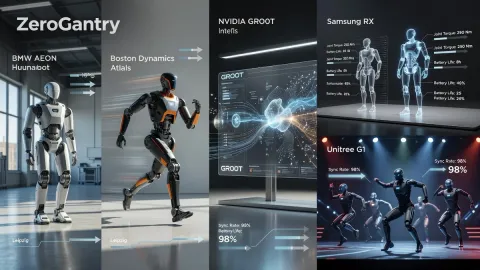
ZeroGantry analysis
Physical AI software momentum dominated, with NVIDIA’s GR00T N2 gains directly enabling the kind of factory pilots BMW is already running. Surprises included the blunt economics from Samsung and Figure’s theatrical fleet disposal, revealing that scaling will hinge as much on service models and IP protection as on technical capability. Next week, watch for partner traction around the new NVIDIA tools and whether Boston Dynamics’ leadership change accelerates Atlas commercialization.
Lede The week of October 2–9, 2026, underscored a pivotal shift in robotics: physical AI and humanoid systems moved from lab demos to real-world economics and deployments. NVIDIA’s software breakthroughs on Friday, October 9, paired with Boston Dynamics’ new CEO appointment and BMW’s ongoing Leipzig pilot, signaled accelerating industrial adoption. At the same time, maintenance cost disclosures and a high-profile fleet retirement revealed the financial and operational realities facing companies scaling these machines. Public entertainment showcases and elder-care grants added cultural and societal dimensions, while a California regulatory notice highlighted emerging legal boundaries.
Humanoid Deployments in Manufacturing Industrial trials took center stage as manufacturers tested humanoids in production environments. On Monday, October 5, BMW Group advanced its pilot of Hexagon Robotics’ AEON at the Leipzig plant for high-voltage battery assembly and component manufacturing. The 1.65-meter wheeled platform, first tested in December 2025, entered expanded summer 2026 trials, marking Europe’s first automotive humanoid production effort. This deployment connects directly to broader European automation pushes, where wheeled mobility offers stability advantages over bipedal designs in structured factory floors.
The BMW-Leipzig story [BMW Leipzig Humanoid Robot Pilot Advances with Hexagon AEON](/articles/bmw-leipzig-humanoid-robot-pilot-advances-with-hexagon-aeon) illustrates how early pilots are generating data on integration challenges, from battery handling precision to safety protocols around high-voltage systems. ZeroGantry sees this as a bellwether: success here could accelerate similar programs at other OEMs, but only if reliability metrics justify the engineering overhead disclosed elsewhere this week.
AI Software and Foundation Model Advances NVIDIA’s Friday, October 9, preview of GR00T N2 at GTC 2026 delivered the week’s clearest software leap. The company claimed more than double the success rate on novel tasks versus prior VLA models, supported by the new Cosmos 3 world foundation model and Isaac Lab 3.0 with its Newton physics engine. Industrial partnerships with ABB, FANUC, and KUKA signal that these tools are being tuned for real factory floors rather than research labs alone.
This announcement [NVIDIA GR00T N2 Preview at GTC 2026 Advances Physical AI](/articles/nvidia-gr00t-n2-preview-at-gtc-2026-advances-physical-ai) complements the hardware pilots reported earlier in the week. Improved simulation-to-real transfer via Newton could shorten the timeline for BMW-style deployments, yet it also raises questions about compute requirements and data privacy when multiple robot makers feed into shared foundation models. The through-line is clear: software velocity is now outpacing mechanical iteration, shifting competitive advantage toward those who master simulation ecosystems.
Leadership Changes and Fleet Strategy Corporate moves reflected the need for fresh expertise in scaling Physical AI. On Wednesday, October 7, Boston Dynamics appointed Rohit Prasad, former Amazon Alexa and AGI leader, as CEO effective that day. He succeeds interim chief Amanda McMaster after Robert Playter’s February exit and will drive Atlas integration under Hyundai ownership.
The leadership shift [Rohit Prasad Appointed Boston Dynamics CEO for Atlas Push](/articles/rohit-prasad-appointed-boston-dynamics-ceo-for-atlas-push) arrives alongside Figure AI’s dramatic Tuesday, October 6, retirement of its F.02 fleet. The company trained the robots to jump into a 75-ton electric arc furnace in Imatra, Finland, following Arnold Schwarzenegger’s public suggestion to protect intellectual property while scaling newer models. This sendoff [Figure AI Melts F.02 Fleet: Schwarzenegger's Terminator Sendoff](/articles/figure-ai-melts-f-02-fleet-schwarzenegger-s-terminator-sendoff) underscores how quickly fleets are being refreshed and the lengths firms will go to safeguard proprietary control algorithms.
Maintenance Economics and Service Realities Ownership costs emerged as a sobering counterpoint to deployment hype. Thursday’s October 8 report on Universal Robots detailed UR Care service plans with fixed annual fees covering preventive maintenance, 24/7 support, parts, and repairs for cobots such as the UR5e. Independent options like Robotics Integration were compared for downtime management.
That analysis [Universal Robots Repair Costs: UR Cobot Maintenance Plans Compared](/articles/universal-robots-repair-costs-ur-cobot-maintenance-plans-compared) gained context from Wednesday’s Samsung RX disclosure at the September 30 AI Forum. The humanoid carries roughly $100,000 in hardware plus another $100,000 in engineering, with $20,000 yearly operations and maintenance. These figures [Samsung RX Humanoid: $20k Annual Maintenance at AI Forum](/articles/samsung-rx-humanoid-20k-annual-maintenance-at-ai-forum) highlight that even before full factory trials, total cost of ownership remains a gating factor. ZeroGantry notes that service plans and transparent economics will determine whether pilots like BMW’s expand or stall.
Research Grants, Public Demos, and Regulatory Signals Diverse applications rounded out the week. Monday’s October 5 NIH grant of nearly $3 million to Hello Robot will advance the Stretch mobile manipulator for older adults with mild cognitive impairment or early Alzheimer’s, partnering with University of Illinois Urbana-Champaign on cognitive assistance and safety in home settings.
Tuesday’s October 6 Unitree G1 performance on America’s Got Talent Season 21 finale demonstrated synchronized multi-robot dance with eight units alongside dancer Wu Yufei, building on June auditions. Meanwhile, Saturday’s October 3 California State Athletic Commission cease-and-desist to REK founder Cix Liv targeted the September 18 human-versus-EngineAI T800 event but left robot-only exhibitions untouched.
These stories [Hell
Sources
- https://nvidianews.nvidia.com/news/nvidia-launches-cosmos-3-the-open-frontier-foundation-model-for-physical-ai
- https://blockchain.news/news/nvidia-cosmos-3-groot-n2-robotics-partnerships-gtc-2026
- https://developer.nvidia.com/blog/develop-physical-ai-reasoning-world-and-action-models-with-nvidia-cosmos-3/
- https://nvidianews.nvidia.com/_gallery/download_pdf/69b86b823d6332366cc17dcd/
- https://www.universal-robots.com/services/service-plan/
- https://www.roboticscenter.ai/guides/robot-maintenance-preventive-schedule
- https://roboticsintegration.com/robotics-repair/universal-robots-repair/
- https://www.therobotreport.com/universal-robots-updates-ur-care-field-care-services-cobot-applications/
Who services this hardware
Topics
Related articles
- Figure AI Melts F.02 Fleet: Schwarzenegger's Terminator Sendoff — Figure AI retired its F.02 humanoid fleet by training the robots to jump into a 75-ton electric arc furnace in Imatra, Finland. CEO Brett Adcock followed Arnold
- Robotics Week in Review: Sep 25–Oct 2, 2026 — Humanoid robots advanced toward real warehouse and factory roles while software platforms and record industrial deployments underscored automation's acceleratin
- Physical Intelligence San Francisco Lease Signals 2026 Physical AI Scaling — Physical Intelligence subleased 80,000 square feet at 850 Brannan Street in San Francisco from Airbnb in September 2026. The robotics AI firm is expanding its B
- IFR Data: 5 Million Robots Signal Labor Shift, Not Humanoid Revolution — The International Federation of Robotics' World Robotics 2026 report shows global factory robot stock reached 5 million units in 2025, with China installing 59