Editorial · AI-derived
Robotics Week in Review: Oct 23–Oct 30, 2026
Humanoid platforms advanced from synchronized demos and records to production lines and enterprise AI tools this week. Tesla, Figure, AgiBot, and Google DeepMind drove progress in hardware, data collection, simulation, and warehouse deployments.
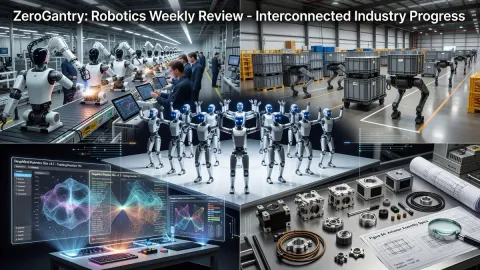
ZeroGantry analysis
The dominant trend this week was the transition from record-setting demonstrations and design locks to concrete production starts and multi-site warehouse scaling, with data infrastructure and simulation tools emerging as key differentiators. Tesla's intensive capture operations and Figure's actuator progress surprised with their speed, while AGIBOT's productivity metric and Boston Dynamics' service transparency added needed realism to the hype cycle. Next week, monitor whether enterprise AI releases like Gemini ER 2 begin driving measurable adoption beyond pilots.
Humanoid Hardware Milestones and Records
The week opened with notable strides in humanoid hardware and deployment scale. On Saturday, October 24, Figure AI CEO Brett Adcock announced that Figure 04 had reached full design lock during an October 22 all-hands meeting, with parts now shipping and in-house actuators under characterization alongside millimeter-level fingertip tracking refinements. This milestone signals Figure's shift from conceptual development to tangible manufacturing readiness for its next-generation platform.
Just a day later, on Sunday, October 25, AgiBot set a Guinness World Record with 110 Expedition A3 humanoids performing a synchronized dance in Jinan, China. The production units leveraged LinkBots cluster control and UWB positioning technology, underscoring the company's focus on scalable coordination for upcoming roles in tourism and public services. These events highlight a broader industry pivot toward proving reliability through real-world numbers rather than isolated prototypes.
Friday's AGIBOT Innovation Day in Shanghai reinforced this trend. The company unveiled the AHA3 humanoid platform featuring liquid-cooled IP67-rated joints and OmniHand 3 dexterous hands, while introducing the Worken productivity metric to prioritize measurable industrial output over sheer deployment counts. Paired with new AI models and the G2 Max robot, AGIBOT's announcements emphasize practical metrics that could reshape how success is evaluated in the humanoid sector.
Data Collection and Simulation Breakthroughs
Training infrastructure emerged as a critical enabler this week. On Thursday, October 29, Tesla detailed its ongoing 24/7 data collection operations at Palo Alto and Texas facilities. Dedicated teams wear 24 lb sensor suits equipped with up to 40 cameras and 3D sensors across three shifts, generating training datasets for Optimus that dwarf those used in vehicle development. This sustained effort, running for months, positions Tesla to accelerate AI capabilities through volume and diversity of real-world interactions.
Wednesday's release of Google DeepMind's Genie 4 on October 27 further amplified simulation capabilities. The interactive world model delivers photorealistic scenes with native audio, real-time steering, and physics consistency extending up to two minutes. Demonstrations included integration with Gemini 4 Argon to simulate Apptronik's Apollo humanoid playing checkers, offering a glimpse into how advanced world models could compress years of physical testing into accelerated virtual environments.
These parallel advances in physical data capture and synthetic simulation suggest a converging strategy: real-world volume from companies like Tesla combined with scalable virtual training from DeepMind could compress development timelines dramatically.
Warehouse Deployments and Enterprise Integration
Logistics applications showed concrete expansion. On Tuesday, October 27, GXO Logistics revealed plans to deploy Agility Robotics Digit humanoids at warehouses in Statesville, North Carolina, and Lebanon, Tennessee beginning in early 2027. This follows more than 100,000 totes already moved by Digit at the existing Flowery Branch, Georgia site, illustrating how early pilots are scaling into multi-site operations.
The same day, Google DeepMind launched Gemini Robotics ER 2 in public preview on Google Cloud. The embodied reasoning model introduces enterprise-grade tools for natural conversation, long-horizon planning, and multi-robot coordination across diverse hardware platforms. Its availability signals that foundational AI capabilities are maturing toward plug-and-play integration for logistics and manufacturing users.
Production Scaling and Service Economics
Production and support realities came into sharper focus mid-week. On Monday, October 26, Tesla confirmed that early Optimus production had begun on a high-volume line at its Fremont factory during Q3 2026, with external deliveries targeted for late 2027 pending resolutions in durability, safety, hands, and AI. This timeline aligns with the company's aggressive data-gathering push reported later in the week.
Also on Monday, Boston Dynamics outlined Spot's pricing and service structure: base units start near $75,000, with configured systems reaching $150,000–$300,000. Spot Care plans offer accidental damage coverage with 10-day turnaround, parts, labor, and shipping, exemplified by one documented $27,280 annual contract. These details provide rare transparency into the total cost of ownership for quadruped platforms that often serve as stepping stones to humanoid fleets.
What to Watch Next Week
Next week will likely reveal how these hardware locks, data pipelines, and deployment expansions translate into measurable productivity gains. Watch for follow-through on AGIBOT's Worken metric, additional Figure actuator test results, and any early feedback from Gemini Robotics ER 2 enterprise users. The interplay between Tesla's Fremont output ramp and DeepMind's simulation tools could set the pace for 2027 delivery targets across the industry.
Sources
- https://www.prnewswire.com/news-releases/agibot-introduces-worken-to-measure-productive-robot-work-at-agibot-innovation-day-2026-302923486.html
- https://humanoidroboticstechnology.com/articles/agibot-innovation-day-2026/
- https://www.humanoidsdaily.com/news/agibot-innovation-day-2026-worken-ai-models-g2-max
- https://www.therobotreport.com/agibot-introduces-worken-measure-robot-productivity-innovation-day-2026/
- https://x.com/Scobleizer/status/2115275386963755067
- https://www.ziprecruiter.com/c/Tesla/Job/Data-Collection-Operator%2C-Optimus/-in-Palo-Alto%2CCA?jid=c1da279fbd7fae41
- https://robovations.com/analysis/tesla-pulled-optimus-training-off-the-assembly-line-after-workers-balked-at-teaching-their-replacements/
- https://electrek.co/2026/09/25/tesla-optimus-production-ramp-hands-ai-generalization-problems/
Topics
Related articles
- Gemini Robotics ER 2 Hits Google Cloud in Public Preview — On October 27, 2026, Google DeepMind released Gemini Robotics ER 2 in public preview on Google Cloud. The embodied reasoning model adds enterprise tools for nat
- Robotics Week in Review: Oct 16–Oct 23, 2026 — This week highlighted rapid progress in embodied AI models, cross-embodiment world models, and hardware optimizations alongside China's policy push boosting Uni
- AGIBOT Dataset Sharpens Robot Decision-Making in Shifting Scenes — AGIBOT released its AGIBOT WORLD 2026 Release 4 physical reasoning dataset on October 22. The open Hugging Face resource trains robots to adapt actions to chang
- Robotics Week in Review: Oct 9–Oct 16, 2026 — AI training breakthroughs and record funding dominated robotics this week, as models like Gemini 4 Argon slashed humanoid learning times while NVIDIA and others