Editorial · AI-derived
Gemini Robotics ER 2 Hits Google Cloud in Public Preview
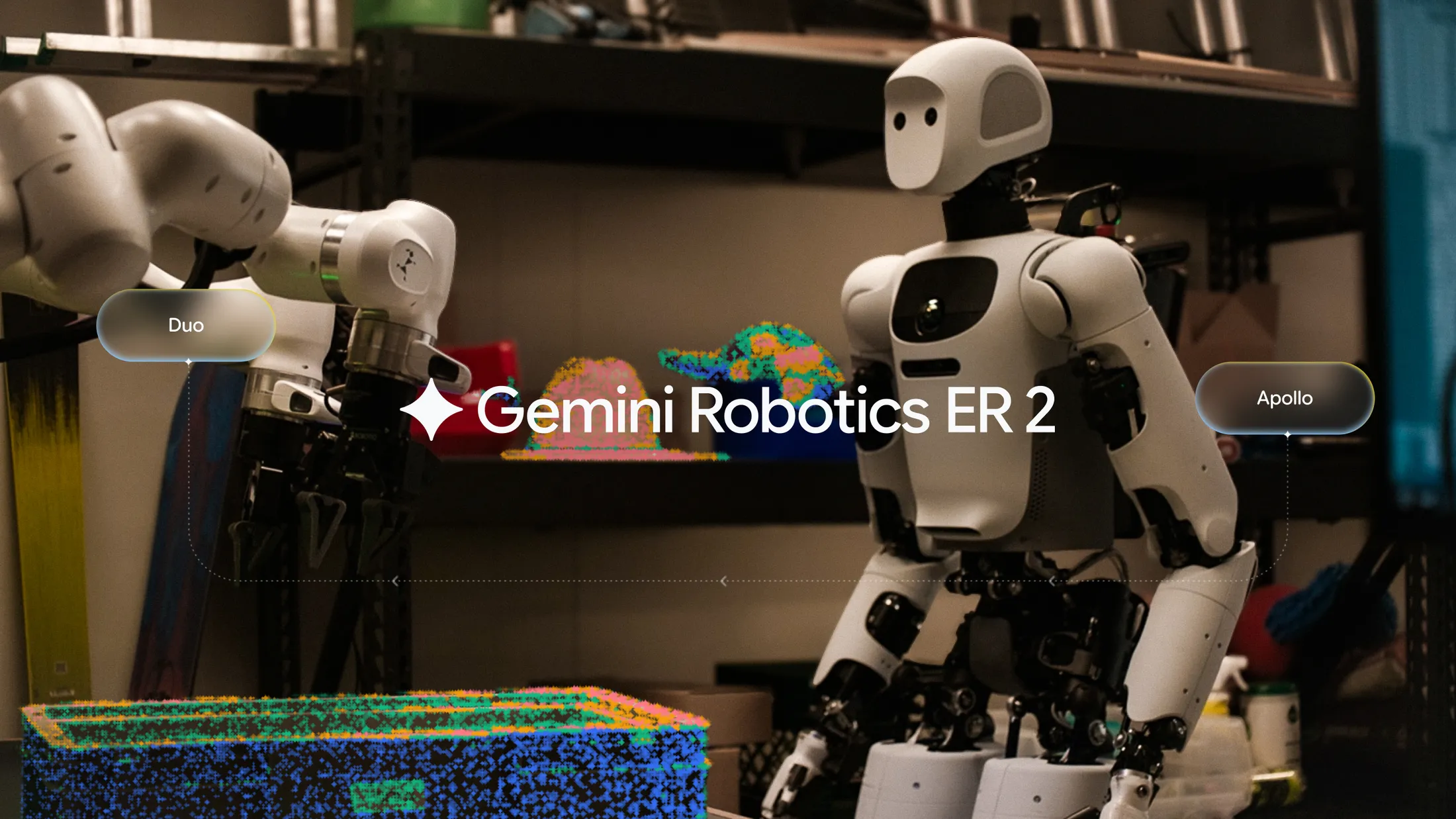
On October 27, 2026, Google DeepMind released Gemini Robotics ER 2 in public preview on Google Cloud. The embodied reasoning model adds enterprise tools for natural conversation, long-horizon planning, and multi-robot coordination across robot types.
ZeroGantry analysis
The public preview bundles ER 2 with Google Cloud's existing security and orchestration stack, cutting integration overhead that previously kept pilots in isolated environments. At 4x reported execution speed and sub-second event detection, the model supports tighter safety loops than prior ER versions without proportional compute growth. Watch for adoption in mixed fleets already running Apptronik or Agility hardware; ignore if on-prem latency or data-residency rules block cloud bursts.
EDITORIAL / OPINION
Google DeepMind crossed a threshold on October 27, 2026, when it moved Gemini Robotics ER 2 from limited previews into public preview on the Gemini platform inside Google Cloud. The move supplies enterprises with a specialized vision-language model tuned for physical reasoning rather than another general-purpose chatbot. Carolina Parada, VP and Head of DeepMind Robotics, and Applied AI Blackbelt Adrian Jones detailed the release in the official Google Cloud blog post that day.
From Lab Demo to Enterprise Stack
Earlier versions of the ER line appeared in July 2026 alongside the broader Gemini Robotics 2 family. Those releases emphasized whole-body control on humanoids and basic multi-robot handoffs. The October 27 announcement adds Google Cloud's security controls, multi-agent orchestration, and lifecycle tooling. Organizations can now simulate, evaluate, and deploy the model without stitching together separate simulation, training, and inference environments.
The model handles inputs that include interleaved text, images, video, and audio up to a 128k context window. It outputs text plans that lower-level vision-language-action models then execute on hardware. Built-in safety guardrails and tool-use capabilities, such as native Google Search calls, sit inside the same stack. This architecture separates high-level reasoning from low-level motor commands, a pattern already visible in July documentation but now packaged for production fleets.
Performance Numbers That Matter for Deployment
DeepMind reports 91.3 percent accuracy on precise event detection in video streams, with a mean absolute frame distance of 0.96 seconds. The system runs at four times the execution speed of larger competing models while using a fraction of the compute. Task progress classification reaches 57.4 percent accuracy, allowing robots to score their own steps in binary, categorical, or continuous formats. These metrics support real-time adjustments without full workflow restarts.
Spatial reasoning extends to reading values from more than ten instrument categories directly from camera feeds. Circular dials, sight glasses, digital displays, linear scales, and liquid thermometers all fall within scope. The numbers come from the same October 27 Cloud blog post and earlier July model cards, giving developers concrete benchmarks before they commit hardware budgets.
Multi-Robot Collaboration and Embodiment Flexibility
ER 2 coordinates fleets that mix stationary arms, wheeled rovers, quadrupeds, and full humanoids. Different robot types share a semantic workspace model and divide tasks autonomously. A single high-level plan can hand off subtasks across embodiments without custom middleware for every pair of machines. This capability directly addresses warehouse and factory scenarios where one robot type cannot complete an entire workflow alone.
The public preview runs inside Google Cloud's existing enterprise features: data residency controls, audit logging, and integration with Pub/Sub, BigQuery, and Distributed Cloud for on-premises latency-sensitive inference. NVIDIA Isaac Sim and MuJoCo simulation workloads can sit on the same project, reducing the friction that has kept many physical AI pilots in isolated sandboxes.
Cost, Latency, and Serviceability Implications
Sub-second event detection at reduced compute cost changes the economics of continuous video monitoring. Fleets no longer need dedicated high-end GPUs on every edge node for progress tracking. Instead, cloud bursts handle reasoning spikes while lighter on-device models manage immediate motor loops. The 4x speed improvement matters for safety loops that must interrupt pouring, cutting, or assembly before damage occurs.
Serviceability gains come from standardized progress classification. Maintenance teams can query a robot's internal task score rather than parsing raw logs. When a step fails, the model suggests targeted retries instead of full resets, cutting mean time to recovery in documented multi-minute sequences that involve hundreds of decisions.
Counter-Arguments and Realistic Limits
Public preview still leaves questions about guaranteed uptime and pricing tiers for sustained 24/7 operation. The model depends on video feeds of sufficient quality; dusty or poorly lit industrial settings may degrade the reported 91.3 percent event accuracy. Multi-robot collaboration assumes compatible lower-level controllers across vendors, an assumption that has tripped up earlier orchestration efforts.
Independent verification of the 57.4 percent progress classification and 0.96-second frame metrics remains limited to DeepMind's internal benchmarks. Enterprises will need their own validation runs on target hardware before scaling. The architecture also inherits Gemini's broader data-handling policies, which some regulated industries will scrutinize closely.
Second-Order Effects on Labor and Supply Chains
Wider access to frontier embodied reasoning lowers the barrier for mid-sized manufacturers and logistics operators that lack in-house AI teams. This could accelerate deployment of mixed robot fleets in sectors already experimenting with Apptronik Apollo or Agility Digit platforms. At the same time, the cloud-centric approach concentrates expertise inside Google’s ecosystem, raising questions about vendor lock-in for long-horizon planning logic.
Geopolitically, the release arrives as multiple national programs race to field domestic humanoid fleets. Google Cloud's global footprint gives non-U.S. enterprises a compliant path to test the model without exporting sensitive video data to every jurisdiction. Whether that advantage persists depends on upcoming data-localization rules and competing open-weight reasoning models.
The October 27 move signals that embodied AI is graduating from research videos to production contracts. Execution will depend on how quickly integrators translate the reported accuracy numbers into measurable uptime
Sources
Topics
Related articles
- Robotics Week in Review: Oct 16–Oct 23, 2026 — This week highlighted rapid progress in embodied AI models, cross-embodiment world models, and hardware optimizations alongside China's policy push boosting Uni
- AGIBOT Dataset Sharpens Robot Decision-Making in Shifting Scenes — AGIBOT released its AGIBOT WORLD 2026 Release 4 physical reasoning dataset on October 22. The open Hugging Face resource trains robots to adapt actions to chang
- Robotics Week in Review: Oct 9–Oct 16, 2026 — AI training breakthroughs and record funding dominated robotics this week, as models like Gemini 4 Argon slashed humanoid learning times while NVIDIA and others
- Gemini 4 Argon Cuts Apptronik Apollo Cornhole Training to Hours — Google DeepMind's Gemini 4 Argon model analyzed a human cornhole video on October 13, 2026, built a MuJoCo simulation, and trained an Apptronik Apollo 2 humanoi