Editorial
Robotics Week in Review: Nov 13–Nov 20, 2026
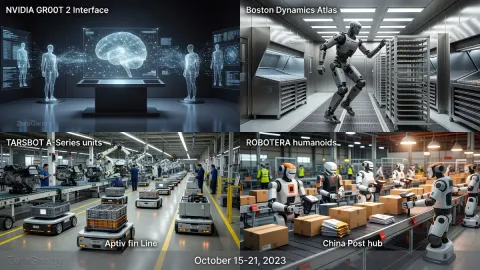
This week highlighted rapid progress in embodied AI and humanoid deployments across manufacturing and logistics. NVIDIA's GR00T 2 model and new pilots from Boston Dynamics, TARSBOT, and ROBOTERA signal accelerating real-world adoption in industrial settings.
ZeroGantry analysis
The dominant trend this week was the tight coupling of data-efficient AI models with immediate industrial deployment commitments, moving humanoids from R&D showcases to contracted production use. The surprise was the speed of the China Post rollout achieving 1,500 parcels/hour across 11 hubs so quickly after the March pilot. Next week, focus on whether additional semiconductor or logistics players announce similar volume commitments ahead of the GR00T code release.
Lede The robotics industry advanced on multiple fronts this week, with AI model improvements directly enabling new humanoid pilots in semiconductors, automotive supply chains, and postal logistics. From Tuesday through Friday, four major dispatches underscored how pretrained world models and targeted deployments are moving humanoids from prototypes to production lines at scale. The through-line is clear: data-efficient learning combined with sector-specific partnerships is compressing timelines for commercial viability.
Embodied AI Model Breakthroughs On Friday, November 20, NVIDIA unveiled GR00T 2, a world action model pretrained on hundreds of thousands of hours of human video and robot data. The model achieved a 95% average success rate across 50 tasks after just five demonstrations per task and a 30-minute fine-tune on a single RTX 5090 GPU, with open code slated for December 2026. This represents a significant leap in sample efficiency compared to prior iterations, directly addressing one of the biggest barriers to humanoid scaling: the cost and time of collecting robot-specific training data.
The timing is no coincidence. [NVIDIA GR00T 2 Hits 95% Success With Five Demos](/articles/nvidia-gr00t-2-hits-95-success-with-five-demos) lands as hardware partners prepare for 2027 deployments. By lowering the barrier to task adaptation, GR00T 2 could enable smaller manufacturers to customize humanoids without massive data centers or engineering teams. ZeroGantry sees this as validation that foundation models are maturing faster than physical hardware platforms, shifting competitive advantage toward those who control both the model and the integration stack.
Semiconductor and Automotive Humanoid Pilots Thursday's announcement from Boston Dynamics and GlobalFoundries marks the first non-automotive customer in Atlas's early adopter program. Testing at semiconductor fabs is scheduled to begin in early 2027, expanding the humanoid's operational envelope beyond traditional automotive environments into cleanroom-adjacent settings. [Boston Dynamics Atlas GlobalFoundries Pilot Begins Early 2027](/articles/boston-dynamics-atlas-globalfoundries-pilot-begins-early-2027) signals growing confidence that Atlas's latest generation can handle the precision and contamination controls required in chip fabrication.
This pairs with Wednesday's TARSBOT-Aptiv agreement. At the 9th China International Import Expo, the companies committed to deploying 100 A-Series industrial embodied AI robots across Aptiv factories by December 2026, with first units already on production lines and a longer-term goal of 1,000 robots backed by Shanghai's Jiading District. [TARSBOT A-Series: Aptiv Deploys 100 Units by End 2026](/articles/tarsbot-a-series-aptiv-deploys-100-units-by-end-2026) illustrates how automotive suppliers are moving beyond pilots into volume commitments. The common thread between Atlas-GlobalFoundries and TARSBOT-Aptiv is the focus on high-mix, high-precision environments where humanoids can justify their cost through 24/7 operation and reduced changeover times.
Logistics Scale in China Tuesday's report on ROBOTERA showed the fastest path to measurable throughput gains. Since a March 2026 pilot in Guangzhou, the company's humanoids now operate at 11 China Post hubs across eight Guangdong cities, averaging more than 1,500 parcels per hour. [ROBOTERA Humanoids Hit 1,500 Parcels/Hour at 11 China Post Hubs](/articles/robotera-humanoids-hit-1500-parcels-hour-at-11-china-post-hubs) demonstrates that logistics tasks—sorting, picking, and transport—offer lower regulatory and safety hurdles than many manufacturing applications, allowing quicker iteration and higher utilization rates.
Collectively, these stories reveal a bifurcated adoption curve: Western and multinational players emphasize precision manufacturing and cleanroom environments, while Chinese deployments prioritize high-volume, lower-complexity logistics first. Both paths validate the underlying AI and mechanical advances, but the data from China Post hubs provides the earliest public benchmarks of sustained commercial ROI.
What to Watch Next Week Expect further model releases or fine-tuning announcements as NVIDIA's December code drop approaches. Watch for additional semiconductor or electronics firms joining Atlas or similar early-adopter programs, and monitor whether TARSBOT or ROBOTERA expand beyond their current Chinese footprints. The convergence of efficient world models with committed industrial partners suggests 2027 will be the year humanoids transition from headline pilots to line-item capital expenditures.
Sources
- https://research.nvidia.com/labs/gear/gr00t-2/
- https://www.techtimes.com/articles/330365/20261110/nvidia-gr00t-2-robot-model-reports-95-success-while-leaving-50-test-tasks-unnamed.htm
- https://servospace.io/news/nvidia-gr00t-2-corl-foxconn-siemens
- https://bostondynamics.com/news/boston-dynamics-globalfoundries-expand-robotics-collaboration/
- https://www.therobotreport.com/boston-dynamics-atlas-humanoid-lands-first-non-automotive-trial/
- https://interestingengineering.com/ai-robotics/atlas-humanoid-semiconductor-manufacturing
- https://www.prnewswire.com/news-releases/tarsbot-and-aptiv-deepen-strategic-collaboration-on-embodied-ai-302939149.html
- https://www.rockingrobots.com/aptiv-plans-to-deploy-100-tarsbot-robots-in-factory-operations-by-end-of-2026/
Topics
Related articles
- Robotics Week in Review: Oct 30–Nov 6, 2026 — This week featured hardware upgrades for logistics, open AI perception models, China's first humanoid standards, and a major robotics SPAC debut. NVIDIA's Cosmo
- Robotics Week in Review: Oct 9–Oct 16, 2026 — AI training breakthroughs and record funding dominated robotics this week, as models like Gemini 4 Argon slashed humanoid learning times while NVIDIA and others
- Robotics Week in Review: Sep 25–Oct 2, 2026 — Humanoid robots advanced toward real warehouse and factory roles while software platforms and record industrial deployments underscored automation's acceleratin
- Robotics Week in Review: Oct 2–Oct 9, 2026 — Humanoid pilots expanded in factories while AI software leaps and maintenance realities surfaced. Leadership changes and regulatory scrutiny rounded out a week
AI-derived: drafted with AI assistance and checked against cited sources. How we label articles