Frontier · AI-derived
ISO 25785-1 Sets Safety Rules for Dynamically Stable Humanoids
ISO 25785-1 is advancing as the key safety standard for industrial mobile robots with active stability control, including humanoids and legged systems. It addresses fall prevention and human collaboration risks as deployments increase in 2026.
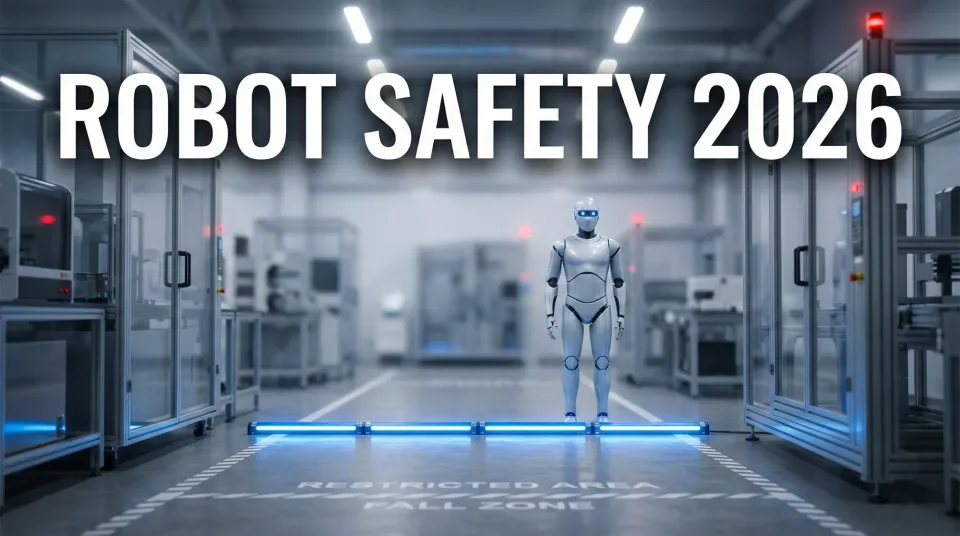
Emerging Safety Framework for Active Stability Robots
ISO 25785-1 targets industrial mobile robots that rely on continuous sensor feedback and actuator adjustments to maintain balance. These systems include bipedal humanoids, quadrupeds, and self-balancing wheeled platforms. The draft specifies risk assessment procedures that account for dynamic instability during locomotion and interaction with humans. Working group participants from Agility Robotics and Boston Dynamics have contributed requirements that differentiate these robots from fixed-base industrial arms covered by prior ISO 10218 revisions.
Risk categories in the draft emphasize collision forces during unexpected falls and recovery maneuvers. Engineers must model the center of mass trajectory in real time to predict tipping points before they occur. The standard requires documented verification that control loops respond within defined latency bounds to prevent hazardous motion. This approach builds on existing mobile robot standards while introducing explicit clauses for legged locomotion.
Control Theory and Sensor Requirements
Dynamically stable robots maintain equilibrium through feedback loops that fuse inertial measurement units, joint encoders, and force-torque sensors. The draft references stability margins derived from zero-moment point calculations, where the projection of the net force must remain inside the support polygon during gait cycles. Latency targets for sensor-to-actuator paths are implied through performance criteria that ensure corrective torques activate before the robot exceeds recoverable lean angles.
Reproducibility of safety validation tests receives attention through prescribed test fixtures and environmental conditions. Facilities must demonstrate consistent recovery from perturbations applied at standardized velocities and directions. These protocols help manufacturers generate comparable data across different hardware platforms. The emphasis on repeatable metrics supports third-party certification and insurance assessments for industrial deployments.
Integration with Existing Standards
ISO 25785-1 complements the 2025 update to ISO 10218 and ongoing revisions to ISO 13482 for personal care robots. It fills gaps where active stability introduces new failure modes not addressed by static robot assumptions. The working draft avoids anthropomorphic terminology, focusing instead on locomotion type and stability control architecture. This technical framing allows the standard to cover both humanoid and non-humanoid forms without separate documents.
Industry stakeholders note that early adoption of draft principles already influences design reviews at companies shipping legged systems. Risk assessments now routinely include simulated fall scenarios and human proximity detection thresholds. The standard is expected to reach final publication between late 2026 and 2027, providing a clearer compliance path for facilities integrating these robots alongside conventional automation.
Implications for Industrial Deployment
Manufacturers developing humanoids must incorporate additional layers of functional safety hardware to meet the emerging requirements. Redundant sensing and independent monitoring channels become necessary to achieve the required performance levels during dynamic motion. Operational limits on speed and payload near humans receive quantitative guidance tied to measured stopping distances under active balance control.
Training programs for integrators will likely expand to cover the unique verification methods outlined in the draft. Documentation of control parameter tuning and sensor calibration procedures forms part of the required safety case. As more facilities move legged robots from pilot cells to production lines, these standardized practices reduce uncertainty in hazard analysis.
The ongoing development process continues to draw input from international experts through ISO working group meetings. Feedback from early deployments informs refinements to fall detection algorithms and recovery strategies. This iterative approach ensures the final standard reflects practical experience with current hardware capabilities.
Future Revisions and Broader Impact
Subsequent parts of the ISO 25785 series may address system-level integration and specific application domains. The current part one focuses on the robot itself, leaving collaborative workspace design for later or parallel documents. Continued alignment with ANSI/A3 R15.06 revisions in the United States supports harmonized global requirements.
Academic research groups studying legged locomotion can reference the standard when designing reproducible experiments on balance recovery. Published test methods provide benchmarks that link theoretical stability margins to measurable hardware performance. This connection between standards and research accelerates translation of laboratory advances into certified industrial products.
Sources
Topics
Related articles
- Unitree UnifoLM-X2-1.0 Powers G1 Autonomous Sparring Demo — On September 7, 2026, Unitree Robotics released UnifoLM-X2-1.0, a real-time world model that lets the G1 humanoid spar fully autonomously against a human withou
- AGIBOT Leads Humanoid Shipments with 9,700 Units in H1 2026 — AGIBOT shipped about 9,700 humanoid robots in the first half of 2026 to capture over 43% global market share. Counterpoint Research data shows total shipments e
- Unitree G1+ Adds 2-DOF Neck and 110% Torque Boost at $15K — Unitree launched the G1+ humanoid on September 14, 2026, with a movable neck, stronger and cooler motors, and new sensors. The base model lists at about $15,000
- Agility Digit 5 Launch Targets Barrier-Free Warehouse Work — Agility Robotics launched Digit 5 on September 15, 2026, its first humanoid designed for safe close-proximity work alongside humans in warehouses and factories