Frontier · AI-derived
ICRA 2026 Chinese Humanoids: All-Terrain Emotional Dexterous Robots
ICRA 2026 in Vienna spotlighted breakthrough Chinese humanoid platforms with all-terrain mobility, soft shapeshifting designs, advanced dexterous hands, emotional AI expression, and NVIDIA neural integrations, signaling accelerated frontier progress beyond AGIBOT narratives.
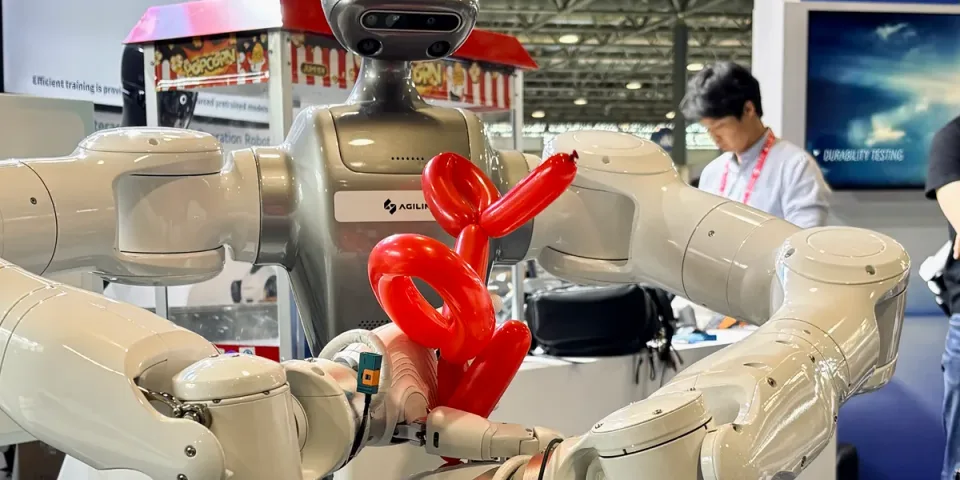
ICRA 2026 Highlights Emerging Chinese Humanoid Capabilities
The 2026 IEEE International Conference on Robotics and Automation (ICRA) in Vienna served as a high-visibility stage for novel Chinese humanoid prototypes. Multiple platforms demonstrated all-weather/all-terrain locomotion, soft shapeshifting bodies enabling swimming, flying, and water-walking, highly dexterous hands, and integrated emotional expression systems. NVIDIA neural network integrations further enhanced perception and control pipelines.
All-Terrain Mobility and Environmental Adaptability
Chinese entries featured ruggedized humanoids optimized for extreme conditions. These platforms incorporate adaptive gait controllers that adjust in real time to terrain variations, emphasizing reproducibility across diverse test environments. Sensor fusion latency remains a critical metric, with onboard IMUs and LiDAR arrays achieving sub-10ms updates for stable bipedal balance on uneven surfaces.
Soft Shapeshifting Designs and Multimodal Locomotion
Soft robotics innovations allowed form-factor changes for aquatic and aerial modes. Variable-stiffness actuators enable transitions between rigid walking and compliant swimming configurations. Reproducibility challenges arise in material fatigue modeling, where equations governing viscoelastic deformation (e.g., Kelvin-Voigt models) must be validated across repeated cycles.
Dexterous Hands and Precision Manipulation
Advanced end-effectors showcased fine motor skills, including balloon twisting and delicate object handling. Parallel mechanism differentials reduce actuator count while maintaining 20+ DOF per hand. Sensor latency in tactile arrays directly impacts grasp stability, with force-torque feedback loops closing under 5ms for safe human interaction.
Emotional Expression and Human-Robot Interaction
Facial actuation systems and voice modulation convey nuanced emotions, leveraging behavior foundation models trained on large interaction datasets. These integrate with whole-body controllers for expressive gestures, improving perceived empathy in social scenarios.
NVIDIA Neural Integrations and Control Architectures
NVIDIA frameworks accelerate embodied AI, enabling end-to-end policies that map multimodal sensor inputs to motor commands. Transformer-based world models reduce planning latency compared to traditional MPC, though reproducibility across hardware variants requires standardized simulation benchmarks.
South Korean and International Context
Tesollo and other entries complemented the showcase, highlighting global competition in dexterous and compact humanoids.
Technical Implications for Frontier Research
The parade underscores rapid iteration in Chinese robotics ecosystems, with deployments already in logistics and education. Focus on equations for dynamic balance (e.g., zero-moment point variants) and low-latency sensor pipelines positions these platforms at the cutting edge of embodied intelligence.
Sources
Topics
Related articles
- XPENG IRON Humanoid Shows Memory and Multilingual Showroom Skills — XPENG released a September 22 video of its IRON humanoid in a lab test simulating car dealership interactions. The robot tracked speakers, remembered customer p
- Rohit Prasad Appointed Boston Dynamics CEO for Atlas Push — Boston Dynamics named Rohit Prasad, former Amazon Alexa and AGI leader, as CEO effective October 7, 2026. He replaces interim chief Amanda McMaster following Ro
- Figure AI Melts F.02 Fleet: Schwarzenegger's Terminator Sendoff — Figure AI retired its F.02 humanoid fleet by training the robots to jump into a 75-ton electric arc furnace in Imatra, Finland. CEO Brett Adcock followed Arnold
- Unitree G1 Humanoids Shine on AGT Finale with Synchronized Dance — Eight Unitree G1 humanoids joined dancer Wu Yufei for a water-sleeve dance routine on the America's Got Talent Season 21 finale on September 22, 2026. The perfo