Service · AI-derived
GMO Debuts Humanoid Ambulance Van for Tokyo Robot Repairs
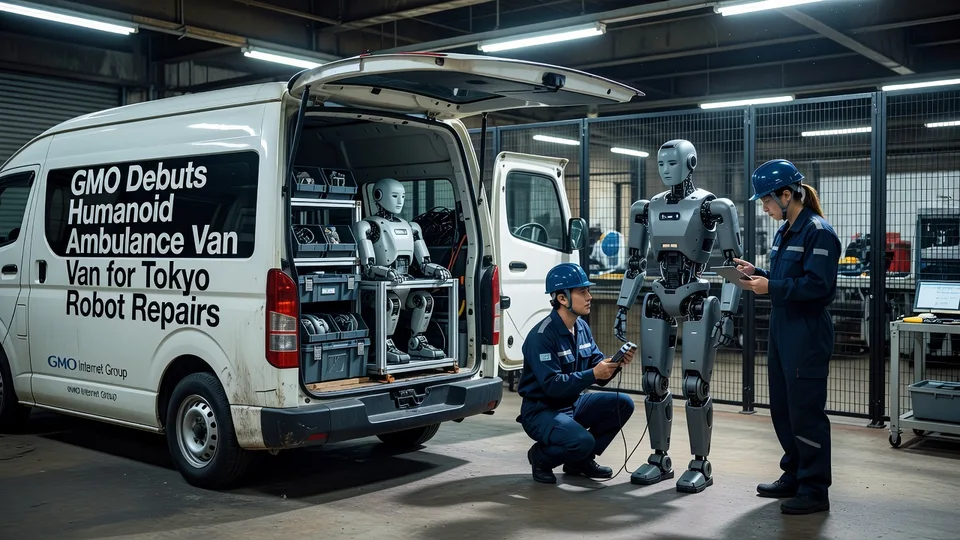
GMO Internet Group launched Japan's first humanoid robot ambulance in Tokyo this month. The van carries engineers, spare parts, diagnostic tools, and a replacement robot to minimize downtime for deployed units from Unitree and similar platforms during on-site service calls.
ZeroGantry analysis
GMO’s swap-first ambulance reduces the $125k–$500k hourly downtime exposure that dominates humanoid TCO models, but its closed ecosystem for Unitree resales risks vendor lock-in and slower price competition on parts. Fleet operators running 24/7 logistics should watch response SLAs and spare-unit inventory closely; early data from Haneda trials through 2028 will reveal whether mobile service delivers measurable uptime gains over factory returns. Ship on platforms with modular actuators if service coverage remains thin outside Tokyo.
GMO's Mobile Service Model Targets Humanoid Downtime
GMO Internet Group unveiled its humanoid ambulance on September 8, 2026, with public coverage appearing September 11 through Euronews and expanded analysis on September 15 by The Rundown AI. The vehicle operates from GMO AIR’s Tokyo headquarters and serves humanoids the company resells, primarily Unitree platforms used in trials such as baggage handling with JAL Ground Service at Haneda Airport through 2028. Engineers carry diagnostic gear, repair tools, spare parts, and a standby humanoid so technicians can attempt on-site fixes first. If repairs exceed quick turnaround, the spare unit stays behind while the damaged robot returns to GMO’s Humanoid Lab in Shibuya for deeper work.
This approach directly addresses a core pain point in early humanoid deployments: unplanned downtime costs that dwarf routine maintenance. Industry models cited in September 2026 analyses place median unplanned downtime at $125,000 per hour, with peaks reaching $500,000 in high-severity scenarios. GMO’s swap-first strategy reduces that exposure by keeping customer operations running while the original unit undergoes repair. CEO Tomohiro Uchida noted the service grew from prior experience where shipping damaged units left sites idle for extended periods.
The single van currently covers case-by-case dispatches in Tokyo. GMO indicated plans to scale vehicles and bases as fleet sizes grow. Service remains limited to GMO AIR-deployed robots rather than open third-party support, creating a closed-loop model that ties hardware resale to ongoing maintenance revenue.
Maintenance Intervals and Spare Parts Realities
Humanoid platforms require more frequent attention than traditional industrial arms because of higher actuator counts and dynamic balance demands. Preventive maintenance for bipedal humanoids often falls every 3–6 months in 12–16 hour daily hospital or warehouse use, according to 2026 service guides. Annual preventive costs range €2,000–€5,000 per robot under contract, with corrective repairs adding €1,000–€5,000 depending on response SLA.
Common failure modes include actuator and gearbox wear, cable harness degradation, sensor drift, and battery capacity loss. Replacing a single axis gearbox on legacy industrial robots costs $5,000–$15,000 in parts and labor; humanoid equivalents with 20–30 actuators scale that risk higher. Battery swaps every 2–3 years run $1,000–$2,000 per unit on platforms like Tesla Optimus analogs. GMO’s van stocks critical spares to enable field swaps of modules rather than full limb replacements that can exceed $50,000.
After year seven, maintenance costs typically climb 30–50% as seals, cables, and harmonic drives reach end-of-life. Grabarobot’s 2026 TCO model for a $50,000 mid-size arm shows maintenance and service alone at $25,000 over five years within a total $192,000 ownership cost—nearly 3.8 times hardware price. Humanoid TCO multipliers run higher because of complexity; one analysis pegs five-year ownership for a $20,000 Digit-class unit near $400,000 when including $36,000 annual software and maintenance fees.
Who Services Which Platforms
GMO AIR focuses on Unitree humanoids and similar resale units, offering on-site response unavailable from most OEMs. Broader third-party providers such as The Robot Group (UK) publish tiered plans starting £300 per month for preventive care on leading makes, scaling to £700 for mission-critical SLAs with on-site rapid response and swap strategies. Australian specialist HumanoidRR lists actuator replacement from $490 and emergency callouts from $890 across supported platforms including Unitree, Figure, Agility Digit, and 1X NEO.
OEM service remains limited. Tesla has not published Optimus service pricing. Figure AI offers enterprise contracts that bundle support but no public parts catalog. Boston Dynamics Atlas maintenance estimates reach $9,500 annually. Extended warranty providers like CPS Central target consumer units with mechanical and electrical coverage but exclude commercial fleets. Mobile models like GMO’s fill the gap for operators unwilling to accept factory-send delays.
Total Cost of Ownership Implications
Procurement teams using only vendor quotes underestimate lifetime spend. Creedtec’s September 17, 2026 analysis warns that a $50,000 arm purchase represents just 11% of true 10-year cost when downtime, energy, spares, and training are modeled. Mobile swap services reduce the downtime component—the largest hidden expense—by keeping throughput intact. For a warehouse deploying 10 humanoids, avoiding even one $125,000-per-hour outage per quarter justifies dedicated service infrastructure.
Agility Robotics’ September 10 securities filing disclosure for Digit v5 illustrates the stakes: $200,000 hardware plus $20,000 deployment and $36,000 yearly software/maintenance yields roughly $400,000 over five years, with payback targeted at 1.1 years under optimistic utilization. Service plans that guarantee rapid replacement compress that timeline by protecting revenue-generating hours.
Counter-arguments exist. Closed service ecosystems like GMO’s limit customer choice and may embed higher margins. Open third-party networks could drive competition on price, though current coverage remains patchy outside major metros. In-house technicians cost $100–$200 hourly plus training, viable only above certain fleet thresholds.
Second-Order Effects on Fleet Operations
Mobile humanoid service changes deployment economics. Operators gain confidence to run higher-duty cycles knowing a replacement arrives same-day rather than weeks later. Airport and logistics trials like GMO’s JAL partnership benefit directly: baggage handling cannot pause for robot shipping. Predictive telemetry from onboard sensors allows preemptive dispatch before failures cascade into multi-axis damage.
Parts logistics matter. Stocking spare actuators, sensors, and batteries in the van avoids expedited shipping premiu
Sources
- https://www.therundown.ai/news/gmo-humanoid-ambulance-robot-maintenance
- https://www.euronews.com/2026/09/11/japanese-company-unveils-robot-ambulance-for-on-site-humanoid-repairs
- https://creedtec.online/the-robot-maintenance-cost-model-every-procurement-team-gets-wrong/
- https://techorange.com/2026/09/10/cost-of-humanoid-robot-factory-worker-agility-robotics-digit-v5/
Who services this hardware
Topics
Related articles
- Boston Dynamics Atlas Actuator Costs Battery Life TCO 2026 — Boston Dynamics' electric Atlas humanoid delivers 4-hour typical battery runtime and autonomous swaps in under 3 minutes. Modular Hyundai Mobis actuators suppor
- Fanuc Robot Repair Costs, Maintenance, and Ohio Service Options 2026 — Fanuc industrial robots typically require $2,000–$8,000 in annual preventive maintenance per unit. Ohio operators weigh authorized providers like FANUC America
- Tesla Optimus Maintenance Cost 2026: Actuator Replacement & TCO — Independent 2026 analyses project annual Tesla Optimus maintenance at $1,500-$4,000 for light use and $5,000-$15,000 for factory cycles. The largest expenses st
- OpenAI Humanoid Robot: Sam Altman Confirms In-House Hardware Plans — OpenAI CEO Sam Altman confirmed on September 2, 2026 that the company will build humanoid robots through its internal robotics division. The project begins with