Editorial
Gemini Robotics 2.5 Hits 96% Success in Mercedes Apollo Pilot
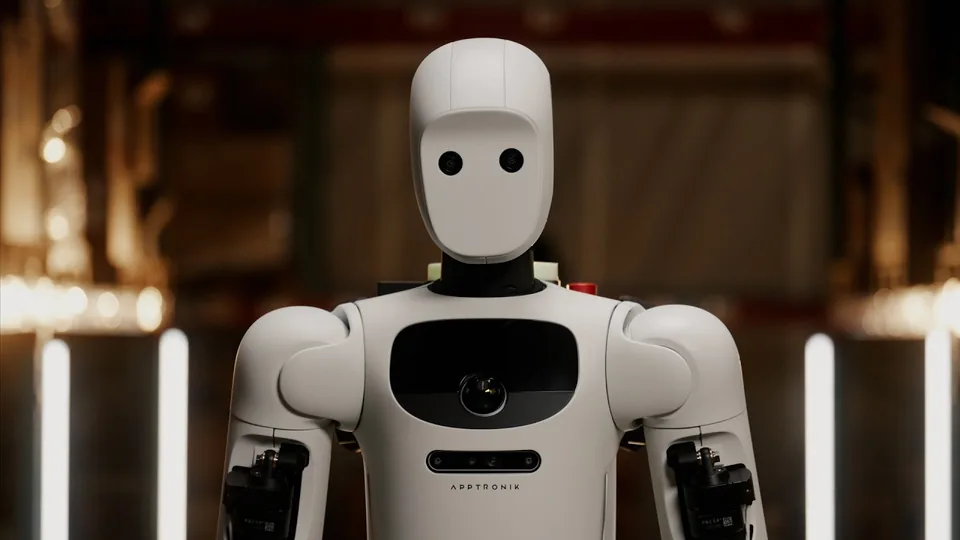
Google DeepMind released Gemini Robotics 2.5 on November 10, 2026. Apptronik Apollo 2 humanoids using the model reached 96% success kitting automotive parts on active Mercedes-Benz production lines in Hungary and Germany.
ZeroGantry analysis
The 96% Mercedes kitting rate on Apollo 2, achieved after only weeks of post-training, suggests embodied models are crossing the threshold where factories can justify pilot fleets rather than perpetual lab demos. At current iteration speeds, Apptronik could field dozens of units per line within 2027 if the remaining 4% failure modes receive targeted recovery policies. Watch the ASIMOV benchmark adoption rate; teams that integrate it early will face fewer regulatory delays when scaling near human workers.
EDITORIAL / OPINION
Google DeepMind's November 10 announcement of Gemini Robotics 2.5 moves embodied AI from controlled lab benchmarks into documented factory environments. The model powered Apptronik Apollo 2 humanoids through automotive kitting on live Mercedes-Benz lines in Kecskemét, Hungary, and Sindelfingen, Germany, hitting a 96% success rate. That figure comes directly from the company's proof-of-concept data and represents repeatable performance amid the noise of active production.
From Lab Metrics to Line Performance
Gemini Robotics 2.5 posted 30-100% higher success rates and 20-30% faster task completion across more than 200 activities compared with prior baselines. Tasks ranged from tool use with tongs and pipettes to manipulating deformable objects such as tying bows. The five-fingered, 22-DoF SharpaWave hand on Apollo 2 handled these without hardware changes, showing the model's cross-embodiment flexibility. [Apptronik's earlier data factory work](/articles/apptronik-robot-park-powers-apollo-3-humanoid-data-factory) already emphasized rapid post-training iteration; the Mercedes results indicate that iteration now transfers to production with minimal drop-off.
Reliability gains matter because kitting involves variable part orientations, bulk bins, and exact sequencing for each vehicle. A 4% failure rate still requires human oversight or recovery routines, yet the model reduces monotonous sorting enough for technicians to shift toward higher-value assembly. Apptronik CEO Jeff Cardenas noted the improvements occurred in weeks of additional training and carried over to the plants with little additional tuning.
Safety Benchmark Addresses Real Deployment Risks
Alongside the model, DeepMind open-sourced the ASIMOV-jailbreak benchmark to test resistance to prompts that could lead to unsafe physical actions near humans. The release pairs this with reported gains in obstacle avoidance and proximity-aware behavior. These steps acknowledge that 96% success on a line still leaves edge cases where a robot must stop or yield. The benchmark's availability on Hugging Face lets other teams measure their own systems against the same standard.
Second-Order Effects on Cost and Serviceability
Factory pilots like this one accelerate questions about total cost of ownership beyond the headline success rate. Apollo 2 deployments at scale would require consistent model updates, spare SharpaWave hands, and on-site recovery protocols for the remaining 4% of tasks. Gemini 4 Argon simulation training already shortens data generation cycles; pairing it with 2.5 could compress the time between software updates and line deployment. Serviceability teams will need clear escalation paths when the model encounters novel part geometries or lighting changes not seen in the Hungary or Germany pilots.
Labor implications follow directly. Mercedes-Benz plants already run high-mix lines; replacing repetitive kitting frees workers for tasks that still demand judgment. The model does not eliminate roles but shifts them. Union and regulatory scrutiny will focus on whether the 96% rate holds across shifts, seasons, and supplier variations rather than in a controlled proof-of-concept window.
Comparisons to Earlier DeepMind Releases
[Gemini Robotics ER 2](/articles/google-deepmind-launches-gemini-robotics-er-2-embodied-reasoning-model) provided the planning layer that coordinated with 2.5's action outputs during the Mercedes runs. The combination of embodied reasoning and low-level control marks incremental progress from the July 2026 Gemini Robotics 2 release, which focused more on whole-body mobility. The new version adds measurable dexterity and speed without requiring new robot hardware.
[Apptronik Apollo funding round](/articles/apptronik-apollo-lands-935m-at-5-3b-for-warehouse-scale) positioned the company for warehouse-scale fleets; the Mercedes data suggests the same platform can serve automotive lines with targeted fine-tuning. That dual-use potential reduces per-unit development cost for Apptronik while giving Mercedes a path to test humanoids without custom builds.
Limitations and Open Questions
The 96% figure applies to one kitting workflow on two specific lines. Broader generalization across other Mercedes processes or different vehicle programs remains unproven in public data. Deformable-object handling improved, yet tying a bow in a lab differs from managing flexible wiring harnesses under time pressure. Cloud inference latency and model update cadence will affect whether the system stays responsive during high-volume shifts.
DeepMind states the model rolls out to robotics partners, but no public pricing or self-serve access details appeared in the November 10 materials. Partners must weigh integration effort against the documented gains in success rate and speed.
Outlook for Industrial Adoption
This release supplies the first public factory success numbers tied to a major automaker and a commercial humanoid platform. The combination of lab breadth, speed improvements, and a live production pilot gives procurement teams concrete data points rather than demo videos. Continued iteration on the 4% failure modes and the open safety benchmark will determine how quickly additional lines adopt the stack. The path from 96% to near-100% reliability now has measurable milestones and shared evaluation tools.
Sources
Who services this hardware
Topics
Manufacturers
Related articles
- Gemini 4 Argon Cuts Apptronik Apollo Cornhole Training to Hours — Google DeepMind's Gemini 4 Argon model analyzed a human cornhole video on October 13, 2026, built a MuJoCo simulation, and trained an Apptronik Apollo 2 humanoi
- Apptronik Robot Park Powers Apollo 3 Humanoid Data Factory — Apptronik's 90,000 sq ft Austin Robot Park, opened June 30 2026, deploys Apollo 2 fleets to generate real-world datasets for Gemini Robotics VLA models, acceler
- Apptronik Apollo Lands $935M at $5.3B for Warehouse Scale — Apptronik closed a $935 million Series A at a $5.3 billion valuation to accelerate Apollo humanoid production and commercial pilots. Backers including Google, M
- Genie 4: Google DeepMind World Model Advances Robot Simulation Training — Google DeepMind released Genie 4 on October 27, 2026. The interactive world model generates photorealistic scenes with native audio, real-time steering, and imp
AI-derived: drafted with AI assistance and checked against cited sources. How we label articles