Players · AI-derived
Apptronik Apollo Lands $935M at $5.3B for Warehouse Scale
Apptronik closed a $935 million Series A at a $5.3 billion valuation to accelerate Apollo humanoid production and commercial pilots. Backers including Google, Mercedes-Benz, and John Deere signal strong demand for AI-driven humanoids in logistics and manufacturing. The round positions the Austin firm to challenge Tesla Optimus and Chinese rivals through expanded fleet deployments.
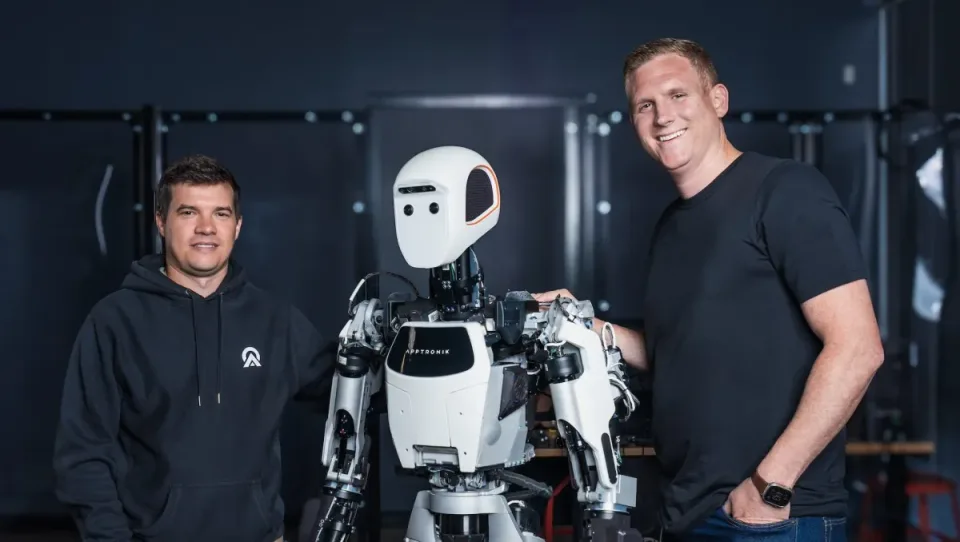
Funding Milestone and Strategic Backers
Apptronik, the Austin-based developer of the Apollo humanoid, completed a landmark Series A totaling over $935 million. This comprised an initial $415 million tranche followed by a $520 million extension round closed in February 2026. The extension valued the company at approximately $5.3 billion post-money, representing a roughly threefold increase from the initial Series A pricing. Key participants include Google, Mercedes-Benz, B Capital, John Deere, Qatar Investment Authority, AT&T Ventures, and PEAK6. These investors bring not only capital but also direct pathways into automotive manufacturing, agricultural equipment, and cloud AI ecosystems.
The capital infusion targets production ramp-up, new training facilities, and a next-generation platform developed in partnership with Google’s Gemini robotics team. Total funding now approaches $1 billion, underscoring investor conviction in Apollo’s path to commercial volume.
Commercial Pilots and Early Deployments
Apptronik has already initiated pilot programs with Mercedes-Benz in manufacturing logistics tasks such as kitting, parts delivery, and inspection. Additional collaborations include Jabil for both building Apollo units and deploying them in intralogistics workflows. Industry reports also reference GXO warehouse operations as a potential venue for fleet testing. These pilots emphasize repetitive, high-mix material movement where humanoids can operate alongside existing automation.
From a fleet control perspective, early deployments highlight the need for orchestration layers that coordinate multiple Apollos across dynamic warehouse floors. Unit economics remain opaque; however, the scale of this raise implies management targets sub-$50,000 per-unit pricing at volume to achieve positive ROI versus human labor in 24/7 logistics settings.
MTBF Realities and Reliability Engineering
Public data on Apollo’s mean time between failures (MTBF) is limited. Industry observers note that current humanoid platforms typically achieve 500–2,000 hours MTBF in controlled pilots, far below the 10,000+ hours required for profitable multi-shift warehouse operation. Apptronik’s Jabil collaboration includes real-world validation on production lines, which should generate the first statistically significant reliability datasets. Investors will scrutinize these metrics closely, as each 1,000-hour MTBF improvement directly impacts total cost of ownership through reduced maintenance crews and spare-part inventories.
Unit Economics and Path to Scale
At $5.3 billion valuation, the market is pricing in aggressive cost-down curves. Hardware bills of materials for high-torque actuators, harmonic drives, and integrated force-torque sensing remain the dominant expense. Apptronik’s partnership with contract manufacturer Jabil is expected to accelerate learning-curve effects. Analysts estimate that achieving 1,000 units per year could bring landed cost below $40,000, enabling payback periods under 18 months in high-labor-cost regions when utilization exceeds 80 percent.
Fleet orchestration software will be decisive. Centralized planners must optimize task allocation, battery swap cycles, and predictive maintenance across heterogeneous environments. Without transparent MTBF and energy-consumption figures, unit economics models stay speculative.
Technical Architecture and Hardware Stack
Architecture Apollo leverages a hybrid control stack combining model predictive control for locomotion with learned policies for manipulation. The Google Gemini partnership suggests integration of large multimodal transformers for high-level task planning and scene understanding.
Actuators and Sensors Hardware centers on custom high-torque electric actuators with integrated harmonic drives, six-axis force-torque sensors at each joint, and wrist-mounted depth cameras. Onboard compute likely includes NVIDIA Jetson-class modules for real-time inference, though exact configurations remain undisclosed.
Limitations Current drawbacks include high energy consumption during dynamic locomotion, latency in cloud-offloaded planning, mechanical fragility at joint interfaces, and capital cost that still exceeds most warehouse automation budgets. Battery endurance limits continuous duty cycles without frequent swaps or charging infrastructure.
Unresolved Questions How will Apptronik publish standardized MTBF and energy-per-task metrics? What latency targets are required for safe multi-robot coordination without teleoperation fallback? Can unit economics reach parity with AMR fleets before 2028?
Autonomy Assessment Apollo’s architecture emphasizes learned end-to-end policies trained on both simulation and real factory data. While early pilots may incorporate supervised teleoperation for edge-case recovery, the Gemini integration points toward progressive reduction in human oversight. True autonomy will be demonstrated when fleets execute multi-hour missions with zero remote intervention and maintain safety certifications in unstructured environments.
Sources
- https://techcrunch.com/2026/02/11/humanoid-robot-startup-apptronik-has-now-raised-935m-at-a-5b-valuation/
- https://www.reuters.com/technology/humanoid-startup-apptronik-raises-520-million-with-backing-google-mercedes-benz-2026-02-11/
- https://www.forbes.com/sites/johnkoetsier/2026/02/11/apptronik-scores-935-million-hits-top-3-for-humanoid-robotics-funding/
- https://apptronik.com/news-collection/apptronik-closes-over-935-million-series-a
Who services this hardware
Topics
Related articles
- Rohit Prasad Appointed Boston Dynamics CEO for Atlas Push — Boston Dynamics named Rohit Prasad, former Amazon Alexa and AGI leader, as CEO effective October 7, 2026. He replaces interim chief Amanda McMaster following Ro
- Hello Robot Stretch Wins $3M NIH Grant for Elder Care Dementia Support — Hello Robot received a nearly $3 million NIH grant to advance its Stretch mobile manipulator for older adults with mild cognitive impairment or early Alzheimer’
- BMW Leipzig Humanoid Robot Pilot Advances with Hexagon AEON — BMW Group has launched a pilot deploying Hexagon Robotics' AEON humanoid at its Leipzig plant for high-voltage battery assembly and component manufacturing. The
- Amazon Dobromierz Deploys 5,000 Robots in Polish Fulfillment Center — Amazon opened its 12th Polish fulfillment center in Dobromierz on September 21, 2026. The 200,000 m² four-story facility uses over 5,000 Amazon Robotics units a