Brain · AI-derived
Apptronik Robot Park Powers Apollo 3 Humanoid Data Factory
Apptronik's 90,000 sq ft Austin Robot Park, opened June 30 2026, deploys Apollo 2 fleets to generate real-world datasets for Gemini Robotics VLA models, accelerating Apollo 3 embodied intelligence for warehouse tasks through neural controllers and RL-driven manipulation.
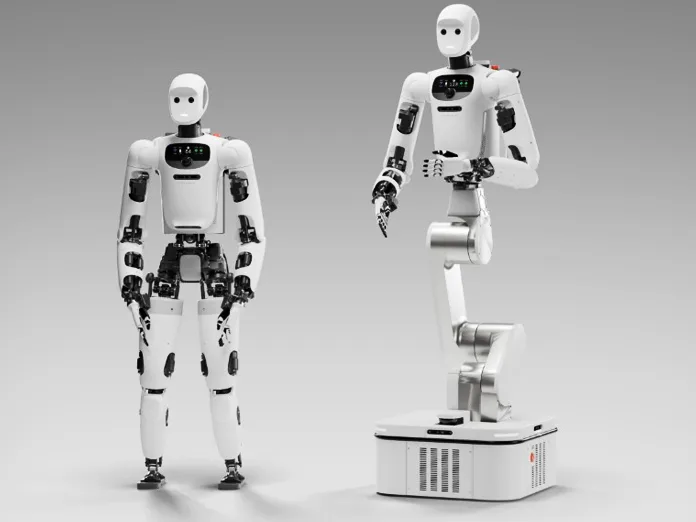
Scaling Real-World Data for Vision-Language-Action Models
Apptronik's June 30 2026 unveiling of the expanded Robot Park facility in Austin marks a pivotal infrastructure investment in the humanoid data arms race. The nearly 90,000-square-foot site serves as a dedicated data factory where fleets of Apollo 2 platforms perform continuous logistics, manufacturing, and retail tasks to capture high-fidelity interaction data. This approach directly addresses the limitations of simulation-only training by prioritizing diverse, contact-rich scenarios that feed into vision-language-action (VLA) transformers such as Google DeepMind's Gemini Robotics models. Unlike purely synthetic datasets, the Park's output includes synchronized multimodal streams—RGB-D vision, proprioception, force-torque, and language annotations—enabling zero-shot generalization in downstream policies.
The partnership with Google DeepMind integrates these datasets into Gemini Robotics VLA training loops, where transformer-based architectures process tokenized visual observations alongside natural language instructions to predict action sequences. Technical analyses from the announcement highlight how Apollo 2's modular design supports both bipedal and wheeled embodiments, allowing ablation studies on locomotion priors that influence manipulation stability. Reinforcement learning components likely refine these VLA outputs through online fine-tuning, using reward signals derived from task success metrics like grasp stability and cycle time. This hybrid pipeline—VLA for high-level planning and RL for low-level torque mapping—represents a concrete step beyond earlier reactive controllers.
Neural Controllers and Torque Mapping in Apollo 2 Platforms
Apollo 2 specifications underscore the hardware constraints that the Robot Park data must overcome. Standing approximately 6 feet tall and weighing around 160 pounds, the platform delivers four-hour runtime on a single charge while achieving 55-pound two-handed lifts. These metrics inform neural controller design, where end-to-end policies map visual-language embeddings to joint torques via learned dynamics models. In practice, the Park's 24/7 operation generates terabytes of interaction data daily, capturing edge cases such as deformable object handling and multi-robot coordination that pure RL from scratch would require prohibitive sample volumes to discover.
Vision-language-action transformers benefit from this scale because they leverage cross-embodiment pretraining on Gemini Robotics, which already supports platforms ranging from ALOHA arms to full humanoids. The resulting controllers exhibit improved sample efficiency when transferred to Apollo 3, with the Park serving as the primary real-world validation environment. Analysts note that torque-level feedback loops, refined through the facility's operator-guided sessions, mitigate sim-to-real gaps that have historically plagued manipulation policies in unstructured warehouses.
Reinforcement Learning Pipelines for Dexterous Manipulation
Reinforcement learning for manipulation gains critical momentum from Robot Park's structured yet varied task distributions. Apollo 2 units execute repetitive pick-and-place, sorting, and conveyor loading cycles under human supervision, producing dense reward signals for policy optimization. These RL stages operate downstream of VLA planning, using techniques such as offline RL on logged trajectories followed by online fine-tuning to achieve reliable contact-rich behaviors. The facility's global network expansion plans suggest distributed data collection that will further diversify the state-action distribution, addressing covariate shift in embodied AI.
Partnership data flows into Gemini Robotics 1.5 iterations, which incorporate agentic capabilities for tool use and long-horizon reasoning. This integration exemplifies how physical data factories close the loop between foundation model pretraining and deployment-ready controllers. Specific metrics from the June announcement indicate that Apollo 3 will inherit out-of-the-box intelligence directly from these streams, reducing the need for extensive customer-site fine-tuning.
Challenges in Generalization and Data Quality
Despite the scale, limitations persist in achieving robust zero-shot performance across novel warehouse layouts. Apollo 2's current sensor suite—primarily vision and proprioception—may under-sample tactile or auditory cues critical for failure detection during RL rollouts. The wheeled versus bipedal variants introduce embodiment-specific biases that VLA models must disentangle, potentially slowing cross-platform transfer. Industry observers highlight that even 90,000 square feet cannot replicate the full diversity of real customer environments, necessitating the planned multi-site network.
Unresolved questions center on data curation efficiency: how to filter low-value trajectories without discarding rare but informative failure modes, and whether current VLA architectures scale compute-efficiently to the volume generated by continuous fleet operation. Apollo 3 timelines, teased for 2027, will test whether the Park's datasets suffice for production-grade reliability without additional billions of simulated steps.
Strategic Implications for Embodied AI Infrastructure
Robot Park exemplifies the emerging paradigm where physical data factories rival compute clusters in strategic importance. By anchoring Apollo 2 operations to Gemini Robotics advancement, Apptronik positions itself to deliver Apollo 3 humanoids with superior manipulation dexterity from day one. This infrastructure play accelerates the transition from prototype humanoids to fleets capable of warehouse autonomy, directly impacting sectors reliant on flexible labor. Continued expansion will determine whether real-world VLA training becomes the dominant pathway for next-generation neural robotic controllers.
Topics
Related articles
- Unitree G1 Humanoids Shine on AGT Finale with Synchronized Dance — Eight Unitree G1 humanoids joined dancer Wu Yufei for a water-sleeve dance routine on the America's Got Talent Season 21 finale on September 22, 2026. The perfo
- Google DeepMind Gemini Robotics 2 Scales via Software Partnerships — Google DeepMind released Gemini Robotics 2 on July 30, 2026, delivering vision-language-action models for whole-body humanoid control, dexterity, and multi-robo
- NVIDIA Expands Open Physical AI Stack with OpenUSD for Humanoids — NVIDIA released updates to its open physical AI stack on September 30, 2026, built around OpenUSD and Omniverse for reusable digital twins in humanoid training
- Skild AI S1 Soccer Skills Emerge from 140 Years of Self-Play — Skild AI announced September 23 that its S1 foundation model learned complex humanoid soccer behaviors through self-play in NVIDIA Isaac Sim. The policy, traine