Whisper Network
CHRT Certification Launches for Humanoid Robot Repair and Fleet Maintenance
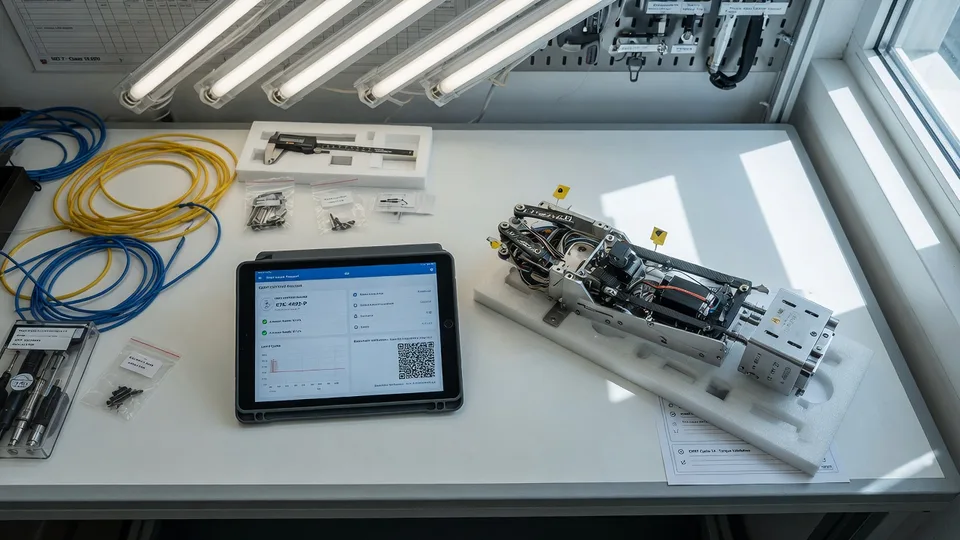
RobotCare has introduced the CHRT credential and Robot Health Passport to support maintenance of humanoid robot fleets. The 15-week program targets technicians working across multiple OEM platforms ahead of wider deployments.
ZeroGantry analysis
The CHRT program targets the exact bottleneck where MTBF data and service history determine whether RaaS contracts clear underwriting at scale. With 210 hours across 15 platforms and blockchain-anchored records, it could compress diagnostic cycles from days to hours once the Q3 2026 directory goes live. Operators running mixed fleets of Optimus Gen 2, Figure 02, and Digit should watch credential uptake closely; early adopters gain verifiable collateral value while laggards face higher insurance loadings.
Addressing the Humanoid Maintenance Gap
RobotCare, LLC announced the Certified Humanoid Robot Technician (CHRT) program on its platform in July 2026. The initiative responds to growing deployments of platforms including Tesla Optimus Gen 2 and Figure 02 Humanoid, where mean time between failures remains a concern for operators. The 15-week, 210-hour curriculum covers actuator systems, battery safety, and AI diagnostics across 15 major OEM platforms. Alignment with ANSI/A3 R15.06-2025 and ISO 13482 standards ensures workflows meet established safety benchmarks for industrial robots.
Fleet operators face immediate pressure as commercial pilots expand. Agility Robotics Digit has logged paid deployments at nine sites, while Figure AI systems have operated continuously for eleven months at BMW facilities. Without standardized service records, insurers and lenders lack data to underwrite residual values or price risk. RobotCare positions the Robot Health Passport as the neutral layer that records every calibration and repair with PKI signatures and blockchain anchoring.
CHRT Curriculum and Platform Coverage
The certification combines a proctored written exam across twelve core modules with a live field evaluation. Graduates receive Service-Ready designation on the RobotCare network, enabling dispatch for cross-OEM repairs. AR-guided workflows direct technicians through sequences that satisfy both ANSI/A3 R15.06-2025 and ISO 13482 requirements. The program explicitly includes platforms such as Unitree H1, Apptronik Apollo, and 1X NEO.
Hands-on modules address actuator alignment, sensor calibration, and predictive diagnostics tied to the patent-pending HR IV algorithm. This algorithm converts verified service history into insurable value metrics for secondary markets. Full CHRT directory access at chrttechnician.com is scheduled for Q3 2026, with sample records already illustrating credential IDs in the CHRT-YY-XXXXXX format.
Robot Health Passport Technical Implementation
The Robot Health Passport stores lifecycle data as tamper-evident entries signed with public-key infrastructure. Each service event links to the performing CHRT technician's credential record, creating an auditable chain from factory calibration through field repairs. Predictive diagnostics draw on multi-OEM telemetry to flag failures 12 to 48 hours in advance, routing parts under a four-hour SLA target.
The system supports RaaS financing models by providing lenders with verifiable maintenance provenance. Comparable automotive data platforms such as CDK Global and Mitchell International reached multi-billion-dollar valuations precisely because they held neutral service records. RobotCare aims to replicate that position for humanoid fleets, where Goldman Sachs now projects 1.4 million annual shipments by 2035.
Standards Alignment and Industry Context
CHRT training explicitly references the July 2026 policy framework issued by Agility Robotics CEO Peggy Johnson. That document called for technician training pipelines and industry-led safety frameworks to support scaling. RobotCare, an A3 Association for Advancing Automation member and IEEE RAS participant, supplies the neutral verification layer that individual OEMs cannot provide for their own fleets.
The credential also incorporates EU Machinery Regulation 2023/1230 and GDPR-ready data handling. Fleet operators can filter technicians by geography, competency tier, and sector endorsement before dispatch, reducing SLA risk. Insurers gain direct access to PKI-signed records for claims review and loss prevention.
Workforce Pipeline and Deployment Timing
The maintenance gap emerges as hardware production accelerates toward industrial volumes. Tesla has begun converting Fremont toward million-unit annual Optimus capacity, while China's MIIT already mandates lifecycle tracking for more than 28,000 deployed humanoids. A U.S. manufacturing labor shortfall nearing 500,000 unfilled positions today underscores the need for targeted technician training.
RobotCare plans to expand the CHRT network through partnered technical institutes. Graduates enter a dispatch system that tracks every repair against their credential, compounding cross-OEM datasets unavailable to any single manufacturer. The platform's patent-pending elements focus on translating maintenance quality directly into lower insurance premiums and higher resale values.
Implications for OEMs and Operators
OEMs benefit from warranty integrity protection when third-party providers hold active CHRT credentials. Fleet operators gain a single directory to confirm technician status before scheduling service on mixed fleets containing Atlas Electric, Sanctuary AI Phoenix, or Fourier GR2 units. The blockchain-anchored records also support secondary-market transactions by establishing clear provenance.
As deployments move from pilot to production scale, the absence of standardized service infrastructure limits ROI justification. RobotCare's combined credential and passport system supplies one operational layer connecting OEMs, operators, insurers, and technicians. Full directory activation in Q3 2026 will test whether the market adopts this neutral record as the default for humanoid fleet management.
Sources
Related dispatches
- LimX Dynamics Centaur Robot Tests Humanoid Limits at WAIC 2026 — LimX Dynamics unveiled its centaur-style wheel-leg hybrid robot at WAIC 2026 in Shanghai on July 20. The design targets rugged terrain transport and inspection
- Agility Robotics Opens 60,000 Sq Ft Fremont Facility for Digit AI Training — Agility Robotics opened a 60,000-square-foot facility in Fremont, California, on July 16, 2026, to train and advance its Digit humanoid robot. The site supports
- ISO 25785-1 Sets Safety Rules for Dynamically Stable Humanoids — ISO 25785-1 is advancing as the key safety standard for industrial mobile robots with active stability control, including humanoids and legged systems. It addre
- 1X NEO Hands: 25-DoF Tendon Upgrade Targets Home Dexterity — 1X Technologies unveiled 25-DoF tendon-driven hands for its NEO humanoid on July 9, 2026. The design adds force-controlled joints and tactile sensing to support