Players · AI-derived
Vesoma Launches Self-Improving Humanoid in Munich
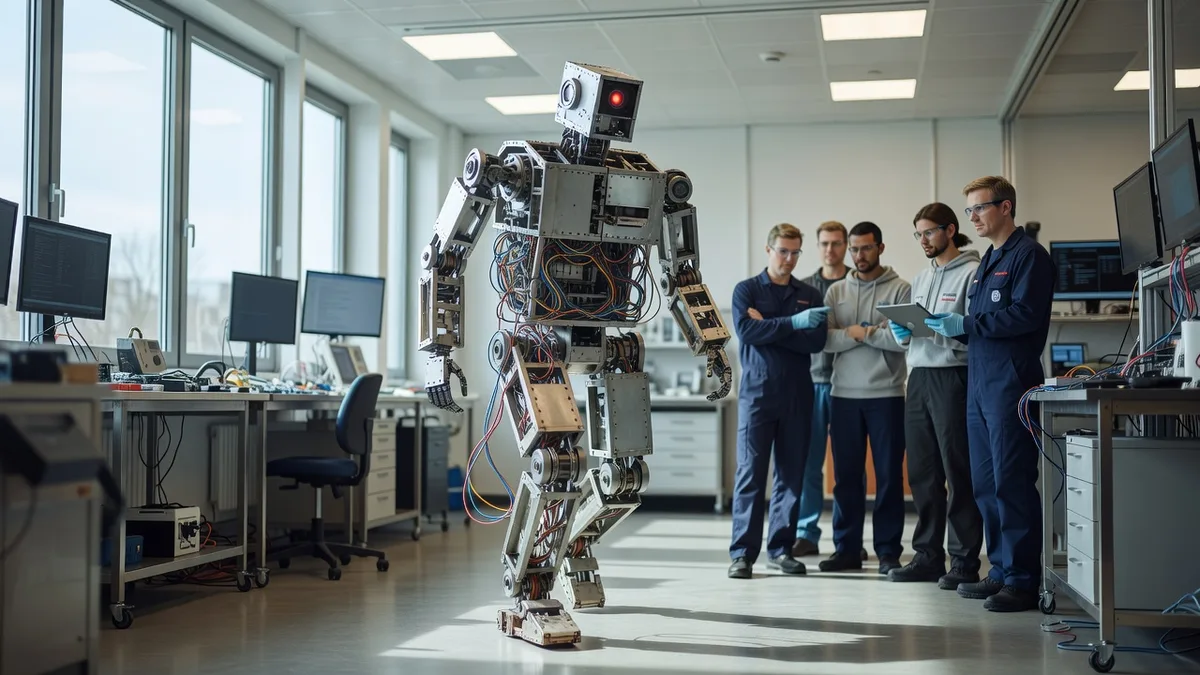
Vesoma emerged from stealth on September 22 with a European humanoid that learns tasks through its own physical interactions rather than human demonstrations. The Munich and Limassol startup, now over 60 people, has already walked prototypes and targets manufacturing and logistics customers.
ZeroGantry analysis
Vesoma's six-month walk milestone on a learned policy is faster than most peers' timelines but still leaves the harder manipulation and reliability phases unproven; with 60+ staff and 3500 sqm facilities already in place, the company can iterate hardware aggressively before capital markets demand revenue. Watch for early 2027 task benchmarks against imitation-trained systems like early Optimus or Figure 02. Ignore unless concrete intervention-rate data emerges.
Vesoma Breaks Cover with Distinct Learning Strategy
Vesoma registered in December 2025 and went public on September 22, 2026, after building its first walking humanoid prototypes in just six months. The company operates labs totaling more than 3,500 square meters across Munich, Germany, and Limassol, Cyprus. Its approach centers on a physics-grounded agent that improves by exploring failures on real hardware instead of relying primarily on imitation learning from human data. This method produced an early locomotion policy without engineered gaits, and the firm now advances Vesoma 1 units while iterating on manipulation and whole-body tasks.
The self-improving philosophy addresses a core industry limitation: robots trained on demonstrations often fail outside narrow distributions and lack mechanisms to recover autonomously. Vesoma argues that contact-rich work in unstructured environments demands competence grounded in physics, not recorded examples. Early results remain limited to locomotion milestones, with no public metrics yet on intervention rates or full-shift reliability in customer-like settings. The company plans to close that gap through rapid hardware-software loops that compound weekly gains.
Leadership Draws from Industrial Robotics and DeepMind
CEO and co-founder Nikolai Ensslen previously co-founded Synapticon, a specialist in motion control and functional safety hardware now used across multiple robot platforms. Chief AI Officer Martin Riedmiller joined from Google DeepMind, where he led the Control Team and advanced data-efficient reinforcement learning techniques already adopted by other labs. Co-founder Peter Skoromnyi brings scaling experience from Easybrain, the logic-puzzle games company. Head of design Marcelo Gutierrez previously contributed to Tesla Optimus, Apptronik Apollo, and Cartwheel Yogi projects.
This combination of actuator and safety expertise with reinforcement learning research gives Vesoma an integrated stack from day one. The team explicitly commits to European safety standards and long-term serviceability rather than short-cycle consumer electronics approaches. Operations lead Jonas Reinecke adds precision-manufacturing background from Daedalus. The firm states it will not pursue weapons, military, or surveillance applications.
European Context Amid Global Consolidation
Vesoma positions itself as a homegrown European player in a sector dominated by US and Asian efforts. It cites the region's industrial base, systems-engineering depth, and safety culture as advantages for building reliable physical infrastructure. Initial target markets include manufacturing, logistics, and warehousing, where labor shortages are acute and environments reward adaptable mobility and dexterity.
In parallel, industry structure continues shifting. Hyundai Motor Group completed its acquisition of SoftBank's remaining stake in Boston Dynamics in mid-2026, securing full ownership of the Atlas platform. Reports indicate discussions around transferring the separate Robotics and AI Institute (RAI), founded by Marc Raibert, to SoftBank, effectively splitting advanced research from Boston Dynamics commercialization activities. This move gives Hyundai clearer control over factory deployment timelines, including planned Atlas use in a Georgia plant starting 2028. Vesoma's independent European base contrasts with such cross-border ownership realignments.
Technical Path and Early Milestones
Vesoma 1 design visualizations show a humanoid form factor optimized for end-to-end policy training rather than retrofitted industrial components. The alpha prototypes already operating in the lab demonstrate learned walking, but the company acknowledges that extending self-improvement to dexterous manipulation and variable environments remains the core challenge ahead. Hardware choices prioritize closed-loop sensing and actuation that support rapid iteration without external data pipelines.
The firm emphasizes that owning both agent and body accelerates learning because kinematic and dynamic parameters can be co-optimized. Safety architectures developed by the team are intended to guide behavior from the first design iteration, including legible failure modes and data-handling rules that keep customer operational data confidential while allowing capability improvements to propagate fleet-wide.
Market Timing and Next Steps
Europe faces projected euro-area labor force shrinkage of around 11 million by 2035 due to aging demographics, amplifying demand for reliable humanoid systems in structured yet variable work. Vesoma has begun conversations with prospective customers in its initial sectors and states that first Vesoma 1 units are now under construction. No customer delivery dates or pricing have been disclosed.
The September 22 launch drew immediate attention from robotics observers tracking European entrants alongside established names. Continued progress will be measured by concrete task performance metrics, intervention frequency reductions, and hardware durability under repeated training cycles rather than demonstration videos alone.
Sources
Topics
Related articles
- Mercedes-Benz Apollo Humanoid Pilots Advance at Berlin and Kecskemét Plants — Mercedes-Benz continues its Apptronik Apollo humanoid pilots at the Digital Factory Campus in Berlin-Marienfelde and the Kecskemét plant in Hungary. The robots
- UBTECH UWORLD U1 First Deliveries Begin in China — UBTECH has started shipping the first UWORLD U1 consumer humanoid robots to Chinese buyers after 13,000 pre-orders. The move tests whether full-size emotional c
- ICE Forecasts $1-2M Boston Dynamics Spot Robot Buy for Public Safety — U.S. Immigration and Customs Enforcement plans a sole-source purchase of Boston Dynamics Spot quadrupeds worth $1-2 million. The robots would handle remote insp
- Amazon Proteus Fleet Expansion Hits New North American Sites — Amazon has expanded its Proteus autonomous mobile robot fleet to additional fulfillment centers across North America. The robots now handle heavy and bulky item