Players · AI-derived
Tuya Doova and OlloBot OlloNi SS1 Debut Elder Care Robots at IFA 2026
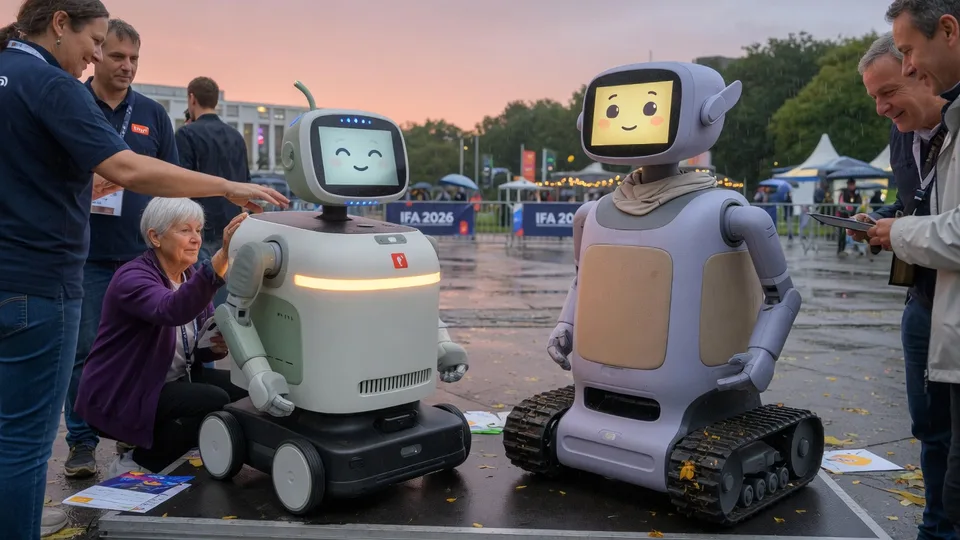
Tuya Smart launched the wheeled Doova companion robot at IFA 2026 for seniors living alone, featuring fall response, LLM conversation, and smart-home control. OlloBot introduced the OlloNi SS1 in Europe with emotional AI for ongoing family interaction.
ZeroGantry analysis
Tuya’s Doova leverages an existing IoT platform for faster ecosystem integration than pure-play robot startups, potentially achieving lower customer acquisition costs through smart-home bundling. OlloBot’s emotional recording module introduces novel data-retention mechanics that could complicate GDPR compliance yet differentiate retention metrics. Watch both for pilot deployment numbers in 2027; ignore if they remain demo-only without published uptime or engagement data.
Tuya Doova Targets Independent Seniors with Proactive Safety Features
Tuya Smart unveiled Doova at IFA 2026 in Berlin as a wheeled AI companion built specifically for older adults living independently. The robot uses LDS LiDAR for navigation, a four-microphone array for sound localization, and AI vision with skeletal tracking to respond when a user calls for help. Upon detecting an emergency, Doova rolls to the person, assesses posture, and if no response occurs within 60 seconds, initiates a two-way video call to family members. This workflow addresses the critical delay between a fall and external awareness without relying on automatic fall detection alone.
Daily functions extend beyond emergencies. A multimodal large language model powers natural conversations, document reading, scam flagging, and schedule management. The 10.1-inch display supports dynamic facial expressions and sits at a height suitable for standing, seated, or reclining users. Doova also serves as a mobile smart-home hub within Tuya’s AIoT ecosystem, controlling lights, appliances, and other connected devices through voice commands. When away, it patrols selected room centers for 360-degree scans and generates security reports sent to a smartphone.
Design choices emphasize approachability over industrial aesthetics. Soft curves and a knitwear-like presentation at the show reduce the mechanical feel common in robots. Autonomous docking handles recharging without user intervention. Pricing, battery runtime, and detailed privacy architecture were not disclosed at launch, leaving open questions about long-term ownership costs and data handling in home environments.
OlloBot OlloNi SS1 Emphasizes Emotional Continuity Over Task Execution
OlloBot debuted the OlloNi SS1 at IFA Berlin with a focus on sustained emotional presence rather than physical assistance or emergency protocols. The robot incorporates the EmpathCore emotional intelligence engine and Affinilog recording system to learn user habits, emotional states, and routines through repeated interactions. A removable Memory Heart Module stores these connections portably, preserving interaction history across device changes.
Physical responses include touch, sound, and facial expressions that make companionship feel tangible. Auto Capture records family moments with permission, while proactive behaviors allow the robot to approach users or greet them based on recognized voices and faces. The design targets multiple household members, including seniors seeking non-intrusive daily stimulation and children returning from school.
OlloBot postponed its planned Kickstarter campaign from late August due to product readiness and regulatory considerations, with no revised date announced. Demonstrations continued through September 8 at the company’s IFA booth. This measured rollout reflects caution in bringing emotionally oriented consumer robots to European and North American markets amid varying data-protection rules.
Market Context for Social and Care-Oriented Robotics in 2026
Both launches occur against rising demand for home-based elder support driven by aging populations. Tuya’s integration of safety sensors with conversational AI and smart-home control positions Doova as a practical extension of existing IoT platforms. OlloBot’s emphasis on long-term emotional modeling differentiates it from command-driven devices, potentially appealing to users who prioritize relational continuity.
Wheeled platforms like these avoid the complexity and cost of bipedal humanoids while delivering mobility within typical domestic spaces. Navigation relies on LiDAR and vision rather than advanced dexterity, lowering barriers to deployment in cluttered homes. Integration with established ecosystems such as Tuya’s AIoT further accelerates adoption compared with standalone hardware.
Privacy and reliability remain focal points. Doova’s camera use for posture assessment and video alerts raises questions about data retention and access controls, especially when alerts reach family members automatically. OlloBot’s emotional recording engine stores interaction histories, requiring clear user consent mechanisms. Manufacturers have not yet published detailed specifications on local processing versus cloud dependency.
Technical and Commercial Implications for Companion Robot Fleets
Fleet economics for these devices differ from industrial humanoids. Lower per-unit hardware costs from wheeled bases and consumer-grade sensors could support higher volumes in residential settings. Tuya’s existing developer tools and Matter compatibility may enable third-party extensions, creating recurring revenue through software features or ecosystem services. OlloBot’s community-focused Kickstarter approach aims to build early user feedback loops before wider distribution.
Production ramps will depend on supply-chain access to LiDAR modules, displays, and AI accelerators. Tuya’s global manufacturing partnerships provide an advantage in scaling Doova compared with newer entrants. Battery life and autonomous docking reliability will determine real-world uptime in homes where users may not perform maintenance.
Regulatory pathways in Europe and North America will influence timelines. Data-protection requirements around video monitoring and emotional data collection could delay full commercial availability. Both companies have highlighted user-controlled features, yet independent audits of these claims are still pending.
Competitive Landscape Among Home Companion Platforms
Doova and OlloNi SS1 join a growing set of non-industrial robots addressing social and care needs. Their wheeled forms and focused feature sets contrast with more ambitious humanoid projects aimed at broader task execution. Success will hinge on measurable outcomes such as reduced emergency response times, sustained user engagement metrics, and integration friction with existing home networks.
Tuya’s September 2026 announcements also includ
Sources
- https://www.humanoidsdaily.com/news/tuya-unveils-doova-an-ai-companion-robot-targeting-elder-care-and-smart-home-hubs
- https://theaiinsider.tech/2026/09/05/ollobot-debuts-companion-robot-olloni-ss-in-europe/
- https://www.prnewswire.com/news-releases/tuya-smart-unveils-doova-at-ifa-2026-an-ai-home-companion-robot-designed-to-support-independently-living-seniors-302870724.html
- https://apnews.com/press-release/globenewswire-mobile/press-release-e71794c492dd3247e08459a496f3d9c8
Related articles
- 1X NEO Beta Trial Program Starts Real-Home Household Testing — 1X Technologies has launched a limited NEO Beta Household Trial Programme. Select households worldwide will test the humanoid robot in their homes for three mon
- ICE Forecasts $1-2M Boston Dynamics Spot Robot Buy for Public Safety — U.S. Immigration and Customs Enforcement plans a sole-source purchase of Boston Dynamics Spot quadrupeds worth $1-2 million. The robots would handle remote insp
- Amazon Proteus Fleet Expansion Hits New North American Sites — Amazon has expanded its Proteus autonomous mobile robot fleet to additional fulfillment centers across North America. The robots now handle heavy and bulky item
- Tesla Optimus Supply Chain Orders for 5,000 Units Signal Fremont Ramp — Chinese supply chain reports indicate Tesla placed bulk component orders covering roughly 5,000 Optimus humanoids in early September 2026. The procurement follo