Brain
Skild AI Open-Sources Steel Solver for Scalable Robot Training
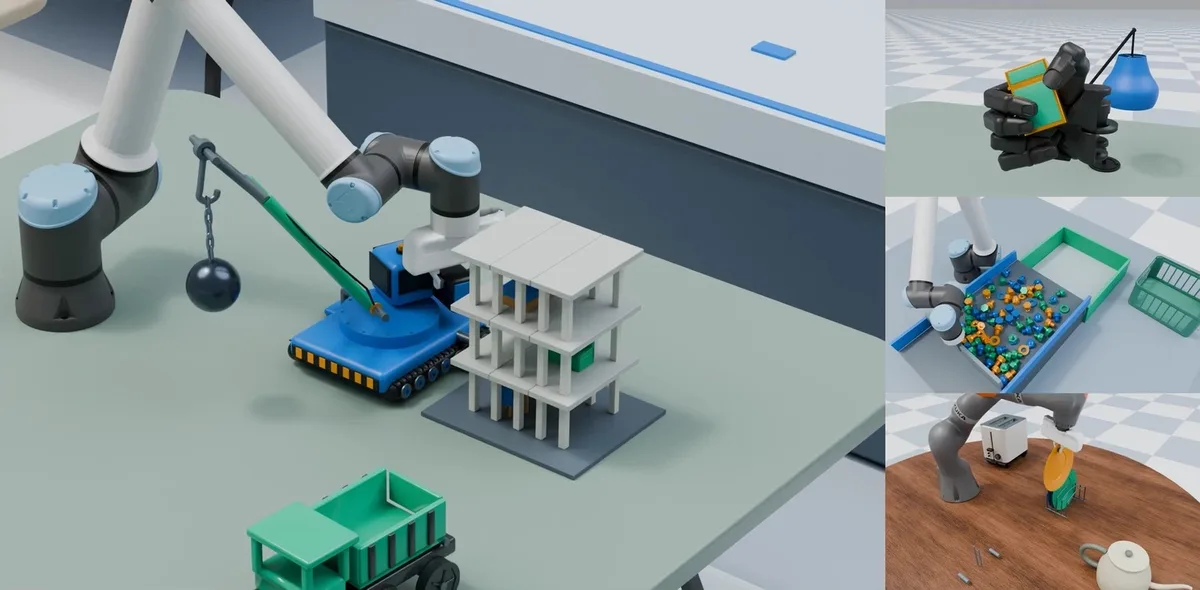
Skild AI released Steel, a GPU-accelerated rigid-body physics solver built with NVIDIA and integrated into the open-source Newton engine. The Apache 2.0 code delivers up to 13× PhysX throughput on heterogeneous manipulation tasks while using roughly 3× less GPU memory, enabling faster large-scale policy training across diverse robots.
ZeroGantry analysis
Steel's 13× heterogeneous throughput on 245,760 environments directly multiplies the feasible scale of VLA pre-training loops that mix morphologies. Labs previously limited to ~60k parallel scenes can now target 200k+ without proportional hardware growth, cutting per-policy training cost by roughly the same factor once observation and reset overheads are amortized. Watch for rapid forks into custom torque-mapping pipelines; ignore only if your workloads remain strictly homogeneous locomotion.
Steel Targets the Manipulation Simulation Bottleneck
Skild AI announced the open-source release of Steel on November 9, 2026, through its company blog and X account. The solver addresses a core limitation in current physics engines: they excel at homogeneous locomotion workloads but struggle with the millions of diverse, contact-rich manipulation tasks required for modern robot learning. Steel runs inside the Newton physics engine and integrates directly with NVIDIA Isaac Lab, sharing the same model representation and collision infrastructure.
Existing solvers often optimize for repeated copies of identical robots performing identical tasks. Manipulation demands variety across robot morphologies, object properties, and task sequences. Skild notes that coding agents now generate environments at scale, shifting the bottleneck to simulation throughput. Steel's design prioritizes heterogeneous batches that mix different robots and tasks in a single GPU run.
Exact Performance Numbers from Launch Benchmarks
On a single NVIDIA RTX PRO 6000 Blackwell GPU, Steel achieved 3.90 million environment steps per second across a 20-task mixture at 245,760 parallel environments. This figure represents 13.0× PhysX peak measured throughput. At the matched batch size of 61,440 environments, Steel delivered 3.61 million steps per second versus PhysX's 300,000, a 12.0× advantage, while consuming approximately 11 GiB of GPU memory compared with PhysX's 29 GiB.
Across 20 single-task robot-learning benchmarks in Isaac Lab, Steel posted a 3.8× geometric-mean throughput improvement over PhysX when each engine ran at its optimal batch size. The solver proved faster on 19 of the 20 tasks. These measurements count only physics stepping time at the host-return boundary, excluding observations, rewards, resets, and domain randomization.
Independent tests reported by third-party accounts shortly after launch confirmed strong scaling. One evaluation integrated Steel into Isaac Lab 3.0 and simulated an industrial machine-tending cell with a UR10e arm, Robotiq gripper, and 30 parts. PhysX sustained before crashing at 1,024, while Steel ran with successful placements on the same hardware.
Integration with Newton and Isaac Lab
Steel is distributed as `newton.solvers.SolverSteel` within the Newton 1.8 release candidate. Researchers can combine it with Newton's existing solvers; one demo shows Steel handling a rigid Franka arm while Newton's VBD solver manages a flexible cable. The Apache 2.0 license permits commercial use, modification, and redistribution. A WebGPU implementation called steel-webgpu ships alongside the CUDA solver, enabling browser-based interactive testing without installation.
The release aligns with NVIDIA's broader push into physical AI tooling. Newton serves as the physics backbone for Isaac Lab, which in turn supports reinforcement learning pipelines that train vision-language-action policies. Faster heterogeneous simulation directly benefits zero-shot generalization efforts by allowing larger, more varied training distributions within fixed compute budgets.
[Skild AI's earlier S1 model demonstrated in-context learning from single videos without weight updates](/articles/skild-ai-s1-soccer-skills-emerge-from-140-years-of-self-play). Steel's throughput gains could accelerate the data generation step that precedes such post-training phases. Similarly, the [Skild Brain omni-bodied VLA foundation model](/articles/skild-ai-s-1-4b-skild-brain-omni-bodied-vla-foundation-model) relies on massive simulation diversity; the new solver lowers the cost of producing that diversity.
Memory Efficiency and Scaling Implications
The reported memory reduction reaches roughly 62% in mixed-task workloads. Lower per-environment memory footprint allows either more parallel environments on the same GPU or reduced hardware requirements for equivalent scale. For labs running thousands of Isaac Lab environments, this translates to measurable reductions in cloud GPU hours or on-premise cluster size.
Torque mapping and contact-rich manipulation tasks benefit particularly because Steel maintains stability at high parallelism without the memory bloat that forces PhysX to smaller batches. Researchers can therefore increase the number of unique contact configurations per training epoch rather than simply repeating the same scene.
Limitations and Open Questions
Benchmarks focus on physics stepping speed rather than end-to-end training wall-clock time that includes policy inference and rendering. Stiff-contact tuning and contact-force sensor support remain areas for further work, as noted in early independent evaluations. The solver currently targets rigid-body dynamics; deformable or fluid interactions still require hybrid approaches with other Newton solvers.
Longer-term questions include how Steel's performance holds when policies close the loop with camera observations and domain randomization, and whether the geometric-mean gains persist across entirely new robot morphologies not present in the original 20-task suite. Skild encourages community contributions to address these gaps.
Connection to Broader Physical AI Ecosystem
The timing coincides with NVIDIA's ongoing updates to Isaac Lab and GR00T frameworks. [NVIDIA GR00T N2 Preview at GTC 2026](/articles/nvidia-gr00t-n2-preview-at-gtc-2026-advances-physical-ai) highlighted simulation as a foundational layer for physical AI. Steel provides a concrete, open-source lever that any Isaac Lab user can adopt immediately.
Weekly roundups such as [Robotics Week in Review: Oct 9–Oct 16, 2026](/articles/robotics-week-in-review-oct-9-oct-16-2026) and the September edition have tracked simulation advances as a recurring theme. Steel represents the first major open-source physics contribution from Skild, shifting the company from model-only releases toward shared infrastructure.
Practical Adoption Path
Developers can clone the Newton repository, enable the Steel solver, and sw
Sources
Topics
Related articles
- Skild AI's $1.4B Skild Brain: Omni-Bodied VLA Foundation Model — Skild AI closed a $1.4 billion Series C at over $14 billion valuation, led by SoftBank with NVIDIA's NVentures and Bezos Expeditions participating. The funding
- Skild AI S1 Soccer Skills Emerge from 140 Years of Self-Play — Skild AI announced September 23 that its S1 foundation model learned complex humanoid soccer behaviors through self-play in NVIDIA Isaac Sim. The policy, traine
- Robotics Week in Review: Oct 9–Oct 16, 2026 — AI training breakthroughs and record funding dominated robotics this week, as models like Gemini 4 Argon slashed humanoid learning times while NVIDIA and others
- Robotics Week in Review: Sep 18–Sep 25, 2026 — This week showcased explosive humanoid deployments in entertainment, services, and homes alongside major AI training leaps. AGIBOT hit 300 robots at Chimelong w
AI-derived: drafted with AI assistance and checked against cited sources. How we label articles