Players
ROBOTERA Humanoids Hit 1,500 Parcels/Hour at 11 China Post Hubs
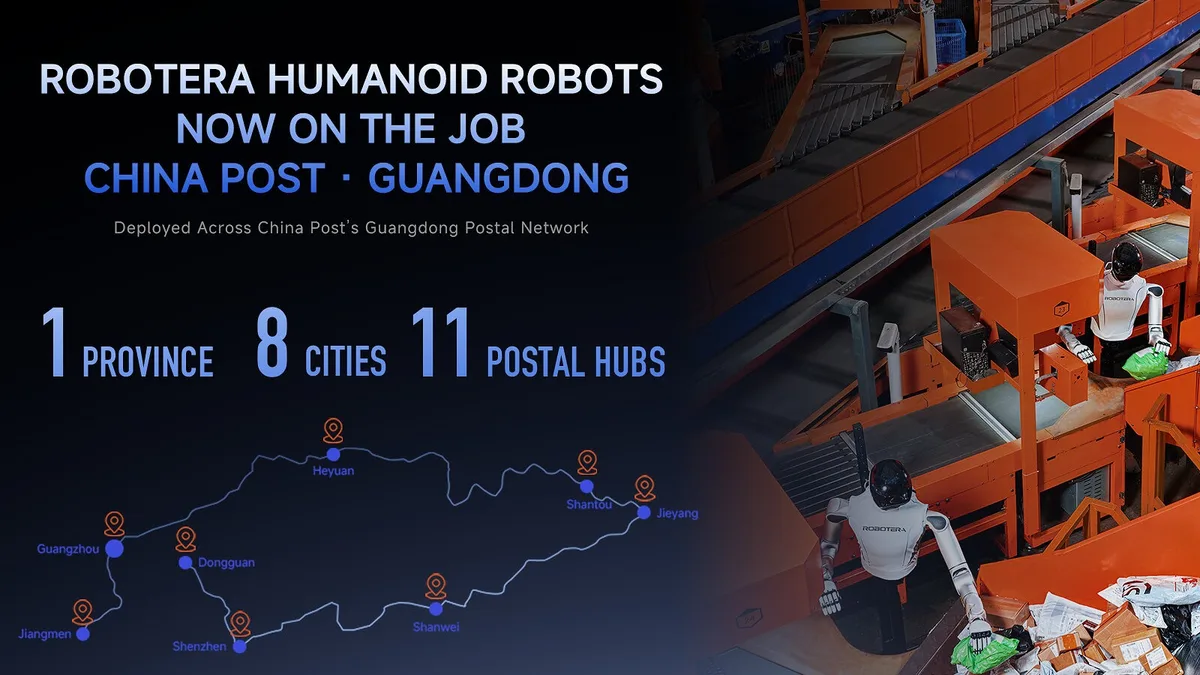
ROBOTERA says its humanoid robots now work at 11 China Post hubs in 8 Guangdong cities, averaging more than 1,500 parcels per hour since a March 2026 pilot in Guangzhou.
ZeroGantry analysis
The jump from about 800 to 900 parcels an hour at launch to an average above 1,500 is the number that matters: it puts ROBOTERA's robots at the pace the company says experienced human sorters keep, on one repetitive stage of the line. What is missing is the denominator. Without robot counts per hub, intervention rates or uptime, the 11-hub rollout shows commercial reach, not yet unit economics.
ROBOTERA scales from one pilot site to a provincial network
ROBOTERA said on Nov. 17, 2026, that its humanoid robots are now working across China Post Group Guangdong Branch's network, covering 11 postal hubs in 8 cities across Guangdong Province. The cities named in the company's PR Newswire release are Guangzhou, Shenzhen, Dongguan, Jiangmen, Shantou, Shanwei, Jieyang and Heyuan. ROBOTERA describes the rollout as the largest-scale and most geographically extensive deployment of embodied intelligence robots in the logistics sector to date. That is the company's own characterization, and the release does not name a third party that measured it.
The project is jointly implemented by China Post Group Guangdong Branch and Beijing Xingdongjiyuan Technology Co., Ltd., the legal name behind the ROBOTERA brand. The work started with a pilot at the Guangzhou Postal District Center in March 2026. Guangming Online reports that the equipment was expanded to the other cities only after it held up under high-load production at the Guangzhou site. ROBOTERA also published an official video of the Guangdong rollout on its YouTube channel the same day.
Guangdong is a demanding place to prove the idea. The release calls it China's largest province by express parcel volume, which makes its postal network a stress test for any machine that claims to keep up with people on a sorting line. The deployment covers several kinds of work, including high-volume sorting and cross-regional logistics coordination.
What the robots actually do on the line
The robots handle parcel induction, the step where packages are picked up and fed into an automated sorting system. It is repetitive, physical work, and it is one stage of a larger operation rather than the whole hub. The release says that since the Guangzhou pilot began, ROBOTERA's robots have achieved an average induction rate of more than 1,500 parcels per hour, which the company calls comparable to experienced human workers.
The Chinese-language report from Guangming Online (gmw.cn) adds operating detail. It says the robots take on high-frequency, repetitive basic tasks in the sorting process and can cover night shifts and e-commerce promotion peaks, absorbing the extra volume that would otherwise strain staffing. The same report says the solution supports 24-hour continuous operation.
ROBOTERA lists several capabilities aimed at the messy reality of postal parcels:
Irregular-item rejection, so odd shapes that could jam the line are pulled out instead of fed in. Adaptive speed control to reduce jams, collisions and missed items. A self-developed five-finger dexterous hand for flexible handling of parcels. Multiple power options to fit different site requirements and support continuous operation.
Guangming Online also reports that the solution works with several common sorting-line layouts, including five-sided scanning, six-sided scanning, top scanning and AGV setups, and that it can be installed without large-scale changes to existing production lines. That matters for adoption. A postal operator can add robots to a working line instead of rebuilding it.
From 800 parcels an hour to 1,500
The headline rate did not arrive on day one. In a China Daily report published on Nov. 17, ROBOTERA co-founder Xi Yue said the robots processed about 800 to 900 parcels an hour when they were first introduced into real-world operations. Technical adjustments and model optimization raised that to around 1,200. The final push from 1,200 to 1,500 parcels an hour was harder, Xi said, because the robots had to deal with less common cases such as irregular packages and unpredictable parcel orientations while keeping sorting accuracy at higher speeds.
Xi described the core engineering problem as coordinating perception, movement and decision-making in real time. "They need to complete 20 to 30 perception-and-action decision cycles per second to cope with randomly positioned packages, varying shapes and other unpredictable conditions, while maintaining stable and continuous operations," Xi told China Daily.
China Daily also reported that ROBOTERA's sorting robots supported this year's Singles Day delivery rush at logistics centers run by China Post and SF Express, reaching a peak sorting rate of 1,500 parcels per hour and operating at more than 10 logistics centers, according to the company.
Beyond Guangdong
The release says ROBOTERA's integrated solution has also been deployed in postal operations in East China, adapting to different parcel types and sorting-line configurations. Guangming Online names one of those sites: the China Post Hangzhou Postal District Center, where it says dozens of units have been deployed in batch. ROBOTERA says it builds its robots with a full-stack, in-house approach that spans data, motion control, foundation models, dexterous hands and humanoid systems.
ZeroGantry covered ROBOTERA's earlier [funding tied to China Post logistics humanoids](/articles/robotera-lands-200m-for-china-post-logistics-humanoids). Today's announcement is the operational follow-through on that bet: robots running on live postal lines across a whole province rather than at a single showcase site.
What is still missing
The numbers come from ROBOTERA and its partners. The release does not say how many robots are installed at each hub, how often a person has to step in, how much uptime each site achieves, or what the robots cost to buy or run. The 11-hub figure counts locations, not machines. The 1,500-per-hour figure is an average induction rate for one stage of sorting, not the throughput of an entire hub. Until China Post or an independent evaluator publishes site-level data, those are the questions buyers should ask before treating the rollout as proof that humanoids can replace dedicated sorting automation at scale.
Sources
- https://www.prnewswire.com/news-releases/robotera-expands-humanoid-robot-deployment-across-china-posts-guangdong-network-reaching-eight-cities-province-wide-302941865.html
- https://www.youtube.com/watch?v=DVXPjs64Ucw
- https://www.chinadaily.com.cn/a/202611/17/WS6afbb33ce4b03ebf8519ccac.html
- https://tech.gmw.cn/2026-11/17/content_39105549.htm
Topics
Related articles
- Robotera Lands $200M+ for China Post Logistics Humanoids — Beijing-based Robotera closed a $200M+ round led by SF Group to scale humanoid deployments in parcel sorting and industrial logistics. The M7 platform is alread
- Robotics Week in Review: Nov 13–Nov 20, 2026 — This week highlighted rapid progress in embodied AI and humanoid deployments across manufacturing and logistics. NVIDIA's GR00T 2 model and new pilots from Bost
- China Publishes First Six Humanoid Robot Standards — China approved its first six national humanoid robot standards on September 28, 2026. They take effect April 1, 2027, covering perception, motion control, manip
- North American Robot Orders Hit $1.2B in H1 2026 — North American companies ordered $1.2 billion worth of robots in the first half of 2026, up 6.6% year-over-year according to A3 data released August 19. Demand
AI-derived: drafted with AI assistance and checked against cited sources. How we label articles