Players · AI-derived
Robotera Lands $200M+ for China Post Logistics Humanoids
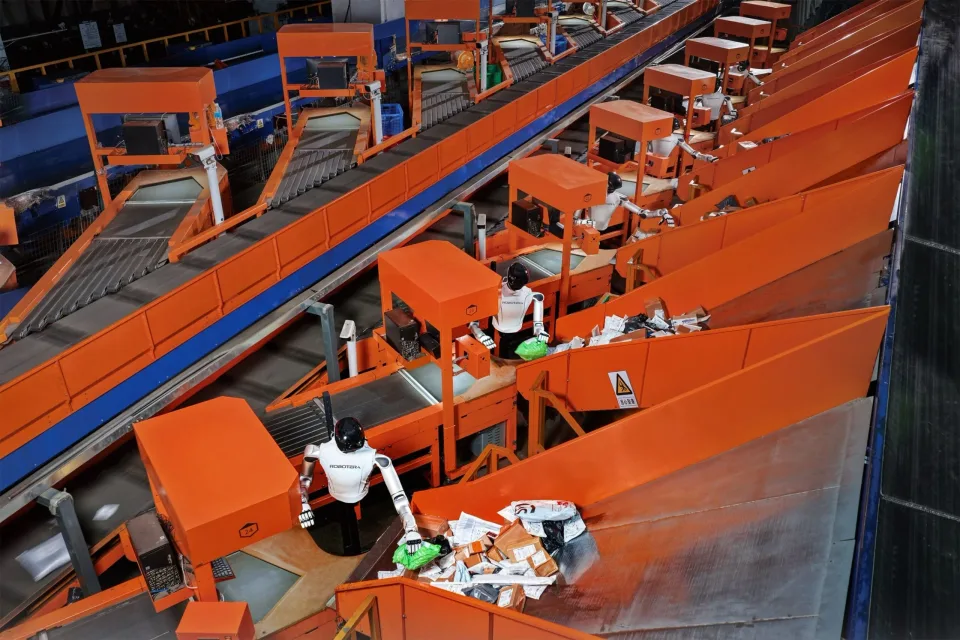
Beijing-based Robotera closed a $200M+ round led by SF Group to scale humanoid deployments in parcel sorting and industrial logistics. The M7 platform is already processing 1,200 parcels per hour at multiple China Post hubs across more than ten sites. This marks one of the first volume commercial rollouts of dexterous humanoids in high-throughput warehousing.
Funding and Strategic Backing
Robotera completed a financing round exceeding $200 million in late April 2026, led by SF Group with participation from HongShan, IDG Capital, CICC Capital, Dongfeng Industry Investment, ICBC Capital, and China Unicom-affiliated funds. The round follows an earlier RMB 1 billion strategic investment in March 2026, bringing total disclosed capital well above $400 million since the company’s 2023 founding.
SF Group’s lead position signals direct alignment between the robotics developer and one of China’s largest express logistics operators, creating a closed-loop path from hardware development to fleet-scale operations.
Deployment Footprint and Throughput Metrics
Robotera’s M7 and L7 humanoids are now operating in more than ten logistics centers operated by China Post and SF Express, including facilities in Guangzhou, Shenzhen, Hangzhou, Hefei, and Beijing. At the Jianggao mail processing center in Guangzhou, each M7 unit sorts up to 1,200 parcels per hour on active conveyor lines handling daily volumes of 6.5–10 million items.
These deployments represent commercial pilot audits rather than laboratory demonstrations. Units run 24/7 shifts with reported operational efficiencies reaching 70–85 % of human baseline in repetitive sorting tasks.
Unit Economics and Fleet Orchestration
Logistics operators evaluate humanoids primarily through total cost of ownership and parcels-per-hour economics. With thousand-unit deliveries already underway in 2026, Robotera is transitioning from pilot economics to fleet-level unit economics. Key variables include amortized hardware cost per parcel, energy consumption per shift, and mean time between failures (MTBF) under continuous conveyor-side duty cycles.
Fleet control orchestration at this scale requires centralized task allocation, real-time exception handling, and predictive maintenance scheduling across heterogeneous sites. Early data from the China Post network will provide the first large-scale MTBF benchmarks for dexterous upper-body platforms in dusty, high-vibration parcel environments.
Technical Architecture and Hardware Stack
The M7 platform combines dexterous multi-fingered hands with vision-based perception for parcel identification, grasping, and placement. While detailed actuator specifications remain proprietary, the system supports both teleoperated data collection and autonomous execution of learned sorting policies. Perception pipelines fuse RGB-D cameras with force-torque feedback at the wrists to achieve reliable handling of variable package shapes and weights.
Autonomy vs Teleoperation Assessment
Current deployments blend learned autonomous behaviors with occasional remote supervision for edge cases such as damaged parcels or novel packaging. True fleet autonomy will be measured by the ratio of fully unsupervised cycles to human-intervention events. Early indicators suggest the M7 is approaching practical autonomy for high-volume, low-variety sorting, but generalization across new product SKUs or facility layouts still benefits from teleoperation data loops.
Limitations and Open Questions
Energy density remains a constraint for extended 24/7 operation without frequent battery swaps or tethered power solutions. Durability of harmonic-drive joints and finger mechanisms under continuous high-cycle loading has yet to be validated at multi-year horizons. Cost per unit at volume must continue to decline to compete with specialized fixed sorters on pure throughput economics.
Unresolved community questions include standardized MTBF reporting methodologies for humanoid platforms, interoperability standards for multi-vendor fleet orchestration, and the capital expenditure versus operational expenditure trade-offs that logistics CFOs will demand before approving thousand-unit orders.
Sources
- https://theaiinsider.tech/2026/05/08/chinas-humanoid-robot-maker-robotera-raises-over-usd-200m-in-new-funding-round/
- https://www.prnewswire.com/news-releases/robotera-raises-over-usd-200-million-in-new-round-led-by-sf-group-hsg-and-idg-capital-302766752.html
- https://www.caixinglobal.com/2026-04-27/robot-era-raises-more-than-200-million-as-chinas-humanoid-robot-race-heats-up-102438549.html
- https://theroboticsmedia.com/article/robotera-200-million-sf-group-humanoid-funding-china
- https://www.finsmes.com/2026/05/robotera-raises-over-usd-200m-in-new-funding.html
Who services this hardware
Topics
Related articles
- Rohit Prasad Appointed Boston Dynamics CEO for Atlas Push — Boston Dynamics named Rohit Prasad, former Amazon Alexa and AGI leader, as CEO effective October 7, 2026. He replaces interim chief Amanda McMaster following Ro
- Hello Robot Stretch Wins $3M NIH Grant for Elder Care Dementia Support — Hello Robot received a nearly $3 million NIH grant to advance its Stretch mobile manipulator for older adults with mild cognitive impairment or early Alzheimer’
- BMW Leipzig Humanoid Robot Pilot Advances with Hexagon AEON — BMW Group has launched a pilot deploying Hexagon Robotics' AEON humanoid at its Leipzig plant for high-voltage battery assembly and component manufacturing. The
- Amazon Dobromierz Deploys 5,000 Robots in Polish Fulfillment Center — Amazon opened its 12th Polish fulfillment center in Dobromierz on September 21, 2026. The 200,000 m² four-story facility uses over 5,000 Amazon Robotics units a