Players
Humanoid UK Lands Bosch Contract in $152M Series A
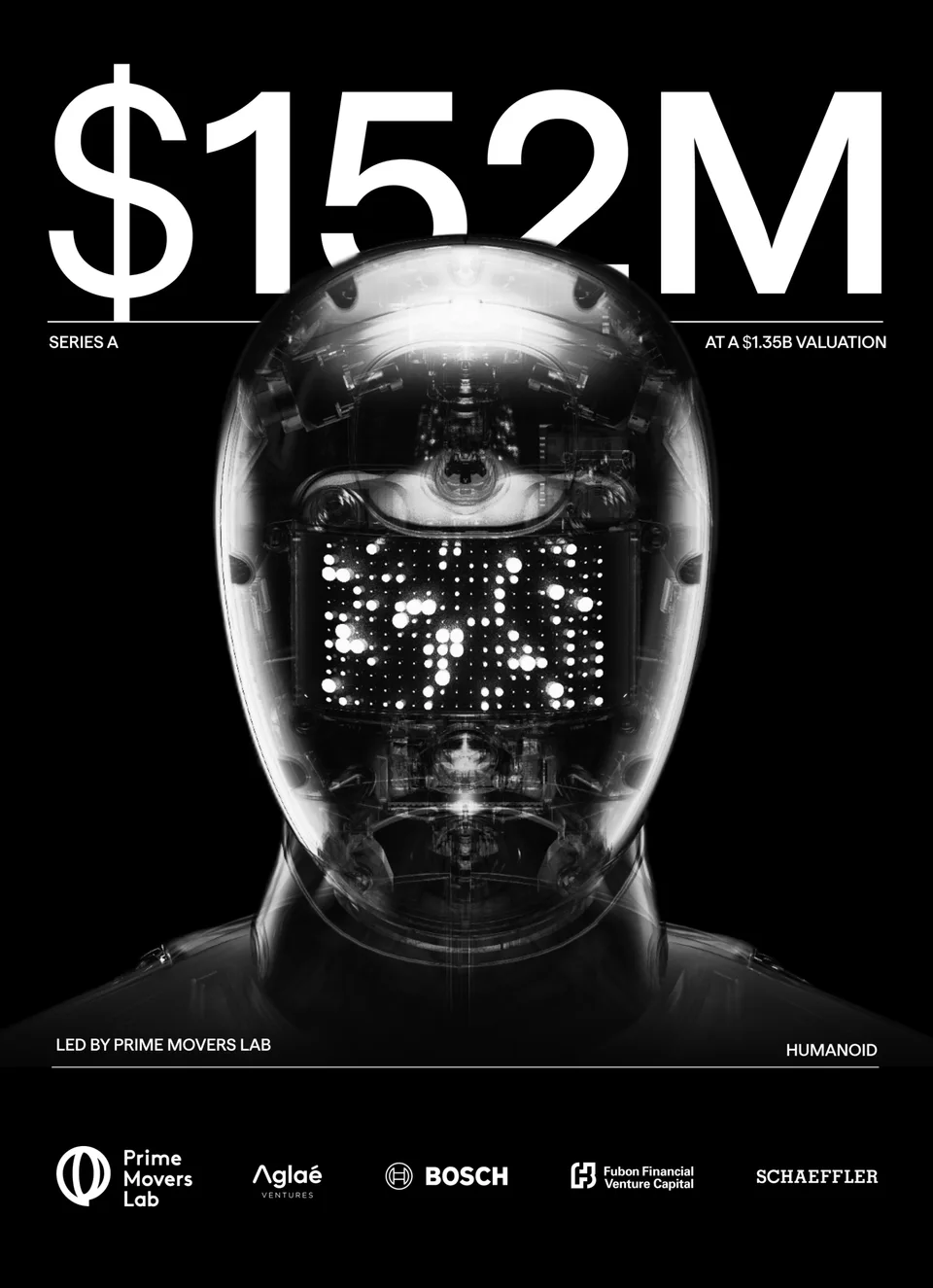
UK-based Humanoid closed a $152 million Series A on July 21, 2026, reaching a $1.35 billion valuation. Bosch will manufacture its wheeled HMND 01 robots while Schaeffler serves as anchor customer and actuator supplier.
ZeroGantry analysis
The Bosch-Schaeffler vertical integration gives Humanoid a clearer path to 100k-unit scale than most peers by 2031, with Schaeffler’s thousands-unit anchor reducing pilot risk. Fleet economics hinge on the wheeled HMND 01 achieving >80% utilization in structured plants; expect MTBF data from Q4 betas to determine if European manufacturing leverage beats US software-first approaches. Ship the partnerships, watch utilization metrics, ignore valuation hype until real deployment numbers appear.
Funding Round Details and Strategic Backers
Humanoid announced the $152 million Series A on July 21, 2026, led by Prime Movers Lab with participation from Schaeffler, Bosch, Fubon Financial Holding Venture Capital, and Aglaé Ventures. The round valued the company at $1.35 billion post-money and brought total funding to $270 million just two years after founding. This capital injection positions the London startup as Europe’s first pure-play humanoid robotics unicorn amid intensifying competition from US and Chinese developers.
The participation of industrial giants Schaeffler and Bosch extends beyond typical venture checks. Both entities hold dual roles as investors and operational partners, creating vertical integration rarely seen at this stage. Prime Movers Lab’s prior backing of Figure AI provides a direct link to leading US humanoid efforts, yet Humanoid’s structure emphasizes European manufacturing leverage over pure software plays.
Bosch Manufacturing Agreement and Capacity Commitments
Bosch’s Robert Bosch Robotics subsidiary will act as contract manufacturer with capacity for up to 100,000 HMND 01 units over five years. This agreement follows a successful proof-of-concept completed in March 2026 and formalizes production scaling for the European market. The arrangement allows Humanoid to bypass traditional hardware ramp-up delays that have slowed many competitors.
Bosch’s involvement includes actuator supply elements that complement Schaeffler’s preferred-supplier status covering over 50 percent of demand through 2031. The combined supply chain reduces component risk and supports consistent quality across high-volume output. Industry observers note that such commitments from established manufacturers provide Humanoid with a production pathway absent in many US humanoid programs still reliant on in-house assembly.
Schaeffler Anchor Customer Deal and Deployment Targets
Schaeffler signed a binding agreement for thousands of wheeled humanoid deployments beginning with initial systems in German facilities before year-end 2026. The phased rollout targets manufacturing logistics and assembly tasks where the HMND 01’s wheeled base offers stability advantages over bipedal designs in structured factory environments. The contract includes actuator sourcing preferences that lock in long-term volume commitments.
This customer-supplier overlap creates immediate revenue visibility and real-world data loops for KinetIQ AI refinement. Early deployments will validate fleet orchestration at scale before broader European expansion. The arrangement contrasts with many humanoid startups that rely on pilot programs without binding volume guarantees.
HMND 01 Platform Specifications and KinetIQ AI
The HMND 01 Alpha Wheeled platform features a 175 cm tall form factor with 29 degrees of freedom excluding end effectors, 15 kg payload capacity, and up to four hours of runtime. High-torque actuators and model-based plus learning-based control enable walking speeds up to 1.5 m/s on the wheeled variant optimized for industrial floors. KinetIQ, built on NVIDIA compute, provides end-to-end perception, manipulation, and fleet-level orchestration through a four-layer AI stack.
Beta deployments are scheduled for Q4 2026 following additional proof-of-concept work with partners including SAP, Siemens, and automotive suppliers. The wheeled architecture prioritizes reliability and speed in logistics and manufacturing over the versatility required for unstructured home environments. This focus aligns with Schaeffler’s immediate needs while deferring full bipedal development to later research platforms.
Competitive Positioning in Global Humanoid Race
Humanoid’s strategy emphasizes European vertical integration against vertically integrated US players such as Tesla Optimus and Figure 02. While those programs pursue broad capability roadmaps, Humanoid’s binding contracts and manufacturing partnerships deliver earlier production certainty. Chinese entrants like Unitree H1 and G1 have achieved lower hardware costs but lack comparable Western industrial customer anchors at this scale.
The $1.35 billion valuation reflects investor confidence in the Bosch-Schaeffler ecosystem as a moat. Fleet economics will hinge on achieving high utilization rates in Schaeffler plants, where thousands of units could generate recurring service revenue. Observers will watch Q4 2026 beta results for MTBF data and actual deployment velocity against the 100,000-unit capacity target.
Outlook for European Humanoid Manufacturing Scale
The July 2026 funding and partnership announcements accelerate Humanoid’s timeline toward volume production. Bosch’s five-year capacity commitment provides a clear ramp path that most pure-play robotics firms still lack. Success will depend on translating early POCs into reliable multi-shift operations across Schaeffler sites.
Additional European partners including Siemens and NVIDIA supply chain elements further strengthen the stack. The wheeled HMND 01’s industrial focus positions the company to capture near-term logistics and assembly demand before legged variants mature. Market participants are monitoring whether this model can replicate at other automotive and manufacturing groups across the continent.
Sources
- https://thehumanoid.ai/humanoid-raises-152-million-at-1-35-billion-post-money-valuation-becoming-europes-first-pure-play-humanoid-robotics-unicorn/
- https://www.techtimes.com/articles/321462/20260724/uk-humanoid-startup-raises-152m-bosch-schaeffler-back-wheels-over-legs.htm
- https://www.reuters.com/business/robotics-startup-humanoid-raises-152-million-series-round-135-billion-valuation-2026-07-21/
- https://www.businesswire.com/news/home/20260723238282/en/Humanoid-Raises-%24152-Million-at-%241.35-Billion-Post-Money-Valuation-Becoming-Europes-First-Pure-Play-Humanoid-Robotics-Unicorn
Topics
Related dispatches
- Skild AI Raises $1.4B for Omni-Bodied Skild Brain Robotics AI — Skild AI closed a $1.4 billion Series C round led by SoftBank at a valuation above $14 billion. The funding supports the Skild Brain, a unified foundation model
- FCC Bans New Chinese Humanoid and Quadruped Robot Imports — On July 28, 2026, the US FCC banned imports of new Chinese-made humanoid and quadruped robots over national security concerns including data risks and cyberatta
- Samsung Forms RX Robotics Division Under CEO for Humanoid Push — Samsung Electronics launched the RX Robotics division on July 21, 2026, reporting directly to DX CEO TM Roh. Led by ex-Hyundai executive Lee Dongkun, it will ac
- Humanoid UK Secures $152M Series A at $1.35B Valuation — UK-based Humanoid raised $152 million in Series A funding at a $1.35 billion valuation, becoming Europe's first pure-play humanoid unicorn. The round supports s