Brain · AI-derived
Skild AI's $1.4B Skild Brain: Omni-Bodied VLA Foundation Model
Skild AI closed a $1.4 billion Series C at over $14 billion valuation, led by SoftBank with NVIDIA's NVentures and Bezos Expeditions participating. The funding accelerates development of the Skild Brain, a unified omni-bodied foundation model capable of controlling diverse robot morphologies through zero-shot generalization. This positions the company at the forefront of scalable neural controllers for physical AI.
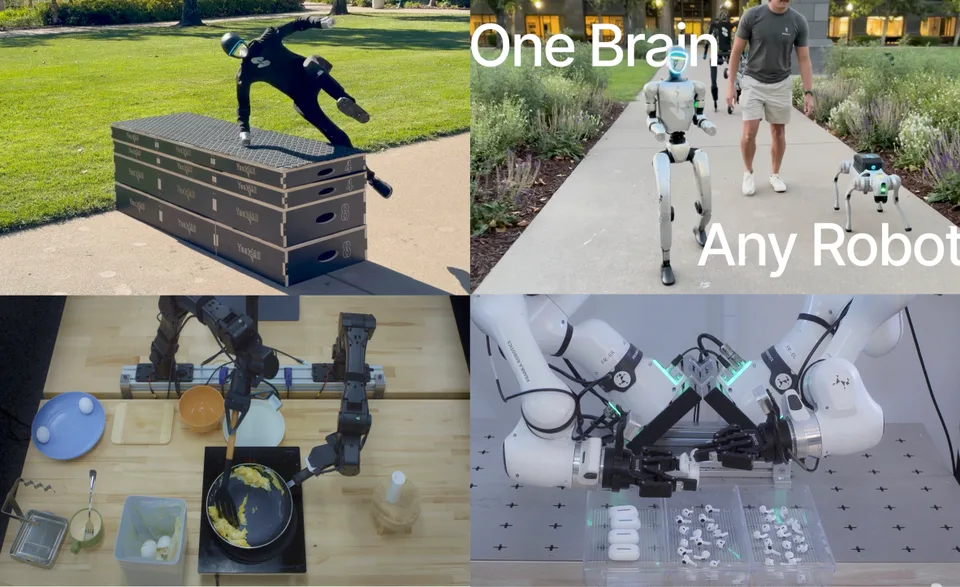
Skild AI's Landmark Funding Signals Maturation of Generalist Robotics Brains
Skild AI announced its $1.4 billion Series C round in January 2026, catapulting the company to a valuation exceeding $14 billion. Led by SoftBank with major participation from NVentures (NVIDIA), Macquarie Capital, and Bezos Expeditions, the round included strategic backers such as LG and Schneider Electric. This capital infusion targets scaling the Skild Brain, described as the industry's first unified robotics foundation model designed for omni-bodied operation across quadrupeds, humanoids, tabletop arms, and mobile manipulators.
The core innovation lies in moving beyond morphology-specific controllers toward a single neural system that maps vision-language inputs directly to actions. Pretraining draws from large-scale simulation generating trillions of synthetic trajectories and billions of internet human videos for manipulation priors. Post-training incorporates teleoperation data mapping images and proprioception to joint torques, plus fleet deployments yielding real-world feedback.
Hierarchical Architecture Enabling High-Frequency Neural Feedback Loops
The Skild Brain employs a two-tier hierarchical policy structure. A low-frequency high-level module handles manipulation and navigation planning, outputting abstract action sequences. These feed into a high-frequency low-level policy that directly commands joint angles and motor torques at rates sufficient for stable physical interaction. This separation allows the high-level planner to operate at semantic timescales while the low-level loop maintains tight proprioceptive feedback, critical for dexterous tasks and terrain adaptation.
Training emphasizes zero-shot generalization across embodiments by exposing the model to diverse morphologies during pretraining, including human video demonstrations. This approach fosters emergent robustness to hardware variations or failures without explicit retraining. Physical torque mapping benefits from the low-level policy's direct optimization on torque-level signals derived from simulation and real teleoperation, enabling finer force control compared to position-only baselines.
Comparisons to prior work like RT-2 or Octo highlight Skild's emphasis on action-grounded pretraining rather than bolting robotics data onto vision-language models. The result is improved physical common sense, such as handling slippery surfaces or fine-grained object interactions, without morphology-specific fine-tuning.
Deployment Momentum and Data Flywheel Dynamics
Revenue reportedly scaled from zero to approximately $30 million within months in 2025 through deployments in security, construction, warehouses, and factories. Each operational robot contributes to a continuous data flywheel, refining the shared model across the fleet. This closed-loop scaling differentiates Skild from purely simulation-driven or narrow-task systems.
Technical Breakdown and Comparative Analysis
Architecture Hierarchical VLA Transformer with high-frequency low-level RL policy for torque control, pretrained on simulation and human videos.
Actuators and Sensors Focus on proprioceptive torque sensing and joint-level motor commands; integrates with standard industrial actuators via direct torque mapping.
Limitations High computational demands for real-time high-frequency inference; persistent sim-to-real gaps in contact-rich scenarios; reliance on quality teleoperation data for post-training.
Unresolved Questions How does torque prediction accuracy degrade across unseen actuator dynamics? Can the model achieve reliable zero-shot transfer to novel high-DOF hands without additional torque calibration?
True Autonomy Through Generalization Versus Teleoperation Dependence
The Skild Brain achieves genuine autonomy by leveraging its foundation model pretraining to execute novel tasks and morphologies without human intervention in the loop. While teleoperation supplies critical post-training signals for torque alignment, deployed inference operates end-to-end from onboard perception, enabling adaptive behaviors in unstructured environments. This contrasts with pure teleoperation systems that require continuous human oversight and lack cross-robot generalization. The omni-bodied capability allows a single trained policy to inhabit entirely different hardware platforms, demonstrating zero-shot transfer that teleop-dependent approaches cannot match at scale.
Sources
- https://www.skild.ai/blogs/series-c
- https://techcrunch.com/2026/01/14/robotic-software-maker-skild-ai-hits-14b-valuation/
- https://www.bloomberg.com/news/articles/2026-01-14/robotics-startup-skild-valued-above-14-billion-after-softbank-led-funding-round
- https://news.crunchbase.com/venture/robotics-startup-skild-ai-triples-valuation/
- https://siliconangle.com/2026/01/14/robot-software-startup-skild-ai-raises-1-4b-round-backed-nvidia-jeff-bezos/
Topics
Related articles
- Figure AI Helix 2.5 Delivers 56% Zero-Shot Success Across 30 Homes — Figure AI released Helix 2.5 on September 17, 2026. The Index-pretrained model enabled Figure 03 humanoids to tidy rooms, fold towels, and make beds in 30 unsee
- Skild AI S1 Drives $100M Revenue Run Rate Ten Months In — Skild AI reached a $100 million annual recurring revenue run rate just ten months after its first commercial deployments of the S1 robotic foundation model. The
- Hugging Face LeRobot GR00T N1.7 Integration and Microduck Biped Launch — Hugging Face updated its LeRobot library in July 2026 to support NVIDIA's GR00T N1.7 VLA model for fine-tuning. In late August, its Pollen Robotics team opened
- Toyota Research Institute Scales LBMs for Manufacturing at Automate 2026 — Toyota Research Institute presented updates on its Large Behavior Models at Automate 2026. Director Erin McColl described diffusion-based multitask policies tha