Players · AI-derived
Humanoid UK Secures $152M Series A at $1.35B Valuation
UK-based Humanoid raised $152 million in Series A funding at a $1.35 billion valuation, becoming Europe's first pure-play humanoid unicorn. The round supports scaled production of its wheeled HMND 01 robots and a major deployment deal with Schaeffler.
ZeroGantry analysis
The $152M round at $1.35B values Humanoid at roughly 5x its prior capital, reflecting investor confidence in wheeled certification timelines and the 1,000+ unit Schaeffler anchor. Fleet economics favor the HMND 01 if Bosch scales to 20k units/year by 2028, but actuator supply concentration creates single-point risk versus diversified US/China peers. Watch for Q4 beta results and CE certification milestones; ignore if pilots slip beyond 2027.
Funding Milestone Signals European Humanoid Momentum
Humanoid, founded in 2024 and headquartered in London, closed its $152 million Series A on July 21, 2026, at a $1.35 billion post-money valuation. The round was led by Prime Movers Lab with participation from Schaeffler, Bosch, Fubon Financial Holding Venture Capital, and Aglaé Ventures. This brings the company's total capital raised to $270 million in just two years. The investment arrives months after Humanoid signed a binding agreement to deploy at least 1,000 robots at Schaeffler facilities starting late 2026, with potential for far higher volumes tied to actuator supply deals. Investors are betting on Humanoid's ability to translate industrial partnerships into certified, revenue-generating deployments ahead of many bipedal competitors still navigating safety standards.
The valuation positions Humanoid as Europe's first pure-play humanoid robotics unicorn, contrasting with the US and China dominance in the sector. Figure AI commands a reported $39 billion valuation while Tesla advances Optimus production and Unitree shipped over 5,500 units in 2025. Humanoid's rapid ascent highlights how targeted European industrial ties and regulatory advantages can carve out space in a market projected to attract tens of billions in 2026 alone. The company's emphasis on wheeled platforms rather than legged systems further differentiates it by enabling faster certification paths.
HMND 01 Platform and KinetIQ Software Stack
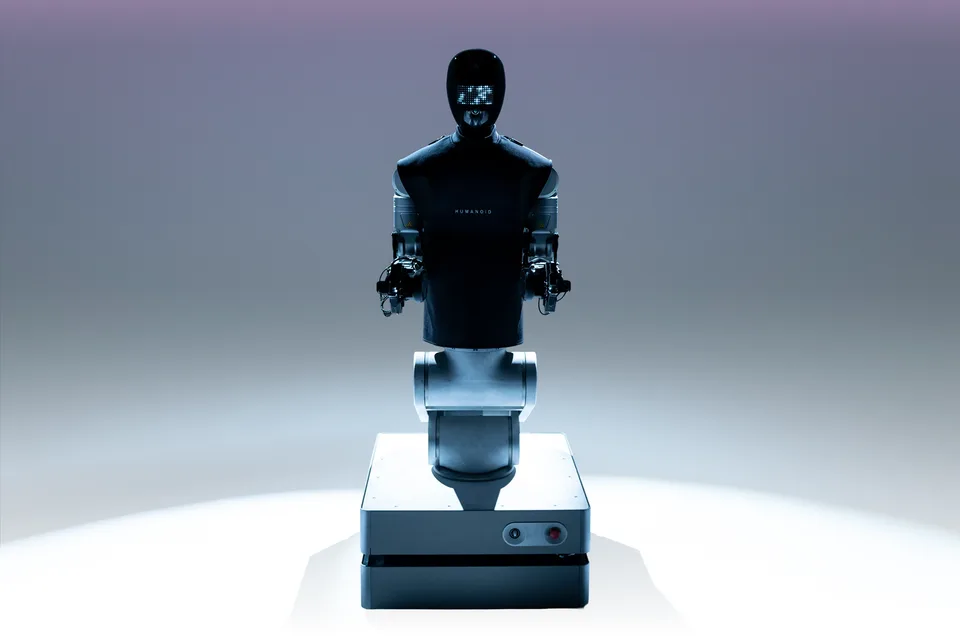
Humanoid's flagship HMND 01 is a wheeled dual-arm mobile manipulator designed for industrial tasks. It features high-torque actuators, modular end-effectors, and a top speed of 1.5 m/s on wheels while achieving human-level or better manipulation speeds in targeted scenarios. The platform supports payloads up to 15 kg with two arms and reaches from floor level to 2 meters. Modularity allows customization of upper and lower bodies plus garments for contamination control or branding, directly addressing low total cost of ownership goals.
The robot's intelligence comes from the four-layer KinetIQ architecture. An agentic fleet coordinator ingests tasks from ERP or warehouse systems and assigns them across robots based on location, charge, and gripper capabilities. A vision-language model decomposes tasks into verifiable workflows, followed by proprietary execution models and a whole-body controller for motion. This stack enables both autonomous and teleoperated operation while supporting fleet-level orchestration rather than isolated units. Beta units are slated for Q4 2026 customer pilots lasting three to six months.
Industrial Deployment Pipeline and Production Scale
The Schaeffler agreement stands as one of Europe's largest humanoid commitments, with deployments beginning in German plants in Herzogenaurach and Schweinfurt by year-end 2026. Schaeffler also serves as preferred actuator supplier under a multi-year deal that could support over 50,000 robots if scaled. Bosch acts as contract manufacturer and strategic partner, targeting capacity for up to 100,000 units over five years while supplying hardware expertise. Additional partnerships with SAP, Nvidia, and Siemens provide integration and compute foundations.
Nine proof-of-concept projects across logistics, manufacturing, and retail have already been completed, with a tenth underway. These early validations focus on goods handling, picking and packing, and kitting in automotive and electronics settings. The wheeled design allows borrowing from existing AMR and collaborative robot certification frameworks, positioning Humanoid for CE marking potentially as early as 2027. This timeline advantage matters because no ISO standard yet fully covers bipedal humanoids for industrial use due to fall risks.
Competitive Positioning Against Global Peers
Humanoid's wheeled approach targets the 85-90% of industrial use cases where legs add unnecessary complexity and certification hurdles. In contrast, bipedal systems from Figure 02 or Tesla Optimus Gen 2 prioritize general mobility across uneven terrain but face longer regulatory paths. Unitree's H1 and G1 platforms emphasize speed and cost but remain primarily bipedal. Humanoid's hiring of over 50 veterans from Boston Dynamics, Sanctuary AI, Apptronik, and 1X accelerates learning curves that cost rivals millions.
Production support from Bosch and actuator volume commitments from Schaeffler provide clearer manufacturing ramps than many pure software-focused startups. The $270 million total funding dwarfs earlier European players while remaining modest compared to US valuations, yet it funds next-generation platform development and KinetIQ expansion. Fleet economics hinge on achieving sub-$100,000 unit pricing with high reliability to deliver ROI in high-mix environments.
Regulatory and Market Implications
Europe's fragmented but stringent safety regime favors wheeled platforms that leverage mature AMR standards. Humanoid's strategy aligns with this reality, potentially allowing earlier commercial sales than legged competitors still awaiting dedicated humanoid norms. The company's London base and continental partnerships also position it to navigate both UK and EU frameworks. Investors including Aglaé Ventures bring consumer and luxury sector exposure that could expand retail applications beyond factories.
Longer term, success depends on translating beta pilots into multi-year fleet contracts and sustaining actuator supply at scale. If Humanoid hits its production targets, it could shift the humanoid narrative from US-China duopoly toward a tri-polar market with credible European volume players.
Funding Round Details and Strategic Backers
Humanoid announced the $152 million Series A on July 21, 2026, led by Prime Movers Lab with participation from Schaeffler, Bosch, Fubon Financial Holding Venture Capital, and Aglaé Ventures. The round valued the company at $1.35 billion post-money and brought total funding to $270 million ju
Sources
- https://www.forbes.com/sites/johnkoetsier/2026/07/21/humanoid-raises-152-million-at-135-billion-valuation-europes-newest-robot-unicorn/
- https://www.reuters.com/business/robotics-startup-humanoid-raises-152-million-series-round-135-billion-valuation-2026-07-21/
- https://thehumanoid.ai/product/
- https://www.businesswire.com/news/home/20260723000000/en/
Topics
Related articles
- Tuya Doova and OlloBot OlloNi SS1 Debut Elder Care Robots at IFA 2026 — Tuya Smart launched the wheeled Doova companion robot at IFA 2026 for seniors living alone, featuring fall response, LLM conversation, and smart-home control. O
- 1X NEO Beta Trial Program Starts Real-Home Household Testing — 1X Technologies has launched a limited NEO Beta Household Trial Programme. Select households worldwide will test the humanoid robot in their homes for three mon
- ICE Forecasts $1-2M Boston Dynamics Spot Robot Buy for Public Safety — U.S. Immigration and Customs Enforcement plans a sole-source purchase of Boston Dynamics Spot quadrupeds worth $1-2 million. The robots would handle remote insp
- Amazon Proteus Fleet Expansion Hits New North American Sites — Amazon has expanded its Proteus autonomous mobile robot fleet to additional fulfillment centers across North America. The robots now handle heavy and bulky item