Players · AI-derived
Humanoid Robot Repair Shops and CHRT Certification 2026
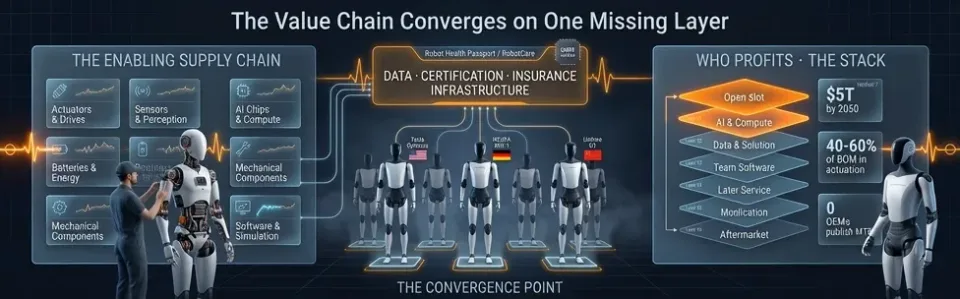
iFixRobot and SuperDroid Robots now provide national repair services for humanoid platforms, covering actuators, batteries, and diagnostics. RobotCare launched the CHRT certification program to standardize technician qualifications across 15 OEM platforms as fleets expand.
ZeroGantry analysis
TCO at 10-20% annually implies a $5,000–$30,000 per-unit service burden once warranties expire, which will dominate ROI models for any fleet exceeding 20–30 units. CHRT's 210-hour cross-OEM curriculum plus Robot Health Passport creates the first neutral data layer that could unlock RaaS financing and secondary markets; watch for adoption metrics from Agility, Figure, and Tesla deployments in 2027. Independent providers like iFixRobot and SuperDroid lower immediate barriers but cannot replace OEM parts ecosystems at scale.
Growing Demand for Humanoid Repair Infrastructure Fleet operators deploying platforms from Tesla, Figure AI, and Unitree face recurring downtime from mechanical and electrical issues. Common failure modes center on walking joints that experience high cyclic loads during locomotion, sensor arrays that degrade from environmental exposure, and power systems strained by continuous operation. These patterns emerge quickly in industrial settings where robots log thousands of hours annually. Public operator forums and directories show limited but expanding service options as deployments move beyond pilots into paid commercial use.
Purchase prices for current-generation humanoids range from roughly $30,000 to $150,000 depending on configuration and OEM. Annual maintenance and repair costs typically fall between 10 and 20 percent of that initial outlay once warranty periods end, according to analyses of hospital-grade and industrial service robots. This total cost of ownership component directly affects fleet economics and return-on-investment calculations for operators scaling to dozens or hundreds of units. Without reliable repair channels, MTBF metrics become irrelevant if parts and labor lead times stretch into weeks.
iFixRobot and SuperDroid Robot Repair Services iFixRobot operates as a national robot service center handling diagnosis, actuator swaps, battery replacements, and full refurbishments with round-trip shipping options. The company supports a range of platforms and provides warranties on completed work, positioning itself for both consumer and enterprise humanoid owners seeking independent repair. Turnaround times average one to three weeks depending on parts availability and complexity.
SuperDroid Robots offers tiered repair programs differentiated by platform size, with diagnostic fees covering round-trip freight and bench evaluation before any parts or labor quotes. Their process requires shipping the operator control unit alongside the robot to diagnose linked issues in drive, video, and arm subsystems. Mid-size and large tactical platforms receive on-site pickup, while compact units use standard carriers. These services address out-of-warranty needs that OEM support often excludes after the first 12 to 24 months.
Both providers report growing inquiries tied to dynamically stable bipedal platforms. Actuator and battery work dominates service tickets, reflecting the mechanical stresses of locomotion and energy demands of onboard compute. Fleet managers cite these independent shops as stopgaps while OEMs build dedicated service networks.
CHRT Certification Standardizes Technician Qualifications RobotCare launched the Certified Humanoid Robot Technician (CHRT) program in 2026 to create a neutral, cross-OEM credential. The curriculum spans 15 weeks and 210 hours of training covering actuator systems, battery safety protocols, AI-driven diagnostics, and augmented-reality guided repair workflows. Graduates receive digital badges verifiable through a public directory at chrttechnician.com.
The program aligns with ANSI/A3 R15.06-2025 and ISO 13482 standards from the outset. Every certified repair generates cryptographically signed entries in the Robot Health Passport, creating auditable lifecycle records for insurers, lenders, and secondary-market buyers. This infrastructure addresses a key gap identified by OEM leaders, including Agility Robotics CEO Peggy Johnson in her July 2026 policy framework calling for technician training pipelines.
CHRT aims to scale the workforce beyond manufacturer-specific teams. Predictive diagnostics integrated with the credential promise 12- to 48-hour failure warnings and parts routing under four-hour service-level agreements. Fleet operators gain a verifiable service network that supports RaaS financing models by improving residual values and insurability.
Fleet Economics and Maintenance Implications Total cost of ownership calculations now include these repair channels as deployments accelerate. For a mid-sized fleet of 50 humanoids operating in automotive or logistics environments, annual service spend could reach several hundred thousand dollars once warranties lapse. Standardized certification reduces variability in repair quality and documentation, lowering risk for financing and insurance partners.
Operators tracking MTBF on walking joints and power systems benefit from documented service histories that feed into predictive models. The emergence of third-party providers and CHRT creates competitive pressure on OEMs to improve parts availability and extend support windows. Directories listing certified technicians and repair shops already appear in operator forums, signaling high search intent for service ecosystem information.
Outlook for 2026 and Beyond The service layer is coalescing faster than many hardware roadmaps anticipated. Independent shops and certification bodies fill immediate gaps while larger players develop in-house capabilities. Fleet economics will hinge on how quickly these networks achieve national coverage and consistent turnaround times. Operators evaluating platforms from Tesla Optimus, Figure 02, Boston Dynamics Atlas, or Unitree H1 should factor repair accessibility into procurement decisions alongside raw performance specs.
Sources
Who services this hardware
Topics
Related articles
- Amazon Dobromierz Deploys 5,000 Robots in Polish Fulfillment Center — Amazon opened its 12th Polish fulfillment center in Dobromierz on September 21, 2026. The 200,000 m² four-story facility uses over 5,000 Amazon Robotics units a
- Agility Digit 5 Humanoid Raises Payload to 50 lb for Warehouse Scale — Agility Robotics launched the Digit 5 humanoid on September 15, 2026. The new model lifts 50 pounds repeatedly, adds cooperative safety features for barrier-fre
- Tesla Optimus Hits Hundreds Weekly at Fremont as Hand Assembly Bottleneck — Tesla scaled Optimus V3 output at Fremont from dozens per week in Q2 to several hundred in August 2026 by converting former Model S/X lines. Most units stay in
- Feather Robotics Launches $30K Wheeled Humanoid for Developers — Feather Robotics unveiled its $29,990 omnidirectional wheeled humanoid on September 24, 2026, alongside a $7.6 million pre-seed round led by Gradient.