Brain · AI-derived
Toyota Research Institute Scales LBMs for Manufacturing at Automate 2026
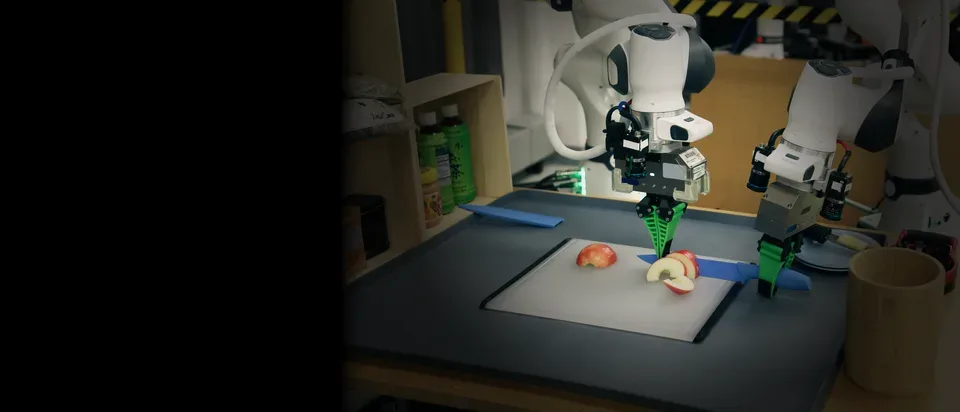
Toyota Research Institute presented updates on its Large Behavior Models at Automate 2026. Director Erin McColl described diffusion-based multitask policies that cut data needs by 3-5x for new manufacturing tasks while delivering consistent gains over single-task baselines.
ZeroGantry analysis
TRI's 3-5x data reduction at 1,700-hour scale translates to roughly 60-80% lower per-task collection costs in high-mix lines, accelerating ROI for early adopters versus single-task baselines. The Boston Dynamics Atlas extension shows the same architecture handling full-body dynamics without separate policy families, suggesting fleet operators could standardize on one LBM checkpoint across arm and humanoid assets. Ship for manufacturing pilots; watch zero-shot language performance before scaling to unstructured environments.
TRI's Automate 2026 Presentation on Scalable Robot Policies
Erin McColl, director of robotics technology adoption at Toyota Research Institute, addressed a standing-room-only crowd at Automate 2026 with details on bridging research prototypes to factory deployment. The session focused on Large Behavior Models as multitask policies trained on nearly 1,700 hours of mixed robot data. Attendees heard how these models support language-conditioned control in variable manufacturing environments where traditional programming falls short.
The presentation emphasized data efficiency as a core advantage. Single-task diffusion policies typically require 100-200 demonstrations per behavior, yet LBM pretraining allows new tasks to reach target performance with 3-5 times fewer examples. This reduction holds especially in settings with changing lighting, object positions, or material properties common on production lines. McColl noted that the approach accelerates the path from lab validation to short-term factory value without waiting for perfect generalists.
Data Composition and Scaling Laws in LBM Training
TRI's LBMs draw from 468 hours of internal bimanual teleoperation on Franka Panda FR3 arms, 45 hours of simulation data, 32 hours of Universal Manipulation Interface recordings, and roughly 1,150 hours curated from the Open X-Embodiment internet dataset. This mixture totals close to 1,700 hours and supports both simulation and real-world checkpoints through shared normalization and proprioceptive inputs.
Rigorous scaling experiments showed steady performance lifts as pretraining hours increased, with no sharp inflection points observed at the examined scales. Even modest additions of diverse tasks produced measurable uplifts in success rates across held-out behaviors. Researchers conducted 1,800 real-world rollouts and over 47,000 simulation trials to establish statistical confidence, using sequential hypothesis testing and 50-rollout per-task protocols that exceed typical robotics evaluation sizes.
The architecture relies on a multimodal Vision Transformer encoder for vision and language inputs paired with a transformer-based denoising head. Observations from wrist and scene cameras plus robot proprioception feed into AdaLN conditioning, while the model outputs 16-timestep action chunks spanning 1.6 seconds. This design enables language prompts to steer the same network across dozens of behaviors without per-task retraining from scratch.
Manufacturing Applications and Boston Dynamics Collaboration
In factory-relevant scenarios, LBMs support visuomotor policies that adapt to unstructured part presentation and variable assembly sequences. McColl highlighted language conditioning as the mechanism for handling the long tail of exceptions that defeat fixed automation. Early deployments focus on tasks where incremental reliability gains justify integration costs before full generality arrives.
TRI maintains an active partnership with Boston Dynamics to extend these models to full-body humanoid platforms. The collaboration applies LBM-style diffusion transformers to Atlas, incorporating whole-body coordination such as foot placement, crouching, and center-of-mass shifts during mobile manipulation. A 450-million-parameter Diffusion Transformer variant with flow-matching objectives has demonstrated language-conditioned execution of long-horizon sequences that leverage the humanoid's kinematic advantages.
These efforts align with broader TRI goals of building foundation models that improve steadily with additional data rather than requiring entirely new architectures for each domain. The same pretraining principles transfer between tabletop bimanual stations and mobile humanoids, suggesting shared scaling benefits across form factors.
Evaluation Rigor and Remaining Challenges
Blind A/B testing protocols and large rollout counts revealed consistent advantages for finetuned LBMs over from-scratch baselines on both seen and novel long-horizon tasks. Performance improved smoothly with pretraining scale, supporting continued investment in data collection pipelines. Subtle implementation details such as action normalization proved more impactful than many architectural tweaks in controlled ablations.
Zero-shot transfer from pretrained checkpoints without finetuning showed mixed results, with language steerability helping but not yet delivering uniform outperformance. Researchers noted that larger vision-language-action prototypes under internal testing mitigate some gaps, pointing to capacity as one lever for future gains. Data quality filtering and cross-embodiment transfer remain active research areas.
Outlook for Factory Adoption
TRI positions LBMs as tools that deliver value on the path to general-purpose systems rather than requiring complete solutions upfront. The 3-5x data reduction directly addresses the economic barrier of collecting robot demonstrations in high-mix manufacturing settings. Partnerships with Boston Dynamics illustrate how the same modeling approach scales from fixed arms to dynamic humanoids without starting from zero.
Ongoing hiring for senior roles in Large Behavior Models and Diffusion Policy signals continued expansion of the effort. Cross-organizational work with Woven by Toyota further extends the techniques into end-to-end driving stacks, reusing visual-language-action components developed for manipulation.
The Automate 2026 update reinforces that scaling laws observed in other AI domains are manifesting in embodied policies at practical data volumes. TRI's emphasis on rigorous, large-scale evaluation provides a template for the field to move beyond intuition-driven progress toward evidence-based iteration.
Watch
Sources
Topics
Related articles
- Unitree G1 Humanoids Shine on AGT Finale with Synchronized Dance — Eight Unitree G1 humanoids joined dancer Wu Yufei for a water-sleeve dance routine on the America's Got Talent Season 21 finale on September 22, 2026. The perfo
- Google DeepMind Gemini Robotics 2 Scales via Software Partnerships — Google DeepMind released Gemini Robotics 2 on July 30, 2026, delivering vision-language-action models for whole-body humanoid control, dexterity, and multi-robo
- NVIDIA Expands Open Physical AI Stack with OpenUSD for Humanoids — NVIDIA released updates to its open physical AI stack on September 30, 2026, built around OpenUSD and Omniverse for reusable digital twins in humanoid training
- Skild AI S1 Soccer Skills Emerge from 140 Years of Self-Play — Skild AI announced September 23 that its S1 foundation model learned complex humanoid soccer behaviors through self-play in NVIDIA Isaac Sim. The policy, traine