Players · AI-derived
ICE Forecasts $1-2M Boston Dynamics Spot Robot Buy for Public Safety
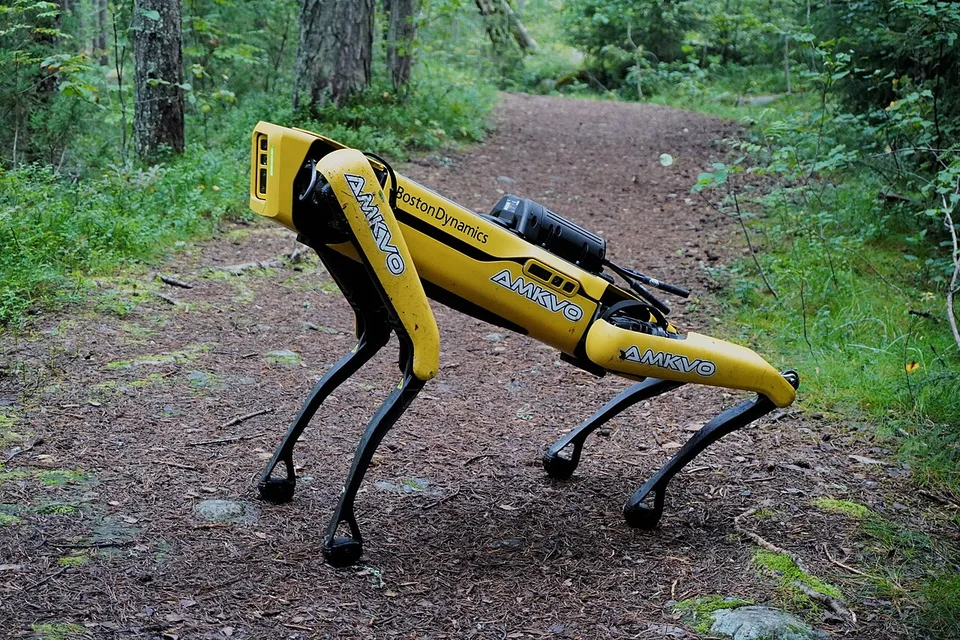
U.S. Immigration and Customs Enforcement plans a sole-source purchase of Boston Dynamics Spot quadrupeds worth $1-2 million. The robots would handle remote inspection and hazard assessment in high-risk settings to protect officers.
ZeroGantry analysis
The $1-2M ceiling at ~$75k base plus kits implies a fleet of roughly 8-15 units with spares and training, sufficient for a single tactical element rather than nationwide coverage. Sole-source structure and Fort Benning performance location suggest training-first integration before operational spread. Watch for follow-on RFPs or competing quadruped bids once initial units prove serviceability; ignore hype around mass replacement of personnel.
Procurement Forecast Details and Timeline
U.S. Immigration and Customs Enforcement published its procurement forecast on August 27, 2026, under the title “Boston Dynamics SPOT Robots Procurement.” The notice, issued by the Department of Homeland Security, outlines a firm-fixed-price acquisition valued between $1 million and $2 million for Spot units plus accessories and support. The solicitation was scheduled for September 4, 2026, with an award expected by the end of the federal fiscal year and completion targeted for April 24, 2027. Place of performance is listed as Fort Benning, Georgia, an Army installation rather than a typical border or field office location. As of September 9, 2026, no formal request for proposals had been released, keeping the action at the forecast stage.
The purchase falls under FAR Subpart 13.5, allowing a non-competitive award because Boston Dynamics is the sole manufacturer of the Spot platform. This approach mirrors prior government buys where proprietary hardware and software integration justify skipping open bidding. Spot units carry a base list price near $75,000 each, suggesting the budget could cover roughly ten to twenty configured robots once arms, cameras, radios, and service packages are added. ICE has stated the systems will serve inspection, situational awareness, and hazard assessment tasks without replacing officer judgment or enabling arrests.
Boston Dynamics Ethical Safeguards and Existing Deployments
Boston Dynamics confirmed that any ICE order must comply with the company’s standard terms prohibiting weaponization and requiring public disclosure of usage policies for law enforcement customers. The policy bars autonomous targeting and mandates that buyers maintain oversight to protect privacy and civil rights. Spot already operates with multiple federal and municipal agencies, including the U.S. Secret Service on federal grounds and various bomb squads for suspicious-package inspection. Chemical-response teams and search-and-rescue units have logged deployments in confined spaces, unstable structures, and post-disaster environments where human entry carries elevated risk.
Public records show Spot configurations equipped with 360-degree cameras, thermal imaging, gas sensors, and optional manipulator arms priced in the low hundreds of thousands per unit when fully outfitted. Earlier purchases by the NYPD and LAPD illustrate the range: two NYPD units totaled approximately $750,000 in 2023, while a donated LAPD unit carried a $277,917 valuation. These precedents indicate ICE’s $1-2 million envelope aligns with acquiring a modest fleet plus training and sustainment rather than a large-scale rollout.
Operational Implications for Government Fleets
A Spot fleet in the low tens of units would give ICE a persistent remote capability for building entries, gas detection, and structural assessment before personnel advance. Quadrupedal mobility allows navigation of stairs, rubble, and uneven terrain where wheeled or tracked alternatives stall. Persistent Systems radio kits enable reliable operator control at extended ranges, while premium Spot Care service contracts address the maintenance demands of field operations. At roughly $75,000 base plus $50,000–$150,000 in mission kits, total cost of ownership over three to five years includes battery replacements, sensor calibration, and software updates that agencies must budget separately from the initial procurement.
Serviceability data from existing public-safety users shows mean time between failures improving with each hardware iteration, yet spare-part lead times and specialized technician training remain constraints for dispersed operations. ICE’s choice of Fort Benning as the performance site may reflect training or integration activities rather than immediate operational deployment, potentially allowing phased rollout and operator certification before wider use.
Broader Context of Legged-Robot Adoption
Government interest in Spot reflects a wider pattern of quadruped adoption for public-safety missions. More than sixty bomb squads and SWAT teams across the United States and Canada had fielded the platform by late 2025, according to industry reporting. International examples include the Netherlands Defence Explosive Ordnance Disposal Service, which credits Spot with supporting thousands of annual suspicious-package responses. These deployments demonstrate measurable risk reduction: operators stay outside blast or contamination radii while the robot supplies real-time video and sensor data.
Counter-arguments center on cost-effectiveness versus simpler drones or existing unmanned ground vehicles. Quadrupeds excel in vertical mobility and stair climbing but carry higher per-unit prices and require more frequent maintenance than aerial systems. Privacy advocates have raised questions about data retention and facial-recognition integration, although Boston Dynamics terms explicitly restrict certain capabilities and require agency transparency. ICE’s explicit statement that the robots will not conduct arrests aims to address some of these concerns, yet public scrutiny of any federal robotics program remains high.
Cost and Scaling Considerations
At the upper end of the forecast, $2 million could equip a small tactical unit with redundant platforms, spare batteries, and extended service agreements. Scaling beyond this initial tranche would require additional appropriations and demonstrated return on investment measured in reduced officer exposure or faster incident resolution. Fleet economics favor standardization on one platform for shared training pipelines and common spare inventories, which Spot’s installed base already supports across multiple agencies. Long-term sustainment contracts typically run 15–20 percent of hardware cost annually, adding predictable operating expenses that procurement officers must model before award.
Boston Dynamics continues to iterate on payload integration and au
Sources
- https://thenextweb.com/news/ice-boston-dynamics-spot-robots-procurement
- https://www.bostonglobe.com/2026/08/29/business/boston-dynamics-robot-dog-ice/
- https://www.massdailynews.com/2026/08/29/ice-procurement-waltham-boston-dynamics-spot-robot-federal-raids
- https://www.boston.com/news/local-news/2026/09/09/ice-plans-to-buy-boston-dynamics-robot-dogs/
- https://www.wbur.org/news/2026/08/31/ice-robot-dogs-immigration-enforcement-boston-dynamics
Who services this hardware
Topics
Manufacturers
Related articles
- Tuya Doova and OlloBot OlloNi SS1 Debut Elder Care Robots at IFA 2026 — Tuya Smart launched the wheeled Doova companion robot at IFA 2026 for seniors living alone, featuring fall response, LLM conversation, and smart-home control. O
- 1X NEO Beta Trial Program Starts Real-Home Household Testing — 1X Technologies has launched a limited NEO Beta Household Trial Programme. Select households worldwide will test the humanoid robot in their homes for three mon
- Amazon Proteus Fleet Expansion Hits New North American Sites — Amazon has expanded its Proteus autonomous mobile robot fleet to additional fulfillment centers across North America. The robots now handle heavy and bulky item
- Tesla Optimus Supply Chain Orders for 5,000 Units Signal Fremont Ramp — Chinese supply chain reports indicate Tesla placed bulk component orders covering roughly 5,000 Optimus humanoids in early September 2026. The procurement follo