Players · AI-derived
NEURA Robotics Lands Record $1.4B Series C for Cognitive Humanoids
Germany's NEURA Robotics secures up to $1.4 billion in Series C funding from Tether, NVIDIA, Amazon, Qualcomm and others to scale cognitive humanoid deployments, Neuraverse platform and real-world NEURA Gym training facilities, marking the largest full-stack robotics raise amid intensifying competition from Tesla Optimus, Figure and Unitree.
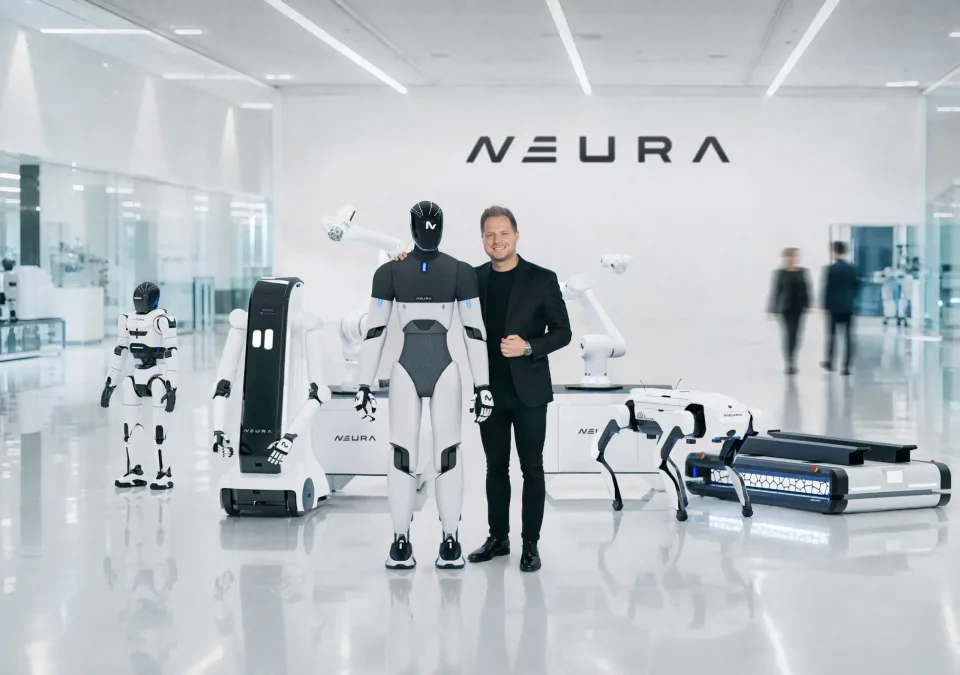
NEURA Robotics Secures Landmark $1.4B Series C to Advance Cognitive Humanoids and Physical AI
On June 10, 2026, German robotics pioneer NEURA Robotics announced a record Series C round of up to $1.4 billion, backed by an elite syndicate including Tether, Qualcomm Technologies, Amazon, NVIDIA, Bosch, Schaeffler, the European Investment Bank, imec.xpand, Lingotto Horizon and InterAlpen Partners. The financing values the company at approximately $7 billion and targets accelerated global deployment of its cognitive humanoid platforms, expansion of the Neuraverse orchestration ecosystem, and rollout of NEURA Gyms—dedicated physical training environments that generate high-fidelity real-world data.
This round stands as the largest full-stack robotics financing to date and signals a decisive shift toward commercialization of embodied physical AI. While U.S. players like Figure AI and Tesla have dominated headlines with massive valuations and internal manufacturing ambitions, NEURA's European-backed raise underscores the emergence of a truly global competitive landscape.
Context Among Leading Humanoid Players
In the broader "Players" pillar of humanoid robotics, 2026 has become a pivotal year for fleet economics and production ramps. Tesla continues self-funding Optimus development with tens of billions in projected capex, aiming for high-volume manufacturing inside its own factories. Figure AI closed a substantial Series C exceeding $1 billion at a reported $39 billion valuation, focusing on enterprise deployments with partners like BMW and OpenAI integration. Boston Dynamics, now under Hyundai ownership, has transitioned its electric Atlas to production-ready status with advanced dexterity for industrial pilots. Chinese manufacturer Unitree has carved a niche with affordable, agile platforms like the G1, priced around $13,500, targeting research, education and light industrial use cases.
NEURA's raise differentiates through its emphasis on cognitive capabilities and an open ecosystem. The company’s 4NE1 humanoid and MAV mobile robots are designed for seamless integration into existing industrial workflows, particularly automotive assembly and logistics. Strategic investments from industrial giants Bosch and Schaeffler provide not only capital but also deep manufacturing expertise and supply-chain access critical for scaling beyond prototypes.
Neuraverse and NEURA Gyms: Building the Data Moat
Central to NEURA’s strategy is the Neuraverse—an orchestration platform that connects robots, aggregates real-world interaction data, and distributes learned behaviors across the fleet. Complementing this is the NEURA Gym network: physical facilities where dozens to hundreds of robots practice complex tasks under controlled variability. This approach addresses the core bottleneck in physical AI: the scarcity of high-quality, embodied training data that simulation alone cannot fully replicate.
By closing the loop between simulation (leveraging NVIDIA Isaac platforms) and physical execution, NEURA aims to accelerate model generalization. Early Gym deployments have already demonstrated robots mastering variable lighting, object affordances and human collaboration scenarios—capabilities essential for safe deployment in unstructured environments.
Fleet Economics and Manufacturing Scale Implications
The $1.4 billion infusion directly targets production capacity expansion, with ambitions to reach several million units by 2030. This scale is necessary to drive down per-unit costs and achieve positive fleet economics. Early humanoid deployments remain expensive; operators must factor in maintenance, energy consumption, safety certification and software updates. NEURA’s partnership with NVIDIA and Qualcomm suggests edge-compute optimizations that could lower operational expenditure compared to cloud-heavy alternatives.
Compared with Tesla’s vertically integrated approach and Figure’s enterprise-focused pilots, NEURA positions itself as a platform play. The Neuraverse enables third-party developers and partners to contribute and monetize applications, potentially creating network effects similar to mobile app stores but for physical tasks. European regulatory support via the EIB further de-risks large-scale deployments in manufacturing and logistics sectors where labor shortages are acute.
Technical Breakdown
Architecture NEURA’s cognitive robotics stack integrates multimodal perception, large-scale world models and hierarchical planning, trained via a hybrid of synthetic data from the Neuraverse and real interactions in NEURA Gyms. The system emphasizes continual learning, allowing deployed units to improve collectively through shared experiences.
Actuators and Sensors While detailed specifications remain limited, the 4NE1 platform incorporates high-DoF electric actuators optimized for both precision and force control, paired with vision, tactile and proprioceptive sensing arrays. Collaboration with Qualcomm points to advanced edge AI chips for low-latency onboard inference.
Limitations Current humanoids, including NEURA’s, still face challenges in long-horizon task reliability, energy efficiency for extended shifts and robust recovery from unexpected disturbances. Full autonomy in highly dynamic human environments remains an open frontier.
Unresolved Questions Key questions include the exact milestone-based release of the conditional funding tranches, timelines for first large-scale customer deployments, and how the Neuraverse will handle data privacy and intellectual property across an open ecosystem.
Competitive Intelligence and Outlook NEURA’s raise intensifies pressure on all players to demonstrate not just impressive demos but measurable ROI through fleet deployments. As manufacturing ramps accelerate across Germany, the U.S. and China, 2026–2027 will likely see the first meaningful commercial fleets operating in automotive, warehousing and eventually service sectors. Investors and strategists
Sources
- https://neura-robotics.com/record-series-c/
- https://qz.com/neura-robotics-series-c-amazon-nvidia-tether-061126
- https://techfundingnews.com/neura-robotics-1-4b-series-c-tether-amazon-nvidia/
- https://www.cnbc.com/2026/06/10/neura-robotics-funding-ai-humanoid-robots.html
- https://www.manufacturingdive.com/news/neura-robotics-startup-backed-by-nvidia-amazon-bosch-qualcomm-raises-1b-series-c/822900/
Topics
Related articles
- Rohit Prasad Appointed Boston Dynamics CEO for Atlas Push — Boston Dynamics named Rohit Prasad, former Amazon Alexa and AGI leader, as CEO effective October 7, 2026. He replaces interim chief Amanda McMaster following Ro
- Hello Robot Stretch Wins $3M NIH Grant for Elder Care Dementia Support — Hello Robot received a nearly $3 million NIH grant to advance its Stretch mobile manipulator for older adults with mild cognitive impairment or early Alzheimer’
- BMW Leipzig Humanoid Robot Pilot Advances with Hexagon AEON — BMW Group has launched a pilot deploying Hexagon Robotics' AEON humanoid at its Leipzig plant for high-voltage battery assembly and component manufacturing. The
- Amazon Dobromierz Deploys 5,000 Robots in Polish Fulfillment Center — Amazon opened its 12th Polish fulfillment center in Dobromierz on September 21, 2026. The 200,000 m² four-story facility uses over 5,000 Amazon Robotics units a