Frontier · AI-derived
Figure 03 Humanoid Achieves Autonomous Ladder Climb in Helix AI Demo
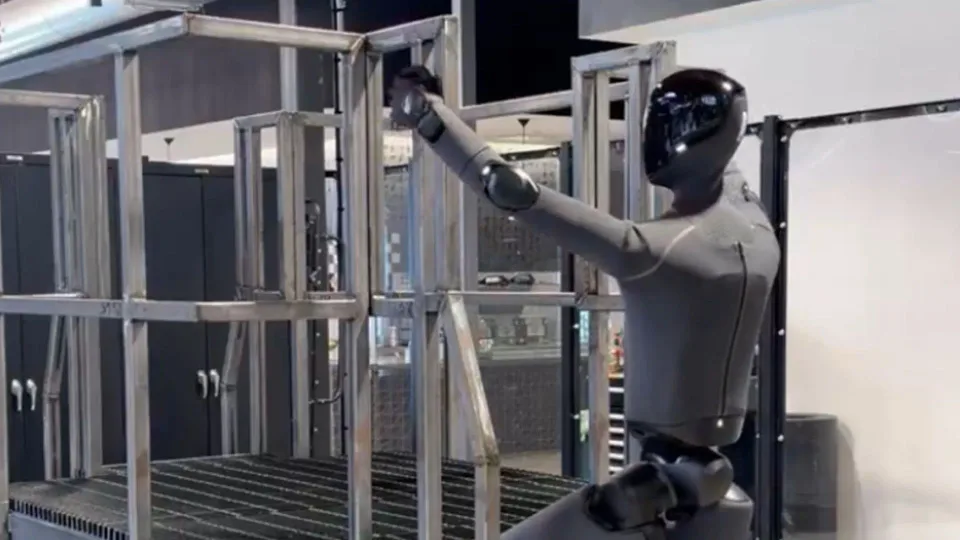
Figure AI released video of its Figure 03 humanoid climbing a short ladder fully autonomously around August 1, 2026. CEO Brett Adcock shared the footage showing coordinated arm-leg motion and real-time planning without teleoperation, marking progress toward navigation in human-designed spaces.
ZeroGantry analysis
At one robot per hour production and 350+ units shipped, Figure prioritizes visible mobility milestones over quantified reliability data; this ladder clip advances perception-driven control narratives but offers no metrics on repeatability or energy cost. Watch BMW deployment logs for operational signals rather than isolated videos; ignore until success rates appear.
Figure 03 Tackles a Classic Mobility Benchmark
Figure AI's Figure 03 humanoid robot executed a fully autonomous ladder ascent in footage posted by founder and CEO Brett Adcock on August 1, 2026. The clip depicts the robot approaching a short ladder, gripping rungs with articulated hands, shifting weight between limbs, and ascending without any visible remote control or human intervention. This demonstration builds directly on the company's Helix AI system, which fuses visual perception from onboard stereo cameras with whole-body motion planning. Observers noted the sequence requires continuous balance corrections and precise foot placement, capabilities that extend beyond flat-floor locomotion tests previously highlighted by the firm.
The task itself serves as a demanding benchmark in humanoid robotics because ladders impose strict constraints on center-of-mass management and sequential support changes. Unlike stair climbing, ladder rungs demand simultaneous hand and foot coordination while the robot maintains stability on narrow contact points. Figure's demo illustrates closed-loop control that reacts to real-time visual input rather than relying solely on proprioceptive feedback from joint encoders. Production context adds weight: the company claims output at its BotQ facility has reached one robot per hour with more than 350 units already delivered, including logistics work at BMW's Spartanburg plant.
Helix AI Architecture and Whole-Body Control
Figure describes the underlying Helix system as an end-to-end model trained via reinforcement learning in simulation across randomized terrains. The recent S0 upgrade incorporates RGB stereo camera streams to construct three-dimensional environmental maps on the fly. This allows simultaneous estimation of rung positions and the robot's own pose, enabling corrective actions mid-climb. Earlier proprioception-only versions limited performance on uneven or elevated surfaces; the addition of visual feedback reportedly reduces reliance on pre-planned trajectories.
Sensor fusion occurs at low latency through onboard processing that generates motion commands without cloud round-trips. The model outputs joint torques and velocities for the full kinematic chain, treating arms and legs as a unified system rather than separate subsystems. Such integrated planning mirrors approaches explored in academic whole-body control literature, where optimization frameworks solve for contact forces and trajectories under friction and torque limits. Figure has not released equations, training datasets, or latency figures, leaving independent replication impossible at present.
Actuation, Sensing, and Environmental Interaction
Figure 03 carries the same general-purpose hardware lineage as prior models, featuring high-torque electric actuators at major joints and compliant elements that absorb impact during rung contact. Stereo cameras mounted in the head provide the primary exteroceptive input, supplemented by inertial measurement units and joint position sensors for state estimation. The demo implies the perception pipeline runs at frame rates sufficient for dynamic balance, though exact timing remains undisclosed.
Real-world ladder environments introduce variables such as rung spacing variations, surface friction changes, and lighting shifts that affect stereo depth accuracy. Figure claims the learned policies transfer directly from simulation without fine-tuning, addressing the persistent sim-to-real gap that has historically required extensive domain randomization. The absence of reported failure modes or success rates across repeated trials makes it difficult to assess robustness against these variables.
Limitations and Verification Gaps
No quantitative metrics accompany the video, including climb success rate, average cycle time, maximum rung height tested, or recovery behavior after slips. Independent verification by third-party labs or standardized benchmarks has not occurred. The short ladder and controlled indoor setting further constrain extrapolation to longer ascents or outdoor conditions with wind or debris. Production ramp-up claims coexist with this mobility showcase, yet deployment data from Spartanburg focuses on simpler logistics tasks rather than ladder navigation.
Unresolved Questions on Scalability
It remains unclear how the Helix policy generalizes to ladders with different geometries or to multi-robot coordination scenarios. Sensor latency under varying compute loads and the energy cost of sustained climbing also lack public numbers. Future releases may address these through arXiv-style technical reports, but current disclosure prioritizes visual proof over engineering specifications.
Implications for Humanoid Deployment
Successful ladder climbing expands the operational envelope for humanoids in factories, warehouses, and maintenance settings where vertical access is routine. Combined with Figure's reported manufacturing cadence, the demo signals accelerating iteration toward practical utility. Continued progress will hinge on transparent performance data that allows comparison against peers pursuing similar whole-body control objectives.
Sources
Topics
Related articles
- XPENG IRON Humanoid Shows Memory and Multilingual Showroom Skills — XPENG released a September 22 video of its IRON humanoid in a lab test simulating car dealership interactions. The robot tracked speakers, remembered customer p
- Unitree UnifoLM-X2-1.0 Powers G1 Autonomous Sparring Demo — On September 7, 2026, Unitree Robotics released UnifoLM-X2-1.0, a real-time world model that lets the G1 humanoid spar fully autonomously against a human withou
- Agility Digit 5 Humanoid Raises Payload to 50 lb for Warehouse Scale — Agility Robotics launched the Digit 5 humanoid on September 15, 2026. The new model lifts 50 pounds repeatedly, adds cooperative safety features for barrier-fre
- Tesla Optimus Hits Hundreds Weekly at Fremont as Hand Assembly Bottleneck — Tesla scaled Optimus V3 output at Fremont from dozens per week in Q2 to several hundred in August 2026 by converting former Model S/X lines. Most units stay in