Players · AI-derived
1X NEO Beta Trial Begins Home Companion Robot Testing
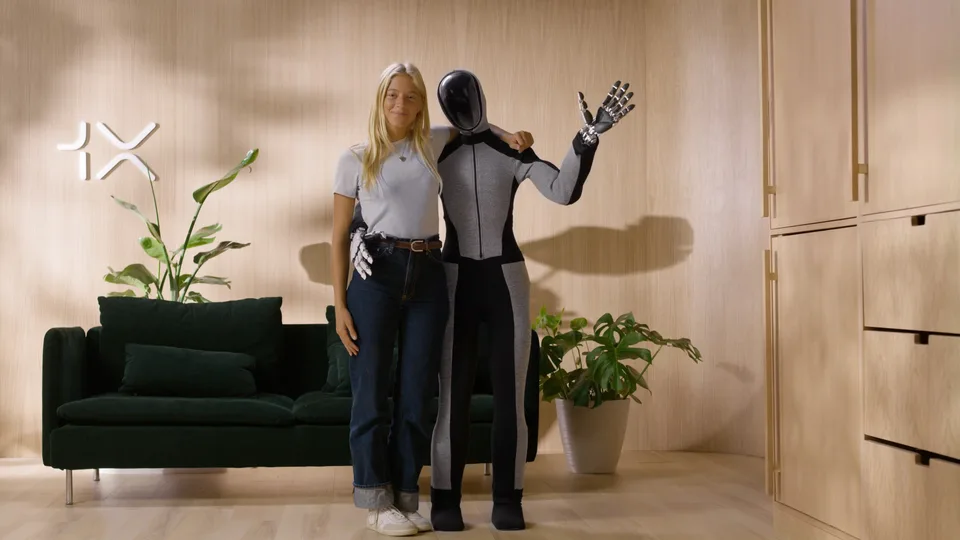
1X Technologies launched its NEO Beta Household Trial Programme this week, placing select robots with global households for real-world safety and interaction testing ahead of 2026 deliveries.
ZeroGantry analysis
The beta trial gives 1X a narrow window to collect diverse domestic failure modes before competitors reach similar scale; with Hayward at 10k units/year capacity, any reliability shortfalls will quickly compound fleet-wide support costs. Watch the three-month cohort retention and autonomous task completion rates—sub-80% uptime or heavy teleoperation reliance would signal that 2027 volume targets are premature. Ignore the Indian-market pricing speculation in secondary coverage; focus on U.S. early-adopter data as the true leading indicator.
1X NEO Enters Real Homes via Beta Trial
1X Technologies announced the start of its NEO Beta Household Trial Programme on August 31, 2026, inviting a limited number of select households worldwide to host the humanoid robot. The three-month testing window focuses on gathering data about safety protocols, reliability in unstructured environments, and natural human-robot interactions before wider commercial availability. Participants receive the unit with dedicated technical support and must submit detailed daily performance logs and edge-case reports directly to the engineering team.
The trial marks a deliberate shift from controlled lab demonstrations to lived-in domestic settings. 1X emphasizes multi-layer safety systems, including collision detection, force-limiting actuators, and emergency stop mechanisms tailored for homes with children, pets, and elderly residents. This approach addresses regulatory and consumer concerns that have slowed other humanoid programs targeting consumer spaces.
Production is already underway at the company’s 58,000-square-foot Hayward, California facility. The plant currently supports an annual capacity of 10,000 units, with a second San Carlos site planned to scale output to 100,000–250,000 robots per year by late 2027. Early Access owners who placed $200 fully refundable deposits in late 2025 are positioned for priority 2026 deliveries, priced at $20,000 outright or $499 per month via subscription.
Tendon-Driven Hands Deliver Human-Level Dexterity
Central to the beta program is the latest iteration of NEO’s hands, unveiled in July 2026. Each hand provides 25 degrees of freedom—nearly matching the human hand’s 27—through tendon-driven actuation routed from forearm motors. This design reduces hand mass while enabling rapid finger motion, hyperextension beyond human limits, and compliant grasping that yields on unexpected contact.
The hands are IP68 waterproof, allowing the robot to wash itself, and have demonstrated tasks including pouring tea, sorting grapes by color, plugging USB-C cables, and performing basic sign language. Durability testing showed the structure surviving repeated hammer strikes without failure. These capabilities directly support household chores such as loading dishwashers, folding laundry, and handling delicate objects that earlier rigid grippers struggled with.
1X CEO Bernt Børnich noted that human-like hands simplify training from internet video data because the morphology aligns with existing human demonstration footage. The company’s Redwood AI world model uses this hardware foundation to improve zero-shot generalization across novel objects and layouts encountered during the beta trials.
Safety Design and Home Deployment Constraints
NEO stands 5 feet 6 inches tall and weighs 66 pounds, with a soft fabric exterior and rounded contours inspired by consumer-friendly aesthetics rather than industrial armor. Maximum lift capacity reaches 154 pounds while arm payload is limited to 18 pounds, reflecting deliberate trade-offs for safe coexistence with people. Walking speed tops out at 1.4 m/s and running at 6.2 m/s under controlled conditions.
The beta phase explicitly tests how these specifications perform across varied home floor plans, furniture arrangements, and daily routines. Early feedback loops will inform software updates before the company expands beyond the initial cohort. 1X has stated that first-year production slots sold out within days of preorder opening in October 2025, indicating strong early demand despite the robot still requiring occasional remote teleoperation for complex tasks.
Competitive Context Among Home Humanoids
1X’s home-focused strategy contrasts with competitors emphasizing industrial or logistics deployments. Tesla continues Optimus development with factory pilots reported through mid-2026, while Figure AI and Boston Dynamics prioritize enterprise contracts. Unitree’s H1 and G1 platforms remain primarily research and education oriented. 1X’s decision to open beta households now positions NEO as one of the first general-purpose humanoids attempting sustained unsupervised operation in private residences.
The trial also highlights ongoing industry tension between teleoperation-assisted performance and full autonomy. Beta participants will experience a hybrid model where the app allows scheduling and remote oversight, with the goal of progressively increasing autonomous task completion as the world model ingests new domestic data.
Production Scale and Fleet Economics Implications
Hayward’s initial 10,000-unit annual run rate implies that meaningful fleet statistics will emerge only after multiple quarters of deliveries. Maintenance logistics, spare-part supply chains, and software-over-the-air update cadence will determine whether early owners achieve acceptable uptime. The subscription model bundles hardware refreshes, potentially smoothing long-term ownership costs compared with outright purchase.
Analysts tracking the sector note that 1X’s vertical integration—from actuators to AI—may accelerate iteration cycles relative to companies relying on third-party component suppliers. However, scaling beyond the Hayward facility’s current staffing of more than 200 employees will require sustained capital and supply-chain discipline through 2027.
The beta program’s success metrics—measured in task completion rates, safety incidents per operating hour, and user retention—will set benchmarks for the broader consumer humanoid category. Data collected over the coming months will influence not only 1X’s 2027 production targets but also regulatory discussions around home robot certification in multiple jurisdictions.
Sources
Who services this hardware
Topics
Manufacturers
Related articles
- Physical Intelligence Pi API Beta Speeds Figure 03 and Tiangong Fine-Tuning — Physical Intelligence opened beta access to its Pi API on October 13, letting developers fine-tune π0 and π0.5 models on managed compute and run inference throu
- Skild AI Closes $1.4B Series C at Over $14B Valuation — Skild AI raised $1.4 billion in a Series C led by SoftBank, reaching a valuation above $14 billion. The funds support scaling its S1 foundation model for teachi
- UBTECH FAW-Volkswagen Humanoid Logistics Trials Advance 2026 — UBTECH Robotics and FAW-Volkswagen signed a strategic agreement on October 8, 2026, to develop and test humanoid robots for factory logistics. The work builds o
- Rohit Prasad Appointed Boston Dynamics CEO for Atlas Push — Boston Dynamics named Rohit Prasad, former Amazon Alexa and AGI leader, as CEO effective October 7, 2026. He replaces interim chief Amanda McMaster following Ro